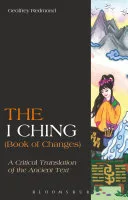
The I Ching (Book of Changes)
 75
75

The I Ching (Book of Changes)
Geoffrey Redmond's translation of the I Ching, published in 2017, presents a commendable effort to render China's oldest classical text accessible. The focus on the early textual layers is a strength, stripping away centuries of commentary to reveal the core divination system. Redmond's commentaries, while generally helpful, occasionally lean towards oversimplification when explaining the intricate relationships between hexagrams and their philosophical underpinnings. A passage illustrating the hexagram *Kun* (The Receptive) and its reliance on flexibility and yielding, for instance, effectively demonstrates the text's practical wisdom, yet the commentary could benefit from deeper engagement with its philosophical implications for leadership. The work's primary limitation lies in its occasional struggle to balance accessibility with the profound depth of the original. Nevertheless, this edition serves as a valuable portal for newcomers to the *Yijing*.
📝 Description
75
Geoffrey Redmond's translation makes the I Ching's early text accessible.
This edition presents a translation of the I Ching, also known as the Book of Changes. Its origins reach back to the Western Zhou Dynasty, around 1046–771 BCE. The translation focuses on the core principles of this classical Chinese text, which has significantly shaped East Asian thought. It is designed for a wide readership, including those new to Chinese philosophy and experienced practitioners. The book aims to clarify the system of hexagrams and their associated texts. Ancient Chinese thinkers developed the I Ching over centuries, with contributions from figures like King Wen and the Duke of Zhou. It deeply affected Confucianism and Taoism, and people have used its principles for divination and guidance.
The I Ching uses sixty-four hexagrams to represent the idea of change. Each hexagram combines two trigrams, made of three yin or yang lines. This structure symbolizes the interplay of opposing forces, like yin and yang, that drive universal phenomena. The accompanying commentaries help interpret the hexagrams and their relevance to different situations.
The I Ching stands as a central text in Chinese philosophical and divinatory traditions, predating many later schools of thought. Its development over centuries involved scholars and mystics who saw it as a map of cosmic patterns and a guide for human action. Its influence spread through Confucianism and Taoism, embedding its principles of change and balance into East Asian spirituality and ethics. The system of hexagrams, derived from combinations of yin and yang lines, provides a framework for understanding the dynamic forces at play in the world and in individual lives.
💡 Why Read This Book?
• Gain practical wisdom on navigating change by understanding the sixty-four hexagrams, as detailed in the foundational texts of the I Ching, allowing for more informed decision-making. • Explore the ancient Chinese philosophical concept of yin and yang, learning how their dynamic interplay is represented through trigrams and hexagrams, offering a new framework for understanding universal forces. • Engage with a text that has influenced thinkers since the Western Zhou Dynasty, appreciating its historical weight and its role in shaping East Asian thought and esoteric practices.
⭐ Reader Reviews
Honest opinions from readers who have explored this book.
❓ Frequently Asked Questions
When was the I Ching first published?
The I Ching's earliest strata are believed to date back to the Western Zhou Dynasty (c. 1046–771 BCE). This specific translation by Geoffrey Redmond was first published on July 13, 2017.
What is the core system used in the I Ching for divination?
The core system involves sixty-four hexagrams, each composed of six lines. These lines are either solid (yang) or broken (yin), and their combinations are interpreted to provide guidance.
Who were some key figures associated with the early development of the I Ching?
Key figures often credited with contributing to the I Ching's early development include King Wen and the Duke of Zhou, whose interpretations form a significant part of the classical text.
How does the I Ching relate to concepts like yin and yang?
The I Ching uses the principles of yin (receptive, dark, feminine) and yang (active, light, masculine) to construct its trigrams and hexagrams, symbolizing the fundamental dualities and their transformations in the universe.
Is this translation suitable for beginners in Chinese philosophy?
Yes, Geoffrey Redmond's translation is designed to be accessible, simplifying the hexagram system and providing insightful commentaries to help newcomers grasp the cultural significance and core themes of this ancient text.
What is the significance of the hexagrams in the I Ching?
Hexagrams are the primary symbolic language of the I Ching. Each of the 64 hexagrams represents a specific situation or state of transition, offering insights into potential outcomes and advice for action based on the principles of change.
🔮 Key Themes & Symbolism
The Dynamics of Change
At its heart, the I Ching is a manual for understanding transformation. It posits that change is the only constant, driven by the interplay of opposing forces. The sixty-four hexagrams, built from combinations of yin and yang lines, map out the myriad patterns of change in the cosmos and human affairs. This edition clarifies how each hexagram offers a unique perspective on a situation, guiding the user to align with the natural flow of events rather than resist them.
Yin and Yang Principles
The fundamental duality of yin and yang permeates the I Ching. Yang represents active, creative, and assertive energy, while yin embodies receptive, yielding, and nurturing qualities. This translation emphasizes how these forces are not in conflict but are interdependent and complementary, constantly transforming into one another. Understanding their balance is crucial for interpreting the hexagrams and applying their wisdom to life's challenges.
Divination and Guidance
Historically, the I Ching has been employed as a sophisticated tool for divination. This edition presents the early text and its commentaries in a way that respects its oracular function. The system of casting coins or yarrow stalks to generate hexagrams is implicitly understood as a method for accessing subtle cosmic patterns. The generated hexagram then serves as a symbolic mirror, reflecting the underlying dynamics of a situation and offering counsel.
Cosmic Order and Human Action
The I Ching proposes a deep connection between the order of the cosmos and human conduct. The patterns observed in nature, celestial movements, and seasonal changes are mirrored in the hexagrams. The text suggests that by understanding these larger patterns, individuals can act in accordance with the Tao, or the natural Way. This translation highlights how the wisdom of the I Ching encourages ethical behavior and mindful action, leading to harmony.
💬 Memorable Quotes
Direct passages from the work, attributed to the author.
“When the right man is in power, the whole land is in agreement.”
— This highlights the significant impact of wise leadership. It suggests that a just and capable ruler can foster unity and harmony within a society, creating an environment where the populace can thrive collectively.
“The Book of Changes is a book of the most profound truths.”
— This statement underscores the I Ching's perceived depth and enduring relevance. It points to the text's capacity to reveal fundamental principles about existence, change, and the human condition that transcend specific eras.
“Yielding and darkness, that is the character of the earth.”
— This interpretation of the hexagram *Kun* (The Receptive) captures the essence of yin. It emphasizes receptivity, passivity, and the supportive, grounding nature associated with the feminine principle and the earth itself.
“The superior man makes himself strong and ceaseless.”
— This reflects the yang principle of persistent effort and self-cultivation. It encourages continuous striving for improvement and maintaining vitality, akin to the unceasing movement of heaven.
💡 Key Ideas
Editorial paraphrase of the work's core concepts — not direct quotes.
The superior man, when he is poor, is content with his happiness; when he is in the service of the prince, he follows his commands.
This passage speaks to the ideal of inner contentment and integrity, regardless of external circumstances. It emphasizes the importance of maintaining one's principles and fulfilling one's duties with dedication, whether in personal life or public service.
🌙 Esoteric Significance
Tradition
The I Ching occupies a unique position, bridging ancient Chinese cosmology and what later Western traditions would categorize as esoteric philosophy. While not strictly Hermetic or Kabbalistic, its emphasis on symbolic correspondences, cosmic patterns, and divination aligns with the core concerns of esoteric studies. It provides a non-dualistic framework for understanding universal forces, predating many of the specific lineages that would later develop in the West.
Symbolism
The primary symbols are the yin (broken line) and yang (solid line), representing the fundamental dualities that constitute reality. Combined into trigrams and then hexagrams, they form a complex lexicon of cosmic states and transitions. The sixty-four hexagrams themselves function as archetypal patterns, offering symbolic representations of every conceivable situation and its potential evolution.
Modern Relevance
Contemporary thinkers and practitioners across various disciplines continue to draw from the I Ching. Jungian psychology, for instance, recognized the I Ching's principles of synchronicity. Modern esotericists and practitioners of various forms of divination, as well as those interested in systems thinking and ancient wisdom traditions, find its symbolic language and conceptual framework relevant for understanding complex systems and personal growth.
👥 Who Should Read This Book
['• Students of comparative religion and philosophy seeking to understand foundational East Asian texts and their influence.', '• Practitioners of divination and esoteric arts interested in exploring an ancient, sophisticated system of symbolic interpretation.', '• Individuals facing significant life transitions who seek a framework for understanding change and making decisions aligned with natural patterns.']
📜 Historical Context
The I Ching's roots lie in ancient China, with its earliest components dating to the Western Zhou Dynasty (c. 1046–771 BCE). Its philosophical development was significantly shaped by Confucian scholars, particularly during the Han Dynasty (206 BCE – 220 CE), who integrated it into the Confucian canon. While often associated with Confucianism, its divinatory aspects and Taoist resonances also placed it within broader esoteric traditions. Its influence extended to figures like Confucius himself, who is traditionally credited with commentaries, and later thinkers such as Zhu Xi in the Song Dynasty. The text's enduring appeal lies in its sophisticated symbolic system, which offered a framework for understanding cosmic patterns and human affairs, contrasting with more purely philosophical or ethical systems that emerged concurrently.
📔 Journal Prompts
The hexagrams as maps of change: How does the concept of sequential transformation, as depicted in the I Ching, apply to a current challenge?
Yin and Yang balance: Reflect on a situation where acknowledging both assertive (yang) and receptive (yin) energies led to a more balanced outcome.
Interpreting symbolism: Consider the trigrams and their elemental associations. How might the symbolism of Heaven (Qian) and Earth (Kun) inform your perspective on a relationship?
The wisdom of yielding: Analyze a time when embracing flexibility, akin to the principle of the receptive hexagram (Kun), proved more effective than direct action.
Ethical alignment: How can the I Ching's emphasis on acting in accordance with cosmic patterns guide your decisions in the coming week?
🗂️ Glossary
Hexagram
A figure composed of six horizontal lines, each line being either solid (yang) or broken (yin). There are 64 possible hexagrams, representing different states or situations.
Trigram
A figure composed of three horizontal lines, each either solid (yang) or broken (yin). There are eight basic trigrams, which combine to form the hexagrams.
Yin
In the I Ching, represented by a broken line (-- --). It symbolizes the receptive, dark, passive, yielding, and feminine principle.
Yang
In the I Ching, represented by a solid line (---). It symbolizes the active, light, assertive, creative, and masculine principle.
Tao (or Dao)
Literally 'the Way'. In Chinese philosophy, it refers to the fundamental principle that underlies all reality, the natural order of the universe.
King Wen
A legendary ruler of the Zhou Dynasty (c. 1099–1050 BCE) traditionally credited with developing the sequence of the 64 hexagrams and their initial interpretations.
Duke of Zhou
A revered figure in Chinese history, son of King Wu and regent for his young nephew King Cheng. He is traditionally credited with adding the line statements (the judgments for each individual line of the hexagrams).