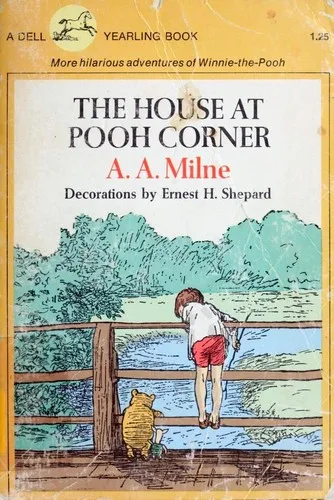
The House at Pooh Corner
 75
75

The House at Pooh Corner
Milne's second Pooh book, The House at Pooh Corner, solidifies the enduring appeal of the Hundred Acre Wood. The strength lies in its understated portrayal of childhood's gradual shift towards maturity, particularly through Christopher Robin's evolving perspective. The introduction of characters like Tigger adds a dynamic energy, though sometimes the narrative's pacing can feel a touch too leisurely, even for this genre. A particularly poignant moment is Christopher Robin's farewell, where his acknowledgment of growing up and the bittersweet nature of parting with his childhood friends carries a weight that transcends simple storytelling. The book's limitation, if one can call it that, is its reliance on a gentle, almost meditative tone that might not satisfy readers seeking overt conflict or dramatic arcs. Ultimately, The House at Pooh Corner offers a comforting, if melancholic, reflection on memory and transition.
📝 Description
75
A. A. Milne published The House at Pooh Corner in 1928, continuing Christopher Robin's stories.
This 1928 volume follows Christopher Robin and his friends in the Hundred Acre Wood. While appearing as a children's book, it examines themes of friendship, the imagination, and the passage from childhood. The narrative presents the world through distinct character viewpoints. The story also touches on Christopher Robin's movement toward adolescence, marking a natural change in his life and relationships.
Milne's writing style offers a gentle counterpoint to the experimental literary styles of the interwar period. The book's reception indicated a need for comforting narratives during a time of societal change. It uses characters like 'Heffalumps and Woozles' to represent childhood anxieties and the unexplored.
Readers may find layers of meaning in the characters' interactions and their symbolic representations of everyday life. The book explores how relationships and perspectives change over time. It is a story that invites contemplation on simple existence and the enduring power of memory.
While not overtly esoteric, The House at Pooh Corner can be read through a lens of Jungian archetypes and the collective unconscious. The anthropomorphic animals embody different facets of the psyche, interacting within a symbolic landscape that mirrors the inner world. Christopher Robin's journey represents the individuation process, moving from the unburdened state of childhood innocence towards the complexities of adolescence. The 'Heffalumps and Woozles' can be interpreted as shadow aspects or unresolved anxieties that must be acknowledged and integrated. The Hundred Acre Wood itself functions as a contained psychic space where these internal dramas unfold.
💡 Why Read This Book?
• Gain a deeper understanding of the symbolic journey of childhood's end, as depicted in Christopher Robin's farewell scene, offering a unique perspective on transitions that feels distinct from other narratives. • Explore the concept of 'Heffalumps and Woozles' as a specific representation of confronting the unknown, a metaphor Milne crafts with particular nuance not found in generic fear-based stories. • Appreciate the subtle character development, such as Eeyore's consistent melancholic outlook, as a specific study in maintaining one's core nature amidst change, a treatment not found elsewhere.
⭐ Reader Reviews
Honest opinions from readers who have explored this book.
❓ Frequently Asked Questions
When was The House at Pooh Corner first published?
The House at Pooh Corner was first published in 1928, following the success of Winnie-the-Pooh.
What is the significance of the 'Heffalumps and Woozles' in the book?
Heffalumps and Woozles symbolize the imagined fears and unknown dangers of childhood, representing what the characters conjure in their minds.
Who is the author of The House at Pooh Corner?
A. A. Milne, an English author and playwright, wrote The House at Pooh Corner.
What is the main difference between Winnie-the-Pooh and The House at Pooh Corner?
While both books feature the same characters, The House at Pooh Corner explores themes of growing up and transition more explicitly, particularly through Christopher Robin's journey.
Does the book have a spiritual or metaphysical interpretation?
While not overtly spiritual, the work's exploration of friendship, imagination, and the passage of time can be interpreted through various metaphysical lenses, focusing on consciousness and ephemeral bonds.
What is the tone of The House at Pooh Corner?
The tone is generally gentle, whimsical, and often tinged with a subtle melancholy, especially as it addresses themes of change and growing up.
🔮 Key Themes & Symbolism
The Nature of Friendship
Friendship in the Hundred Acre Wood is depicted as a foundational element of existence, providing comfort and structure. The characters' interactions, though simple, highlight mutual reliance and the unique bonds formed through shared experiences. Pooh's unwavering loyalty, for example, serves as an anchor for other characters facing anxieties. This theme underscores the idea that companionship is a primary force shaping an individual's reality, offering a consistent presence against the flux of external circumstances.
Childhood as a Liminal State
The narrative treats childhood not as a static period but as a transient phase, a 'house' that one eventually leaves. Christopher Robin's approaching adolescence marks this transition, introducing a sense of inevitable change. The concept of 'Heffalumps and Woozles' can be seen as symbolic of the perceived threats and uncertainties that accompany the movement from the known to the unknown. This liminality is explored with a gentle melancholy, acknowledging the loss inherent in growth.
Imagination and Reality
The boundary between imagination and reality is consistently blurred within the Hundred Acre Wood. The characters' belief in the tangible existence of creatures like Heffalumps, or their acceptance of talking animals, demonstrates the power of collective imagination to shape their world. This suggests that perceived reality is significantly influenced by internal states and shared belief systems, a concept explored subtly through the characters' adventures and dialogues.
The Passage of Time
The subtle awareness of time's passage is a recurring motif, most notably with Christopher Robin's impending departure for school. This introduces a sense of finality and the bittersweet nature of memories. The characters' attempts to hold onto the present moment, or their anxieties about future changes, reflect a universal human experience of confronting temporality and the impermanence of cherished states.
💬 Memorable Quotes
Direct passages from the work, attributed to the author.
““Oh, Bartholomew, you are sad,” said Piglet.”
— This simple exchange highlights Piglet's empathetic nature and his ability to perceive and acknowledge the emotional states of his companions, even Eeyore's persistent melancholy. It underscores the importance of validation in relationships.
““It is fun to be had for everybody.””
— This utterance suggests a universal potential for joy and engagement, implying that happiness is not a scarce resource but an accessible experience for all who seek it, a core tenet of optimistic philosophy.
“Christopher Robin had to go away for a long time.”
— This statement signals the inevitable transition from childhood to adolescence and the necessity of parting with familiar comforts and companions, representing a key theme of growth and change.
“Suppose that you go to somebody’s house, and you are not invited.”
— This scenario prompts reflection on social etiquette and the unspoken rules of interaction, exploring the anxieties and considerations that arise in interpersonal dynamics, even in a seemingly simple context.
““I’m not going to do anything. I’m just going to sit here.””
— This reflects a deliberate choice for quietude and presence, valuing stillness and observation over constant activity. It suggests an appreciation for the state of simply 'being'.
🌙 Esoteric Significance
Tradition
While not aligning with a specific esoteric lineage like Hermeticism or Kabbalah, The House at Pooh Corner can be viewed through a lens of child psychology and archetypal symbolism, particularly relevant to Jungian thought. Its focus on the unconscious world of childhood fears (Heffalumps) and the archetypal journey of growth speaks to explorations of the Self and individuation processes.
Symbolism
The Hundred Acre Wood itself functions as a symbolic landscape representing the microcosm of the child's developing psyche. Pooh Bear embodies the innocent, unburdened Self, while characters like Eeyore represent persistent shadow aspects or melancholic archetypes. The concept of 'Heffalumps and Woozles' serves as a potent symbol for confronting the unknown and the imagined terrors that populate the subconscious, a common motif in spiritual development.
Modern Relevance
Contemporary thinkers in developmental psychology and even mindfulness practices draw parallels to Milne's work. The emphasis on present-moment awareness, as exemplified by Pooh's simple existence, and the gentle exploration of emotional landscapes align with modern therapeutic approaches. The enduring appeal of the characters suggests their archetypal resonance continues to speak to contemporary audiences seeking relatable explorations of human connection and internal states.
👥 Who Should Read This Book
• Aspiring psychologists and literary analysts interested in archetypal characters within children's literature, who can gain insights into the symbolic representation of the developing psyche. • Readers seeking gentle narratives that explore the profound themes of friendship and the bittersweet nature of transition, offering a unique perspective on emotional maturity. • Individuals interested in the interwar literary landscape, looking for works that provided a contrast to modernist trends by focusing on enduring themes of innocence and imagination.
📜 Historical Context
The House at Pooh Corner, published in 1928, arrived during a period of significant cultural flux following World War I. A. A. Milne, already established as a playwright and humorist, tapped into a societal need for comfort and a return to perceived innocence. This stood in contrast to the burgeoning modernist literary movement, which often explored psychological fragmentation and societal disillusionment, as seen in the works of T. S. Eliot and James Joyce. While not directly engaging with philosophical schools like existentialism, Milne's gentle narrative offered an escapist counterpoint, focusing on enduring themes of friendship and imagination. The book's immense popularity, quickly becoming a beloved classic, indicates its success in providing a sense of stability and warmth during uncertain times.
📔 Journal Prompts
The transition of Christopher Robin from childhood.
Pooh's philosophy of 'doing nothing'.
Eeyore's capacity for enduring sadness.
The symbolic meaning of Heffalumps and Woozles.
The nature of friendship as depicted in the Hundred Acre Wood.
🗂️ Glossary
Hundred Acre Wood
The fictional setting for the Winnie-the-Pooh stories, representing a contained, imaginative world where the characters live out their adventures. It symbolizes a area of childhood consciousness.
Heffalumps and Woozles
Imaginary creatures that the characters fear. They represent the unknown, childhood anxieties, and the projection of internal fears onto external entities.
Tigger
A bouncy, energetic tiger character introduced in The House at Pooh Corner. He embodies exuberance and a certain chaotic energy, often contrasted with the more subdued characters.
Eeyore
A melancholic donkey character. Eeyore represents persistent sadness and a world-weary perspective, often serving as a foil to the more optimistic characters.
Christopher Robin
The human boy who owns the toys and is the central figure connecting them. His growth and eventual departure symbolize the transition from childhood.
Pooh
The protagonist, a teddy bear. Pooh represents innocence, simple pleasures, and a gentle approach to life, often embodying a state of contented presence.
The Backson
A creature invented by the characters to explain missing honey, representing a convenient, imagined culprit for problems.
🔮 Readers Also Liked
Browse all →









More by A. A. Milne
All books →




More Free Occult Philosophy Books
View all →