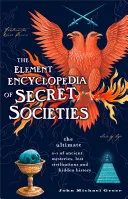
The Element Encyclopedia of Secret Societies: The Ultimate A–Z of Ancient Mysteries, Lost Civilizations and Forgotten Wisdom
 75
75

The Element Encyclopedia of Secret Societies: The Ultimate A–Z of Ancient Mysteries, Lost Civilizations and Forgotten Wisdom
John Michael Greer's 'The Element Encyclopedia of Secret Societies' presents a formidable A-Z compilation that largely succeeds in its ambitious scope. Its strength lies in the sheer breadth of topics covered, offering concise yet informative entries on everything from the Illuminati to the mythical city of Shambhala. Greer’s writing is characteristically clear, making complex historical and esoteric subjects accessible without resorting to sensationalism. A notable example is the detailed exploration of the historical debates surrounding the Knights Templar's supposed survival and influence post-1314. However, the work’s encyclopedic nature means some entries, while accurate, can feel brief, particularly for readers seeking deep dives into specific organizations like the Ordo Templi Orientis. The lack of extensive primary source citations for every claim might also be a limitation for rigorous academic study. Despite these minor drawbacks, the encyclopedia serves as an invaluable, well-organized resource for anyone seeking to understand the landscape of secret societies and forgotten lore. It stands as a solid, if occasionally superficial, guide to the hidden currents of history.
📝 Description
75
John Michael Greer's 2010 encyclopedia offers an A-Z guide to secret societies and ancient mysteries.
Published in 2010, The Element Encyclopedia of Secret Societies is an alphabetical reference work by John Michael Greer. It surveys clandestine organizations, historical puzzles, and esoteric knowledge, from ancient mystery schools to contemporary confraternities. The book examines the myths, individuals, and ideas that form the basis of much Western esotericism. Greer's aim is to clarify and contextualize a wide range of hidden histories and belief systems.
This volume is for researchers, occultists, historians, and anyone interested in detailed information about secret societies and their associated lore. It is particularly useful for those studying Freemasonry, Rosicrucianism, alchemy, or the myths of Atlantis and the Knights Templar. Readers interested in the connections between history, mythology, and hidden traditions will find substantial content. It serves as an introduction for beginners and a reference for experienced scholars.
Greer's encyclopedia appeared in 2010, a time when interest in esoteric subjects was growing, partly due to online resources. The early 21st century saw increased academic attention paid to previously overlooked fields. This work follows a tradition of encyclopedic efforts to organize occult and secret knowledge, often driven by a desire to recover lost wisdom.
💡 Why Read This Book?
• Gain a structured understanding of over 100 secret societies and esoteric concepts, from the Freemasons to ancient mystery schools, providing a comprehensive overview that surpasses general historical accounts. • Explore the historical and mythological significance of figures like King Arthur and Leonardo da Vinci within esoteric traditions, offering specific insights into their symbolic roles not found in standard biographies. • Understand the foundational elements of forgotten sciences and ancient wisdom, with detailed entries that illuminate concepts like alchemy and Gnosticism, crucial for appreciating their influence on Western thought.
⭐ Reader Reviews
Honest opinions from readers who have explored this book.
❓ Frequently Asked Questions
What historical periods does The Element Encyclopedia of Secret Societies primarily cover?
The encyclopedia spans a vast chronological range, from ancient civilizations and their mystery schools to medieval orders like the Knights Templar, and continues through the Renaissance, the Enlightenment, and into the 20th century with modern esoteric movements.
Which specific secret societies are detailed in John Michael Greer's encyclopedia?
It features detailed entries on numerous societies, including Freemasonry, the Rosicrucians, the Illuminati, the Golden Dawn, the Theosophical Society, and many lesser-known or mythical organizations.
Does the book discuss conspiracy theories related to secret societies?
Yes, the work addresses common conspiracy theories associated with groups like the Freemasons and the historical mysteries of Atlantis, providing context and exploring their origins.
What is the significance of Leonardo da Vinci in the context of secret societies according to the book?
Greer examines Leonardo da Vinci as a key figure often linked to esoteric knowledge and hidden symbolism, exploring theories connecting him to Renaissance mystery traditions and secret artistic or scientific societies.
Is the book suitable for beginners interested in esotericism?
Absolutely. Its alphabetical format and clear explanations make it an excellent starting point for those new to esoteric studies, offering a broad yet accessible introduction to complex subjects.
What other forgotten wisdom traditions are explored in the encyclopedia?
Beyond secret societies, the book delves into Gnosticism, Hermeticism, alchemy, and various mythologies, presenting them as foundational elements of forgotten sciences and esoteric philosophies.
🔮 Key Themes & Symbolism
Ancient Mysteries and Lost Civilizations
The encyclopedia meticulously catalogs legends and historical inquiries into lost civilizations like Atlantis, exploring their purported wisdom and societal structures. It connects these myths to ancient mystery schools and the enduring human fascination with origins and forgotten knowledge. Greer examines how these narratives have influenced subsequent esoteric thought and secret societies, often serving as foundational archetypes for seeking hidden truths and a lost golden age.
The Esoteric Role of Historical Figures
Greer analyzes how figures such as King Arthur, Leonardo da Vinci, and even Adolf Hitler have been incorporated into the lore of secret societies and esoteric traditions. These individuals are often portrayed not just for their historical impact but for their perceived connections to hidden knowledge, occult symbolism, or clandestine movements. The work explores the symbolic weight these figures carry within occult narratives, irrespective of historical verification.
Conspiracy Theories and Forgotten Sciences
A significant portion of the encyclopedia is dedicated to dissecting conspiracy theories surrounding secret organizations, examining their historical roots and psychological appeal. It also sheds light on 'forgotten sciences,' such as alchemy and early forms of astronomy, presenting them within the context of historical esoteric practices. The book treats these subjects as vital components of a continuous stream of hidden knowledge passed down through generations.
Structure and Symbolism of Secret Orders
The work systematically details the organizational structures, rituals, and core beliefs of various secret societies, from ancient initiatory orders to more modern fraternal groups. It deciphers the symbolic language and iconography employed by these groups, explaining their significance within the broader esoteric landscape. Understanding these elements is presented as key to grasping the continuity and evolution of Western occultism.
💬 Memorable Quotes
Direct passages from the work, attributed to the author.
“The mysteries of Atlantis continue to fascinate.”
— This highlights the enduring allure of lost civilizations, suggesting their mythical status fuels ongoing quests for hidden knowledge and alternative historical narratives.
“Freemasonry’s rituals hold symbolic meaning.”
— This points to the symbolic depth within Masonic practices, indicating that their ceremonies are not merely performative but convey deeper philosophical or spiritual teachings.
“Leonardo da Vinci's work is often interpreted esoterically.”
— This suggests that historical figures like Da Vinci are viewed through a lens of hidden meaning, with their creations and lives seen as containing coded messages or allegorical significance.
“Conspiracy theories often arise from historical ambiguities.”
— This interpretation explains how gaps or unclear aspects in historical records can become fertile ground for speculative narratives about secret plots and hidden influences.
“Ancient wisdom traditions persist.”
— This underscores the idea that foundational esoteric philosophies and practices, though ancient, maintain relevance and continue to influence modern thought and spiritual seeking.
🌙 Esoteric Significance
Tradition
This work aligns with the broader tradition of Western Esotericism, particularly drawing from Hermeticism, Rosicrucianism, and Theosophy. Greer's approach is that of a historian and synthesizer, cataloging various esoteric currents rather than advocating for a single lineage. It fits within a lineage of encyclopedic works that aim to map the terrain of hidden knowledge, much like later occult encyclopedias sought to systematize the vast array of spiritual and magical traditions.
Symbolism
Key symbols explored include the compass and square of Freemasonry, representing order, measurement, and the ethical construction of one's life according to divine principles. The serpent, often associated with Gnosticism and ancient wisdom, appears as a recurring motif symbolizing rebirth, hidden knowledge, and the cyclical nature of existence. The search for the Holy Grail is also treated as a potent symbol of spiritual quest and the attainment of divine grace or enlightenment.
Modern Relevance
Contemporary practitioners of ceremonial magic, modern Rosicrucians, and students of Western occultism continue to draw on Greer's encyclopedia as a foundational reference. Its clear organization makes it accessible for individuals exploring traditions like the Golden Dawn or Freemasonry. The work's analysis of conspiracy theories also remains relevant in an era where such narratives continue to shape public discourse and influence political and social movements.
👥 Who Should Read This Book
['• Students of Western Esotericism: Those studying Freemasonry, Rosicrucianism, alchemy, or Gnosticism will find detailed entries and historical context to deepen their understanding of these traditions.', '• Historians of Secret Societies: Researchers interested in the documented and mythical histories of clandestine organizations will appreciate the broad scope and cross-referenced entries.', '• Enthusiasts of Mythology and Folklore: Individuals fascinated by legends of Atlantis, King Arthur, and other esoteric narratives will discover connections to secret orders and forgotten wisdom.']
📜 Historical Context
Published in June 2010, John Michael Greer's 'The Element Encyclopedia of Secret Societies' arrived at a time when popular interest in conspiracy theories and esoteric history was amplified by the burgeoning internet. The early 21st century saw a blend of academic re-evaluation of occultism and widespread online dissemination of fringe theories. Greer’s work entered a landscape populated by encyclopedic efforts from authors like Joscelyn Godwin, who explored the history of Western esotericism, and contemporary popularizers of conspiracy lore. While not engaging in direct polemics with specific contemporary authors in its entries, the encyclopedia implicitly contextualizes itself against both scholarly traditions that often dismissed such subjects and more sensationalist accounts. Its comprehensive, alphabetical format offered a structured alternative to the often fragmented and speculative online discourse, providing a grounded reference point for a complex subject matter.
📔 Journal Prompts
The symbolic meaning of the compass and square in Freemasonry.
Atlantis as a foundational myth for secret societies.
The historical role attributed to Leonardo da Vinci.
The structure and purpose of the Knights Templar.
Forgotten sciences like alchemy and their esoteric interpretations.
🗂️ Glossary
Alchemy
An ancient philosophical and proto-scientific tradition practiced throughout Europe, the Middle East, and Asia. It aimed to purify, mature, and perfect certain materials, often interpreted as both a physical process of transforming metals and a spiritual process of human transformation.
Freemasonry
A fraternal organization that emerged in the late 16th to early 17th century from the traditions of stonemasons. It is known for its intricate rituals, symbolic teachings, and hierarchical degrees, often exploring moral and philosophical themes.
Gnosticism
A complex set of religious and philosophical ideas and systems that emerged in the first century CE. Gnostics sought spiritual knowledge (gnosis) to achieve liberation from the material world, often viewing the creator god of the Old Testament as a lesser, flawed deity.
Knights Templar
A Catholic military order founded around 1119, renowned for its role in the Crusades. The order amassed significant wealth and power before its abrupt suppression in 1312, leading to numerous legends and conspiracy theories about its survival and hidden knowledge.
Rosicrucianism
A mystical and esoteric tradition that emerged in Europe in the early 17th century, associated with the legendary figure Christian Rosenkreuz. Rosicrucian manifestos called for a spiritual reformation of society, emphasizing esoteric knowledge and secret teachings.
Theosophy
An esoteric philosophy founded in the late 19th century by Helena Blavatsky and others. It seeks to uncover the hidden universal truths behind religion, science, and philosophy, often drawing from Eastern religions and ancient wisdom traditions.
Atlantis
A legendary island or continent mentioned in Plato's dialogues 'Timaeus' and 'Critias'. It is described as a powerful naval power that conquered parts of Western Europe and Africa before sinking into the ocean, symbolizing a lost utopian civilization.