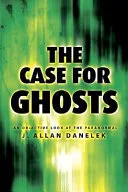
The Case for Ghosts
 84
84

The Case for Ghosts
J. Allan Danelek's "The Case for Ghosts" offers a commendable attempt at an objective, analytical approach to a subject often mired in folklore and unsubstantiated claims. The author's strength lies in his methodical dissection of concepts like the "ghost psyche," moving the conversation beyond mere spectral apparitions to consider the potential psychological and energetic residues of consciousness. He provides a structured framework for understanding spirit communication, which, while speculative, is presented with a commendable lack of dogma. However, the book occasionally falters by presenting hypotheses as near-certainties, particularly when discussing the nature and purpose of "spirit guides." A more rigorous engagement with skepticism, beyond acknowledging its existence, would have further bolstered the work's analytical credibility. Despite this, Danelek’s 2006 publication remains a solid resource for those seeking a reasoned examination of hauntings.
📝 Description
84
J. Allan Danelek's 2006 book, "The Case for Ghosts," examines hauntings with an analytical perspective.
Published in 2006, "The Case for Ghosts" by J. Allan Danelek offers a structured look at paranormal phenomena, particularly hauntings and the nature of spirits. Danelek moves beyond simple stories to analyze the potential psychology of ghosts, how spirit communication might work, and the idea of spirit guides. The book aims to give readers a clear understanding of a topic that has long interested people. Danelek draws on different fields to make sense of these experiences.
This book is for serious investigators of the paranormal who want logical explanations and discussions based on evidence. Readers interested in the psychological aspects of hauntings, the possibility of communication between spirits, and the larger questions about life after death will find it useful. It is for those who want to understand these events more objectively, rather than solely from a belief system.
Emerging in the mid-2000s, Danelek's work entered a period of increased paranormal interest fueled by television. He positioned his book as more academic, contrasting it with sensationalism. The book connects to a spiritualist tradition dating back to the 19th century, referencing figures like Helena Blavatsky and the Theosophical Society. It also attempts to incorporate modern ideas from psychology and science, engaging with concepts debated in parapsychology for decades.
💡 Why Read This Book?
• Learn about the "ghost psyche": Understand Danelek's framework for analyzing the potential psychological and energetic states of discarnate entities, moving beyond simplistic ghost tropes. • Explore spirit communication methods: Gain insight into various theoretical approaches to inter-spirit communication discussed in the book, as presented in the mid-2000s context. • Examine the concept of spirit guides: Consider Danelek's analytical perspective on "spirit guides" and their purported role, as detailed within the book's chapters.
⭐ Reader Reviews
Honest opinions from readers who have explored this book.
❓ Frequently Asked Questions
What is the primary focus of J. Allan Danelek's "The Case for Ghosts"?
The book's primary focus is an objective analysis of hauntings, the potential nature of the "ghost psyche," methods of spirit communication, and the concept of "spirit guides," aiming to offer logical insights into these phenomena.
When was "The Case for Ghosts" first published?
"The Case for Ghosts" was first published in 2006, placing its analysis within the context of early 21st-century paranormal interest.
Does the book present scientific proof of ghosts?
The book offers an analytical framework and explores concepts related to hauntings and spirits, but it focuses on interpretation and potential explanations rather than definitive scientific proof.
What distinguishes Danelek's approach to hauntings?
Danelek's approach is characterized by an analytical and objective examination, aiming to provide insights into the phenomenon by dissecting concepts like the ghost psyche and spirit communication.
Is "The Case for Ghosts" suitable for beginners in paranormal studies?
Yes, it is suitable for beginners and experienced individuals alike who seek a structured, analytical perspective on hauntings and spirit phenomena, moving beyond mere belief.
What are some key concepts explored in the book?
Key concepts include the "ghost psyche," "spirit communication," "spirit guides," and the analysis of hauntings as potentially understandable events.
🔮 Key Themes & Symbolism
The Ghost Psyche
Danelek posits that understanding hauntings requires examining the potential "ghost psyche"—a concept that explores the residual consciousness, emotions, and energetic imprints left by departed individuals. This theme moves beyond simple spectral forms to consider the complex psychological and energetic states that might persist after physical death, offering a framework for interpreting paranormal activity as potentially linked to the unique imprints of former lives and unresolved energies.
Spirit Communication
This theme examines the theoretical possibilities and methods through which communication with discarnate entities might occur. Danelek analyzes various approaches, seeking to establish a logical basis for understanding how information or interaction could be possible across the veil of death. The work examines the potential mechanics and validity of such communications, treating it as a phenomenon that can be studied and understood, rather than dismissed outright.
Spirit Guides
The concept of "spirit guides" is explored not as dogma, but as a subject for analytical inquiry. Danelek considers the notion of entities that may offer assistance or guidance to the living or to spirits themselves. This theme engages with the potential roles and nature of such entities, examining how this concept fits within broader understandings of consciousness and the afterlife, and its implications for those experiencing paranormal phenomena.
Analytical Approach to Hauntings
Central to the book is its commitment to an analytical and objective perspective on hauntings. Rather than relying on sensationalism or anecdotal evidence alone, Danelek seeks to dissect the phenomenon, offering structured interpretations and potential explanations. This theme emphasizes the importance of critical examination and logical frameworks in understanding events often relegated to folklore or belief systems.
💬 Memorable Quotes
Direct passages from the work, attributed to the author.
“The ghost psyche implies residual consciousness and energy.”
— This statement expresses Danelek's view that hauntings might be understood as lingering imprints of personality, emotion, and vital energy left behind by deceased individuals.
“Spirit communication involves potential cross-dimensional interaction.”
— This highlights the book's exploration of how contact might be made with entities beyond the physical realm, suggesting it's a form of interaction across different planes of existence.
“Hauntings can be analyzed logically.”
— This reflects the author's core thesis: that paranormal phenomena, specifically hauntings, are not inherently inexplicable but can be subjected to reasoned examination and interpretation.
“Spirit guides may serve a purpose in the afterlife.”
— This points to the book's consideration of entities that potentially assist spirits or the living, framing them as functional components within a larger spiritual cosmology.
“Objective analysis is key to understanding spectral events.”
— This emphasizes the methodological approach Danelek advocates for, prioritizing critical thinking and evidence-based reasoning when confronting phenomena like hauntings.
🌙 Esoteric Significance
Tradition
While not strictly tied to a single esoteric lineage like Hermeticism or Kabbalah, Danelek's work aligns with the broader tradition of spiritualist inquiry and metaphysical exploration. It shares common ground with Theosophy's interest in post-mortem states and communication, and with psychical research's attempt to investigate the paranormal through systematic methods. The book departs from rigid dogma by emphasizing analytical reasoning, positioning itself as a bridge between esoteric concepts and a more rationalistic examination of the unseen.
Symbolism
The primary "symbol" explored is the ghost itself, not as a mere apparition, but as a complex entity representing residual consciousness, unresolved issues, or energetic imprints. The concept of "spirit guides" can also be seen symbolically, representing higher consciousness, divine assistance, or archetypal forces offering direction. The act of "spirit communication" symbolizes the enduring human desire to bridge the gap between the material and immaterial worlds, seeking connection and understanding beyond physical limitations.
Modern Relevance
Danelek's analytical framework for understanding hauntings and the "ghost psyche" remains relevant for contemporary paranormal investigators and researchers who seek structured methodologies. His work informs discussions in areas like consciousness studies and the philosophy of mind, particularly concerning the persistence of consciousness after death. Modern mediums, spiritual counselors, and those exploring personal development through connection with unseen realms may draw upon his conceptualizations of spirit communication and guidance.
👥 Who Should Read This Book
• Skeptical inquirers into the paranormal: Readers who approach hauntings and spirit phenomena with a desire for logical frameworks and analytical explanations, rather than purely anecdotal accounts. • Students of metaphysical concepts: Individuals interested in exploring theories of consciousness, the afterlife, and inter-spirit communication from a structured, reasoned perspective. • Paranormal investigators: Those seeking to deepen their understanding of hauntings by examining potential psychological and energetic underpinnings, moving beyond simple observation.
📜 Historical Context
Published in 2006, "The Case for Ghosts" emerged during a period of heightened public interest in the paranormal, fueled by popular television shows and a burgeoning community of amateur investigators. J. Allan Danelek's work sought to bring a more analytical and less sensationalist approach to the subject, differentiating itself from the often speculative narratives prevalent at the time. The book engages with a long-standing tradition of spiritual inquiry, tracing roots back to 19th-century Spiritualism and figures like Allan Kardec, but it also aimed to integrate contemporary psychological perspectives. It stands in contrast to purely faith-based or purely skeptical viewpoints, attempting a middle ground. While not directly engaging with specific contemporary authors like Hans Holzer, who was active in the same field, Danelek's methodical examination of concepts like the "ghost psyche" contributed to the ongoing discourse within parapsychology and esoteric studies.
📔 Journal Prompts
The potential ghost psyche and its implications for residual energy.
Methods of spirit communication and their theoretical validity.
The concept of spirit guides as explored in the book.
Analyzing hauntings: comparing Danelek's framework to personal observations.
The objective analysis of spectral phenomena: personal reflections.
🗂️ Glossary
Ghost Psyche
A theoretical construct representing the potential residual consciousness, emotional states, and energetic imprints of a deceased individual that may manifest as paranormal phenomena.
Spirit Communication
The theoretical process or act of exchanging information or interacting with discarnate entities or consciousnesses.
Spirit Guides
Entities theorized to exist on a non-physical plane that may offer guidance, assistance, or impart knowledge to living individuals or other spirits.
Haunting
The phenomenon of perceived paranormal activity, often associated with a specific location, believed to be caused by the presence of spirits or residual energies.
Objective Analysis
An approach to studying phenomena that emphasizes factual evidence, logical reasoning, and the absence of personal bias or preconceived notions.
Residual Energy
The concept that strong emotions or events can imprint energy onto a location or object, which may manifest as paranormal activity.
Discarnate Entity
A being or consciousness that exists without a physical body, typically referring to a spirit or ghost.