The ancient Egyptian coffin texts

 79
79

The ancient Egyptian coffin texts
R. O. Faulkner's compilation offers a direct window into the Middle Kingdom's approach to the afterlife, moving beyond the purely royal sphere of the Pyramid Texts. The sheer volume of spells, meticulously translated, is its greatest strength, providing unparalleled access to the period's magical and religious thought. However, the lack of extensive commentary or contextualization within the translation itself can leave the uninitiated reader adrift in a sea of obscure deities and convoluted underworld geography. A particular passage detailing the spell for 'Not to die a second time' (Spell 368) highlights the texts' core concern: guaranteeing eternal existence through ritual mastery. This is not a book for casual perusal; it demands dedicated study. Faulkner's work is an indispensable scholarly resource, though it benefits greatly from being read alongside secondary scholarly analyses.
📝 Description
79
Inscribed on coffins from the 21st to 17th centuries BCE, the Ancient Egyptian Coffin Texts chronicle spells for the afterlife.
This collection presents funerary spells and incantations from Egypt's Middle Kingdom, primarily between 2100 and 1700 BCE. These texts mark a shift in funerary beliefs, moving beyond the royal exclusivity of the Pyramid Texts. They made religious and magical knowledge accessible to a broader elite, including officials and governors.
The spells were designed to aid the deceased in navigating the underworld, ensuring their rebirth, and attaining a divine state. They offer insight into the religious and magical thought of a significant period in Egyptian civilization. For students of ancient languages, the texts are a valuable resource for textual analysis. They also illuminate the development of afterlife beliefs and ritual practices.
The Coffin Texts arose during a time of social change following the Old Kingdom's collapse. Appearing on coffins and tomb walls rather than exclusively in royal pyramids, these spells reflect a growing democratization of mortuary beliefs. They show theological changes preceding the New Kingdom's Book of the Dead, as Egyptian society engaged with new concepts of divine judgment and personal salvation.
The Coffin Texts are a crucial link in understanding ancient Egyptian conceptions of the afterlife and spiritual transformation. They detail the arduous journey through the Duat, the Egyptian underworld, and the rituals required to overcome its dangers. These spells reveal a sophisticated system of belief focused on achieving immortality and union with the divine, moving beyond mere preservation of the body to the active guidance of the soul. This focus on inner transformation and the overcoming of cosmic obstacles places them within a broader tradition of sacred texts concerned with spiritual ascent.
💡 Why Read This Book?
• Gain direct insight into Middle Kingdom funerary spells, understanding the magical practices intended to secure rebirth and divine status, as detailed in chapters concerning the journey through the Duat. • Explore the evolution of Egyptian afterlife beliefs, tracing the transition from Old Kingdom pyramid texts to the more accessible Coffin Texts and their influence on later funerary literature. • Grasp the specific challenges and strategies for navigating the underworld, as described in spells designed to overcome demons and achieve the state of an *akh*.
⭐ Reader Reviews
Honest opinions from readers who have explored this book.
❓ Frequently Asked Questions
What is the primary purpose of the spells in the Ancient Egyptian Coffin Texts?
The primary purpose was to equip the deceased with magical knowledge and incantations necessary to navigate the dangers of the Duat (underworld) and achieve a successful rebirth into the afterlife as an *akh*.
When were the Ancient Egyptian Coffin Texts primarily in use?
These texts were primarily in use during Egypt's Middle Kingdom period, roughly spanning from the 21st century BCE to the 17th century BCE.
How do the Coffin Texts differ from the earlier Pyramid Texts?
The Coffin Texts represent a democratization of funerary literature, moving from the exclusive use of the Pyramid Texts for royalty to spells inscribed on coffins for a broader elite, including officials and nobles.
What does the term 'akh' refer to in the context of these texts?
An 'akh' is the transliterated Egyptian term for the effective spirit or blessed dead, considered an idealized, luminous being in the afterlife, the state the deceased aspired to achieve.
Who is R. O. Faulkner, the translator of this edition?
R. O. Faulkner was a distinguished Egyptologist whose translations of ancient Egyptian religious texts, including the Pyramid Texts, Coffin Texts, and Book of the Dead, are highly regarded for their accuracy and clarity.
Are there specific spells for protection against demons mentioned?
Yes, numerous spells are dedicated to warding off various demons and hostile forces encountered in the underworld, ensuring safe passage for the deceased.
🔮 Key Themes & Symbolism
Working through the Duat
The Coffin Texts meticulously detail the perilous journey through the Egyptian underworld, known as the Duat. They provide the deceased with the necessary magical utterances and divine names to bypass dangerous guardians, placate monstrous beings, and traverse the various gates and regions of this netherworld. The spells function as a spiritual roadmap, ensuring that the deceased possesses the correct knowledge to overcome obstacles and avoid annihilation, thereby securing their passage to the afterlife.
Transformation and Rebirth
A central theme is the deceased's aspiration for transformation into a divine or semi-divine being. Spells enable the deceased to change form, often into powerful animals like a falcon or a serpent, or even into deities themselves. This capacity for metamorphosis is crucial for their rebirth and integration into the celestial realm. The ultimate goal is to become an *akh*, a transfigured and effective spirit, fully integrated into the cosmic order and capable of interacting with the living.
Magical Efficacy of Words
The texts underscore the potent force of spoken words and written spells in ancient Egyptian belief. Reciting specific incantations correctly, often combined with ritualistic actions or knowledge of divine names, was believed to have direct causal power. These spells were not merely prayers but potent tools designed to manipulate the forces of the cosmos, overcome death, and ensure a favorable outcome in the judgment and resurrection processes.
Democratization of the Afterlife
Emerging during the Middle Kingdom, the Coffin Texts mark a significant shift from the Old Kingdom's exclusive funerary rites for pharaohs. These spells, inscribed on coffins, were accessible to a wider elite, including officials and nobles. This reflects a broadening of the concept of an assured afterlife, suggesting that divine favor and eternal life were attainable through acquired magical knowledge, not solely by royal prerogative.
💬 Memorable Quotes
Direct passages from the work, attributed to the author.
“I am the Great One who comes into being of himself.”
— This declaration, often attributed to the creator god, reflects the self-sufficient and primordial nature of divine power. It speaks to the ultimate source of creation and the inherent ability of the divine to manifest existence independently.
“May I see the gods, may I travel the waterways.”
— This expresses a fundamental desire of the deceased: to achieve a state of divine communion and to be able to move freely within the celestial and underworld realms, signifying a successful transition to the afterlife.
“I know the names of the spirits who guard the gates of the underworld.”
— This highlights the importance of possessing specific, esoteric knowledge, such as the names of supernatural beings. Such knowledge was power, enabling the deceased to bypass or command these entities.
“Do not let my mouth be given to the Devourer.”
— This is a plea for protection against annihilation, specifically the loss of one's ability to speak or eat in the afterlife, symbolizing the complete destruction of the self and the cessation of existence.
“I have come from the land of the living, and I shall enter the land of the blessed.”
— This phrase articulates the transition from earthly existence to the hoped-for eternal life. It signifies a successful departure from the mortal world and an assured entry into the area of the gods and the righteous dead.
🌙 Esoteric Significance
Tradition
These texts are foundational to the study of Western esotericism due to their profound influence on ancient Hermeticism and later magical traditions. While not strictly Hermetic in origin, the Egyptian emphasis on cosmic order, divine knowledge, magical utterance, and the transformation of the soul deeply informed the Neoplatonic and Gnostic milieu that eventually gave rise to Hermetic philosophy. The quest for gnosis, understanding the divine, and achieving spiritual liberation finds early expression in these funerary rituals.
Symbolism
Key symbols include the *djed* pillar, representing stability and resurrection, often associated with Osiris, and the *ankh*, the symbol of life. The underworld itself, the Duat, is a potent symbol of the chthonic realm, a place of trials and transformation. The scarab beetle, representing rebirth and the sun god Ra, also features prominently, signifying the cyclical nature of existence and the promise of regeneration from death.
Modern Relevance
Contemporary esoteric practitioners and scholars of comparative religion continue to draw inspiration from the Coffin Texts. They inform modern magical practices focused on inner transformation and spiritual ascent. Thinkers in Jungian psychology find parallels in the archetypal journey through the underworld. The texts remain a vital source for understanding the roots of Western occult traditions, providing a tangible link to ancient concepts of consciousness, death, and rebirth that continue to be explored.
👥 Who Should Read This Book
• Students of ancient Egyptian religion and mythology seeking primary source material on afterlife beliefs and funerary practices during the Middle Kingdom. • Aspiring practitioners of Western esotericism interested in the historical roots of magical traditions and concepts of spiritual transformation. • Scholars of comparative religion and mythology looking to understand the evolution of afterlife concepts across ancient cultures and their influence on later thought.
📜 Historical Context
The Ancient Egyptian Coffin Texts emerged during a period of significant political and social flux, following the collapse of the Old Kingdom around 2181 BCE and extending through the Middle Kingdom (c. 2055–1650 BCE). This era saw a decentralization of power and a corresponding shift in religious practices. The groundbreaking aspect of the Coffin Texts was their availability to non-royalty, a departure from the exclusively pharaonic "Pyramid Texts" of the Old Kingdom. These spells, inscribed on coffins, provided a means for provincial governors and wealthy officials to secure their own afterlife. This democratization of mortuary religion occurred while scholars like Flinders Petrie were actively excavating and documenting Egyptian sites, providing crucial archaeological context for understanding these evolving beliefs. The intellectual currents involved a complex interplay between traditional cosmology and new conceptions of individual fate and divine judgment, laying the groundwork for the later "Book of the Dead."
📔 Journal Prompts
The deceased's knowledge of the names of underworld guardians.
The specific transformations sought through the spells.
The magical efficacy implied by the recitation of these utterances.
The meaning of becoming an *akh* in the context of the Duat journey.
The symbolic significance of the *djed* pillar or *ankh* symbol within the spells.
🗂️ Glossary
Duat
The ancient Egyptian term for the underworld or area of the dead. It was depicted as a region through which the sun god Ra traveled at night and where the souls of the deceased underwent judgment and transformation.
Akh
The transliterated Egyptian word for the transfigured, effective spirit of a deceased person. Achieving the state of an *akh* was the ultimate goal of funerary rituals, signifying blessed immortality.
Middle Kingdom
A period in ancient Egyptian history spanning roughly from 2055 to 1650 BCE. It is characterized by reunification, stability, and significant developments in literature, art, and religious thought, including the emergence of the Coffin Texts.
Pyramid Texts
The oldest known corpus of ancient Egyptian funerary spells, inscribed on the walls of pyramids from the Old Kingdom (c. 2686–2181 BCE). They were exclusively intended for the pharaoh's burial.
Book of the Dead
A later collection of spells and incantations from the New Kingdom (c. 1550–1070 BCE) onwards, inscribed on papyrus scrolls and placed in tombs. It represents a further evolution and compilation of funerary literature.
Sarcophagus
A stone coffin, typically adorned with inscriptions and imagery. In the Middle Kingdom, the Coffin Texts were often written on the interior surfaces of these sarcophagi.
Osiris
An ancient Egyptian deity of the afterlife, the underworld, and the dead. He was also the god of resurrection and fertility, central to Egyptian mythology and funerary beliefs.
🔮 Readers Also Liked
Browse all →









More by R. O. Faulkner
All books →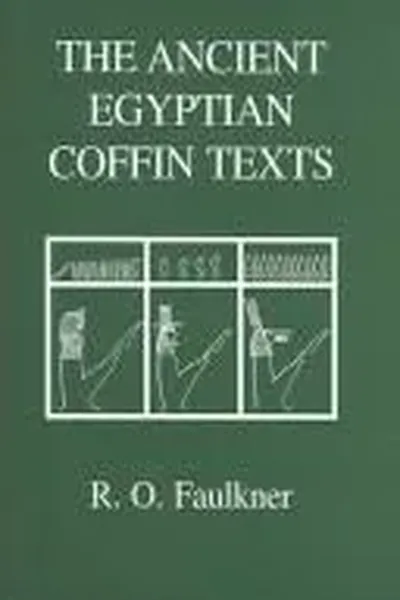
More Free Magic & Ritual Books
View all →