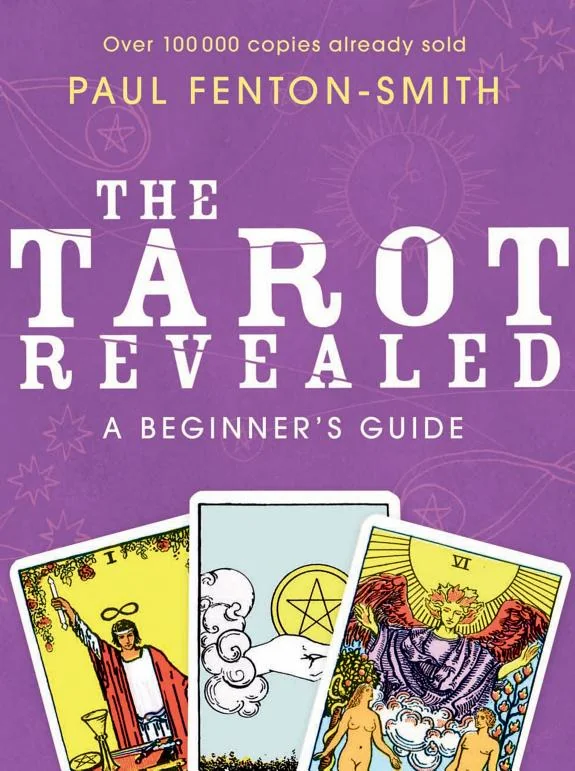
Tarot Revealed
 74
74

Tarot Revealed
Paul Fenton-Smith's "Tarot Revealed" addresses a common barrier for aspiring Tarot readers: the sheer volume of information. Its strength lies in its methodical, almost formulaic, approach to memorizing card meanings, a stark contrast to more philosophical or historically dense texts. The revised edition, published years after its initial 2008 release, benefits from a clear layout that aids comprehension. However, this very focus on simplicity can sometimes feel reductive; the nuanced interplay between cards, a hallmark of advanced readings, receives less attention. Fenton-Smith's explanation of the reversed meanings, while practical, occasionally lacks the depth found in other traditions. The book is a solid, if somewhat dry, primer for absolute beginners seeking a quick start. It successfully demystifies the cards for those intimidated by esoteric jargon.
📝 Description
74
Paul Fenton-Smith published "Tarot Revealed" in 2008 to simplify learning the 78 Rider-Waite-Smith cards.
Paul Fenton-Smith's "Tarot Revealed," published in 2008, offers a structured method for learning the 78 cards of the Rider-Waite-Smith deck. The book divides the cards into accessible sections, detailing interpretations for both upright and reversed positions. Its core aim is to provide a clear system for memorizing card meanings, serving as a practical guide for those new to Tarot study. The work is particularly suited for individuals who find the symbolism and history of the cards initially daunting. Readers seeking a direct approach to understanding card meanings without needing extensive prior esoteric knowledge will appreciate its straightforward presentation. It functions as a starting point for anyone interested in using Tarot for personal insight or divination.
Fenton-Smith's book introduces essential Tarot concepts, including the division of the deck into the Major and Minor Arcana. It highlights how context, particularly the reversed position of a card, alters its interpretation. The author also details the roles of the Court Cards—Page, Knight, Queen, and King—within the Minor Arcana, providing specific keywords and associations for each. This approach aims to demystify the Tarot for beginners, building a solid understanding of its core components.
The Tarot, with roots in 15th-century Italy, has held esoteric significance since at least the 18th century. By the early 2000s, Tarot study had a considerable popular following, largely shaped by the influential 1909 Rider-Waite-Smith deck. Paul Fenton-Smith's "Tarot Revealed" enters this established tradition by offering a simplified gateway. It acknowledges the historical depth and symbolic richness of the cards while presenting a more approachable system for understanding their meanings.
💡 Why Read This Book?
• Learn a direct method for recalling upright and reversed meanings of all 78 cards, as presented in the 2008 edition, enabling quicker divination practice. • Understand the foundational structure of the Tarot, including the distinct roles of the Major and Minor Arcana, as detailed in the book's early chapters. • Gain practical interpretation skills by studying the specific keywords and symbolic associations Fenton-Smith provides for each Court Card, facilitating personal readings.
⭐ Reader Reviews
Honest opinions from readers who have explored this book.
❓ Frequently Asked Questions
What is the primary focus of Paul Fenton-Smith's "Tarot Revealed"?
The book's primary focus is to provide beginners with a clear, simple, and memorable system for understanding the meanings of the 78 Tarot cards, both upright and reversed, as established in its first edition from 2008.
Which Tarot deck is "Tarot Revealed" based on?
The book primarily uses the Rider-Waite-Smith deck as its reference point, a widely recognized standard in Tarot study, first published in 1909.
Does "Tarot Revealed" explain the historical origins of Tarot?
While it acknowledges the mystery surrounding Tarot's origins, the book focuses more on practical interpretation rather than a deep historical or philosophical dive.
Is "Tarot Revealed" suitable for experienced Tarot readers?
No, the book is specifically designed for beginners. Experienced readers might find its approach too elementary, though it could serve as a quick reference for card meanings.
How does the book help in remembering card meanings?
It offers an 'easy formula' and straightforward explanations, breaking down the symbolism and associated keywords for each card to aid memorization.
What is the significance of the revised and updated edition?
The revised edition aims to present the information in an even simpler, more straightforward style, ensuring its accessibility for new students of the Tarot.
🔮 Key Themes & Symbolism
Arcana Structure
The work meticulously dissects the Tarot deck into its two primary components: the 22 Major Arcana and the 56 Minor Arcana. Fenton-Smith explains the thematic differences, positioning the Major Arcana as archetypal life lessons and the Minor Arcana as the everyday events and challenges we encounter. This foundational division is crucial for understanding how the cards interact and tell a broader story within a reading, as detailed from its 2008 publication onwards.
Upright vs. Reversed Meanings
A central tenet of "Tarot Revealed" is its systematic approach to interpreting cards in both upright and reversed positions. It posits that reversed cards often represent an internal aspect of the upright meaning, a blockage, or an external influence. This binary interpretation system, consistently applied throughout the book, provides a clear framework for readers to expand their interpretive vocabulary beyond simple one-word meanings.
Court Card Roles
The book dedicates significant attention to the four Court Cards (Page, Knight, Queen, King) within each of the four Minor Arcana suits. Fenton-Smith assigns distinct personality archetypes and roles to each, framing them as figures or aspects of the querent's psyche or external circumstances. Understanding these 'people' cards is presented as key to unlocking deeper narrative layers in a Tarot spread.
Divinatory Applications
While not exploring complex spread mechanics, "Tarot Revealed" grounds its interpretations in practical divination. The goal is to equip the reader with the knowledge to interpret what is happening 'physically, mentally, emotionally and spiritually,' as mentioned in the original blurb. This focus on actionable insight empowers beginners to use the Tarot as a tool for self-reflection and understanding life's circumstances.
💬 Memorable Quotes
Direct passages from the work, attributed to the author.
“The Tarot helps us interpret what is going on in life physically, mentally, emotionally and spiritually.”
— This statement from the original blurb expresses the book's practical aim: to use the Tarot as a diagnostic tool for understanding various facets of human experience and the external world.
“An easy formula for remembering the meanings of the cards both upright and reversed.”
— This highlights the core pedagogical strategy of the book – to offer a simplified, systematic method for memorization, making Tarot accessible to novices.
“The remarkable accuracy of the ancient Tarot has won many followers.”
— This suggests a belief in the efficacy and predictive power of the Tarot, framing it as a reliable system for gaining insight, a perspective Fenton-Smith aims to validate for his readers.
“The Tarot Revealed has sold over 100,000 copies.”
— This statistic, from its early print runs, speaks to the book's widespread appeal and success in reaching a large audience seeking Tarot instruction.
“Its origins are swathed in mystery.”
— This acknowledges the historical ambiguity surrounding the Tarot's inception, setting the stage for a focus on practical application rather than definitive historical tracing.
🌙 Esoteric Significance
Tradition
While not explicitly aligning with a single esoteric lineage like Hermeticism or Kabbalah, "Tarot Revealed" operates within the broad tradition of Western divination and esoteric psychology. It draws implicitly from the symbolic language established by the Rider-Waite-Smith deck, which itself was influenced by occultists like A.E. Waite. The book's focus on interpreting life's physical, mental, emotional, and spiritual aspects aligns with a psychological and self-help approach common in 21st-century esoteric practice.
Symbolism
The book leverages core symbols from the Rider-Waite-Smith deck. It interprets the four suits (Wands, Cups, Swords, Pentacles) as representing elements and spheres of life (spirit/creativity, emotions/relationships, intellect/conflict, material world/practicality). It also emphasizes the archetypal figures of the Court Cards – Page, Knight, Queen, and King – as representations of personality types or stages of development within these elemental spheres.
Modern Relevance
In contemporary esoteric circles, "Tarot Revealed" serves as a foundational text for self-taught practitioners and those seeking a no-nonsense introduction. Its clear methodology is often cited by online communities and beginner courses. While more advanced practitioners might move towards texts exploring deeper Kabbalistic or astrological connections, Fenton-Smith's work remains relevant for its accessible entry point into symbolic interpretation and personal divination.
👥 Who Should Read This Book
• Absolute beginners to Tarot seeking a structured, easy-to-follow guide to learn card meanings without feeling overwhelmed by complex theory. • Individuals interested in divination and self-reflection who want a practical toolkit for interpreting the Rider-Waite-Smith Tarot deck. • Aspiring readers who prefer a clear, formulaic approach to memorization over historically or philosophically dense esoteric texts.
📜 Historical Context
Published in 2008, "Tarot Revealed" emerged during a period of significant popular engagement with Tarot, largely fueled by the internet and a burgeoning New Age movement. The Rider-Waite-Smith deck, first published in 1909 and central to Fenton-Smith's work, had long been the standard for beginners due to its accessible symbolism. This era saw numerous Tarot books, ranging from deep dives into Kabbalistic correspondences to simpler guidebooks. Fenton-Smith's approach competes with, yet also complements, the more complex works of authors like Rachel Pollack, who had published extensively on Tarot symbolism and history since the 1980s. The book's success, evidenced by its substantial sales figures, indicates a demand for straightforward, explained instruction in a field often perceived as esoteric and intimidating.
📔 Journal Prompts
The Page of Cups' potential meanings in relation to emotional openness.
The reversed Swords' implications for mental clarity or conflict.
Interpreting the King of Pentacles as an archetype of material success.
Reflecting on the Major Arcana's role as overarching life lessons.
The emotional significance of the Cups suit in a personal reading.
🗂️ Glossary
Major Arcana
The 22 trump cards of the Tarot deck, representing significant life events, spiritual lessons, and archetypal forces. Cards range from The Fool to The World.
Minor Arcana
The 56 cards of the Tarot deck, divided into four suits (Wands, Cups, Swords, Pentacles). They represent everyday occurrences, challenges, and situations.
Upright
A card drawn and interpreted in its natural, intended orientation, typically signifying direct or positive expression of its meaning.
Reversed
A card drawn and interpreted upside down, often indicating blocked energy, internal issues, delayed outcomes, or the shadow aspect of the upright meaning.
Court Cards
The four face cards in each suit of the Minor Arcana: Page, Knight, Queen, and King. They often represent people, personality types, or stages of development.
Suits
The four divisions of the Minor Arcana: Wands (fire, spirit), Cups (water, emotions), Swords (air, intellect), and Pentacles (earth, material world).
Divination
The practice of seeking knowledge of the future or the unknown by supernatural means, often using tools like the Tarot.
This book appears in 1 collection
🔮 Readers Also Liked
Browse all →





![The 70 Best Tales of Edgar Allan Poe [69 stories]](/img/thumb/the-70-best-tales-of-edgar-allan-poe-69-stories-edgar-allan-poe-523054.webp)



From the “Minor Arcana” Collection
View all →





More Free Occult Philosophy Books
View all →