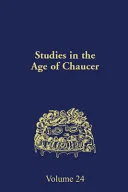
Studies in the Age of Chaucer
 77
77

Studies in the Age of Chaucer
Larry Scanlon's editorial stewardship of *Studies in the Age of Chaucer* consistently upholds the New Chaucer Society's commitment to rigorous scholarship. The 2002 volume, like its predecessors, offers a vital snapshot of contemporary research on Chaucer and his era. While the articles engage deeply with the social and intellectual contexts of late medieval Britain, some pieces could benefit from more direct engagement with the text itself, rather than solely focusing on external historical factors. A particular strength lies in the comprehensive annotated bibliography, which remains an indispensable tool for navigating the deluge of Chaucerian publications. The reviews, too, provide critical evaluations that are both informed and fair. The yearbook serves its intended audience well, providing a consistent standard of academic discourse on a crucial period of English literature.
📝 Description
77
Studies in the Age of Chaucer is the annual yearbook of the New Chaucer Society, published since 1983.
This yearbook, published by the New Chaucer Society, features scholarly articles on Geoffrey Chaucer and his contemporaries. Its coverage extends to their literary predecessors and successors, as well as the wider intellectual and social context of their time. The publication focuses on British culture and writing from approximately 1200 to 1500.
The volume is intended for academics, researchers, and advanced students specializing in medieval literature, particularly Chaucer's works and their historical background. It will also interest those with a serious concern for Britain's cultural and intellectual history between the 13th and 15th centuries. The Age of Chaucer, primarily the 14th century, saw major societal and literary changes in England, including events like the Hundred Years' War and the Black Death, which shaped the literature and thought of the period. Geoffrey Chaucer's writing in Middle English contributed to the rise of vernacular literature, moving away from Latin and French in scholarly and courtly spheres. His work, notably *The Canterbury Tales*, depicted English society and explored themes of pilgrimage, social order, and religious belief.
While not esoteric in the sense of occult studies, this yearbook addresses the complex cultural and intellectual currents of late medieval Britain. It examines the transmission of knowledge and the intellectual shifts occurring during a period marked by significant societal upheaval. The focus on the literary and social fabric of the time, including evolving forms of authorship and audience reception, provides a detailed look at a specific historical moment's worldview. The detailed scholarship within aims to reconstruct and understand the multifaceted intellectual environment of Chaucer's era.
💡 Why Read This Book?
• Gain a structured overview of scholarship on Geoffrey Chaucer and his contemporaries, grounded in the specific focus on British culture between 1200-1500. • Understand the intellectual and social contexts of 14th-century England, as explored through the lens of literary production and reception during that era. • Access an annotated bibliography and reviews of Chaucer-related publications, providing a curated guide to the field as of 2002.
⭐ Reader Reviews
Honest opinions from readers who have explored this book.
❓ Frequently Asked Questions
What is the primary focus of Studies in the Age of Chaucer?
The primary focus is on the writing of Geoffrey Chaucer and his contemporaries, their literary predecessors and successors, and the intellectual and social contexts of late medieval Britain (1200-1500).
Who publishes the Studies in the Age of Chaucer yearbook?
The yearbook is published annually by the New Chaucer Society, an academic organization dedicated to the study of Chaucer and his works.
Does this book cover topics beyond Chaucer's own writings?
Yes, it broadly explores the culture and writing of later medieval Britain, including antecedents and successors to Chaucer's literary output and their societal influences.
What is included in each volume besides scholarly articles?
Each volume typically includes an annotated bibliography of recent publications and reviews of books related to Chaucer and his era.
What is the general time period covered by the articles?
The articles generally focus on the period between 1200 and 1500 in Britain, with a particular emphasis on the literary and cultural landscape during Chaucer's lifetime.
Is this book suitable for casual readers interested in medieval history?
While informative, its dense academic focus makes it more suitable for scholars and advanced students rather than casual readers seeking a general introduction to the period.
🔮 Key Themes & Symbolism
Chaucerian Contexts
This yearbook examines the literary output of Geoffrey Chaucer and his contemporaries, placing their work within a specific historical framework. It investigates not only their immediate antecedents and successors but also the broader intellectual and social currents that shaped their writing. The focus is on the culture of Britain between 1200 and 1500, offering a scholarly lens through which to view the period's unique literary expressions and their embedded societal meanings.
Medieval British Culture
Beyond Chaucer himself, the volume explores the wider cultural field of later medieval Britain. This includes analyses of social structures, religious beliefs, and political events that influenced artistic production. The work seeks to illuminate the complex interplay between literature and the lived realities of the period, providing a nuanced understanding of how societal forces were reflected and shaped by the era's writing.
Scholarly Discourse and Bibliography
A crucial function of *Studies in the Age of Chaucer* is to facilitate ongoing academic conversation. Each volume includes an annotated bibliography that meticulously tracks and summarizes recent publications related to Chaucer. This feature is vital for scholars seeking to stay abreast of current research and critical debates within the field of medieval studies.
Literary Antecedents and Successors
The yearbook's scope extends to understanding Chaucer's place within a literary continuum. Articles often explore the authors and texts that influenced Chaucer, as well as those who followed in his wake, adapting or responding to his innovations. This diachronic approach helps to contextualize Chaucer's contributions and understand the evolution of English literature during the medieval period.
💬 Memorable Quotes
Direct passages from the work, attributed to the author.
“The yearbook publishes articles on the writing of Chaucer and his contemporaries, their antecedents and successors, and their intellectual and social contexts.”
— This statement clearly defines the publication's core mission: to provide a scholarly platform for analyzing Chaucerian literature within its historical and literary lineage, rather than in isolation.
“Articles explore the culture and writing of later medieval Britain (1200-1500).”
— This highlights the broad scope, indicating that the focus is not solely on individual authors but on the societal and cultural milieu that produced and received the literature of this specific era.
“Each SAC volume also includes an annotated bibliography and reviews of Chaucer-related publications.”
— This emphasizes the yearbook's role as a critical resource, offering readers curated summaries and evaluations of contemporary scholarship, essential for academic researchers.
“The publication focuses on the culture and writing of Britain during the later medieval period, specifically between 1200 and 1500.”
— This precise chronological and geographical framing underscores the academic rigor and specificity with which the yearbook approaches its subject matter.
“Studies in the Age of Chaucer is the annual yearbook of the New Chaucer Society.”
— This identifies the authoritative body behind the publication, signaling its affiliation with a recognized academic society and its commitment to scholarly standards.
🌙 Esoteric Significance
Tradition
While *Studies in the Age of Chaucer* is primarily a work of secular literary scholarship, its deep engagement with medieval thought can touch upon esoteric currents. The late medieval period saw a blend of orthodox Christian theology with more mystical and sometimes heterodox beliefs. The work may implicitly engage with traditions that sought hidden meanings in texts, aligning with Hermetic or Neoplatonic approaches to understanding divine order through earthly creation. It operates within the scholarly tradition of examining historical belief systems, which often intersect with what we now categorize as esoteric thought.
Symbolism
The symbolic field of Chaucerian literature is rich, often reflecting medieval Christian cosmology. Motifs like the pilgrimage in *The Canterbury Tales* can be interpreted not just as a physical journey but as an allegory for the soul's path towards salvation. The Wheel of Fortune, a common medieval symbol, frequently appears, representing the unpredictable nature of earthly existence and the divine will. The very act of storytelling and the varied cast of pilgrims can be seen as symbolic representations of different facets of human society and its spiritual condition.
Modern Relevance
Contemporary scholars and writers interested in historical consciousness, archetypal psychology, and the evolution of Western narrative forms draw heavily on the detailed contextualization provided by works like this. While not explicitly esoteric, the study of medieval literature and its symbolic systems informs modern explorations of myth, comparative religion, and the roots of Western esotericism. Thinkers interested in Jungian archetypes or narrative theory often find fertile ground in the symbolic richness of the Chaucerian period.
👥 Who Should Read This Book
• Advanced students of medieval English literature seeking to deepen their understanding of Chaucer's context and contemporaries. • Literary historians and cultural studies scholars interested in the social and intellectual currents of 13th-15th century Britain. • Researchers needing access to current scholarship and bibliographical resources on Chaucerian studies as of 2002.
📜 Historical Context
The Age of Chaucer, predominantly the 14th century, was a dynamic period in English history, marked by the Hundred Years' War, the devastating Black Death, and significant social upheaval like the Peasants' Revolt of 1381. Intellectually, it was a time when scholasticism still held sway, but seeds of humanism were beginning to sprout. Geoffrey Chaucer, writing in Middle English, was an important figure who helped legitimize vernacular literature. This yearbook, published in 2002, engages with scholarship concerning this era, building upon decades of critical work. It situends itself within the broader field of medieval studies, a discipline that often grappled with establishing the significance of English vernacular works against the perceived prestige of Latin and French traditions. Contemporary scholars like Helen Cooper were actively publishing influential works on Chaucer during this period, shaping the discourse that these articles contribute to. The reception of Chaucer's work has historically evolved, moving from courtly appreciation to intensive academic scrutiny, a trajectory reflected in the detailed analysis found within these pages.
📔 Journal Prompts
The concept of pilgrimage in Chaucerian literature: allegorical versus literal interpretations.
Analyze the social hierarchy depicted in the works of Chaucer's contemporaries.
Chaucer's use of Middle English: its significance in the context of 1200-1500 British writing.
The influence of religious devotion on the literary output of the period.
Compare the intellectual currents of the 14th century with those of earlier or later medieval periods.
🗂️ Glossary
Middle English
The Germanic language spoken and written in England from roughly 1150 to 1500. It is a transitional phase between Old English and Modern English, characterized by significant vocabulary and grammatical changes.
Chaucerian
Pertaining to Geoffrey Chaucer, his works, his style, or the literary period in which he lived and wrote.
Antecedents
In a literary context, works, authors, or traditions that precede and influence a later work or author.
Successors
In a literary context, authors or works that follow and are influenced by a preceding text or tradition.
Vernacular Literature
Literature written in the common language of a particular region or country, as opposed to a learned language like Latin.
Scholasticism
A medieval method of critical thought that employed a dialectical method to solve problems and in many areas was used as a tool of philosophical and theological learning.
New Chaucer Society
An international academic organization founded to promote the study of Geoffrey Chaucer and his contemporaries and successors.
This book appears in 1 collection
🔮 Readers Also Liked
Browse all →








From the “Spiritual Alchemy” Collection
View all →






More Free Alchemy & Hermeticism Books
View all →