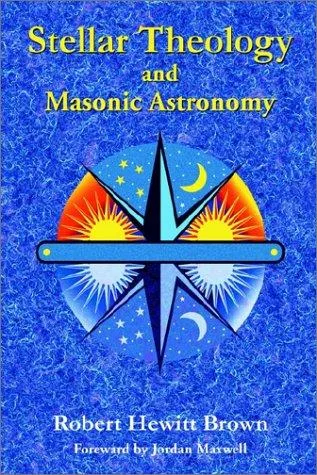
Stellar Theology and Masonic Astronomy
 84
84

Stellar Theology and Masonic Astronomy
Robert Hewitt Brown’s Stellar Theology and Masonic Astronomy attempts to illuminate the often-overlooked celestial dimensions of Masonic symbolism. The book’s strength lies in its earnest effort to connect the practicalities of ancient star-gazing with the abstract principles espoused in Masonic lodges. Brown skillfully draws parallels between ancient cosmologies and Masonic tenets, particularly in his discussion of how constellations and planetary movements informed early religious and philosophical systems that subsequently influenced Freemasonry. However, the work occasionally strains to establish direct, verifiable links, sometimes relying on speculative connections rather than concrete historical evidence. A particularly insightful section explores the symbolism of the 'Great Architect of the Universe' as understood through the lens of cosmic order, though it could benefit from greater engagement with primary Masonic texts from different eras. Despite its occasional interpretive leaps, the book offers a valuable perspective for those seeking to understand the astronomical foundations of Masonic thought.
📝 Description
84
Robert Hewitt Brown's 2021 book connects celestial observation with Masonic symbolism.
Stellar Theology and Masonic Astronomy examines the esoteric links between observing the heavens and the symbolic language of Freemasonry. The book aims to connect ancient astronomical practices with their use in Masonic ritual and philosophy. It discusses how stars, planets, and cosmic cycles were seen by various cultures as more than just tools for navigation, but as imbued with spiritual and philosophical meaning. This tradition later found a place within fraternal orders.
The text is intended for those interested in Freemasonry's deeper symbolic currents, especially its astronomical foundations. It will appeal to Masonic students, those studying comparative religion, and individuals curious about the history of science and its connections to mystical thought. A basic grasp of astronomy and how ancient peoples viewed the cosmos and its impact on human life is helpful for readers.
This book fits within a tradition of Masonic literature that seeks the philosophical and spiritual roots of the Craft. It acknowledges how ancient civilizations, including the Egyptians and Greeks, used astronomy, and how their celestial mythologies influenced later esoteric thought. Brown's work engages with the interest in Freemasonry's esoteric aspects, a field that saw increased attention in the late 19th and early 20th centuries, though he concentrates on Masonic traditions specifically.
💡 Why Read This Book?
• Gain an understanding of how ancient astronomical observations, such as the heliacal rising of Sirius in Egyptian calendars, informed early religious thought and influenced the symbolic language adopted by Freemasonry. • Learn about the specific Masonic symbols and rituals, like the tracing boards and the symbolism of the lodge’s orientation, that directly correlate with celestial bodies and movements. • Appreciate the philosophical underpinnings of the 'Great Architect of the Universe' concept as interpreted through the lens of cosmic order and astronomical cycles, as explored in Brown’s analysis.
⭐ Reader Reviews
Honest opinions from readers who have explored this book.
❓ Frequently Asked Questions
When was Stellar Theology and Masonic Astronomy first published?
Stellar Theology and Masonic Astronomy was first published in 2021, bringing Robert Hewitt Brown's research to a modern audience interested in esoteric subjects.
What is the primary focus of Robert Hewitt Brown's book?
The book's primary focus is the intricate relationship between celestial observations and the symbolic language found within Freemasonry, exploring how astronomical phenomena influenced Masonic philosophy.
Who is Robert Hewitt Brown?
Robert Hewitt Brown is the author of Stellar Theology and Masonic Astronomy, a work dedicated to exploring esoteric connections within Masonic traditions and their astronomical roots.
What kind of reader would most benefit from this book?
Readers interested in Masonic symbolism, comparative religion, the history of esoteric thought, and the philosophical implications of ancient astronomy will find this book particularly beneficial.
Does the book discuss specific constellations or planets?
Yes, the book explores how various celestial bodies and constellations were understood symbolically and how their movements and positions influenced ancient mythologies and subsequently Masonic teachings.
Is this book suitable for someone new to Freemasonry?
While the book delves into specific Masonic concepts, readers with a basic curiosity about esoteric traditions and symbolism will likely find it accessible, though prior familiarity with Masonic terminology might enhance comprehension.
🔮 Key Themes & Symbolism
Cosmic Order and Masonic Symbolism
The work posits that the universe's observable order, particularly the movements of celestial bodies, provided a fundamental framework for ancient wisdom traditions. This cosmic blueprint, according to Brown, was subsequently encoded into the symbolic language and rituals of Freemasonry. The book examines how concepts like the fixed stars, the wandering planets, and the cyclical nature of seasons, all observable in the night sky, became potent metaphors within Masonic teachings for moral instruction and spiritual aspiration. The alignment of the lodge itself, the placement of officers, and various symbolic objects are presented as reflections of this perceived celestial architecture, intended to guide the initiate towards a greater understanding of universal principles.
Ancient Astronomical Practices and Esotericism
Brown investigates how ancient cultures, from the Egyptians to the Greeks, integrated astronomical observation into their religious, philosophical, and mystical systems. These practices were not merely scientific endeavors but were deeply spiritual, seeking to understand humanity's place within the grand cosmic scheme. The book explores how astronomical events were interpreted as divine communications or reflections of underlying spiritual truths. This historical thread of celestial reverence and esoteric interpretation is presented as a crucial precursor to the symbolic astronomy found within Freemasonry, suggesting a continuity of wisdom passed down through millennia, adapted and preserved within fraternal orders.
The Great Architect of the Universe
A central theme is the interpretation of the 'Great Architect of the Universe' (G.A.O.T.U.) through the lens of astronomy. Rather than a purely theological construct, Brown suggests the G.A.O.T.U. is deeply rooted in the recognition of the intelligent design and sublime order manifest in the cosmos. The predictable cycles of the sun, moon, and stars, the mathematical precision of planetary orbits, and the vastness of space all serve as tangible manifestations of this ultimate creative intelligence. The book argues that understanding these astronomical principles is key to a deeper apprehension of the G.A.O.T.U. within the Masonic context, moving beyond abstract dogma to a more concrete, observable divinity.
Masonic Ritual and Celestial Allegory
The text meticulously examines various elements of Masonic ritual and symbolism to demonstrate their inherent connection to astronomical phenomena. Chapters may explore the significance of the 'point within a circle,' the symbolism of the zodiacal belt, or the interpretation of specific stars and constellations as allegorical tools. Brown aims to show that these are not arbitrary symbols but are derived from and intended to represent celestial truths. The progressive stages of Masonic degrees are often presented as mirroring a journey through cosmic understanding, with celestial phenomena serving as the primary allegorical language for spiritual development and moral instruction.
💬 Memorable Quotes
Direct passages from the work, attributed to the author.
“The heavens declare the glory of the Great Architect.”
— This phrase, echoing Psalm 19, highlights the book's central argument that the observable universe, particularly its celestial order, serves as a primary revelation of divine intelligence within Masonic philosophy.
“Ancient peoples looked to the stars for guidance, not just of the seasons, but of spiritual truths.”
— This interpretation emphasizes the book's focus on how celestial observation was intrinsically linked to mystical and religious understanding in antiquity, a practice that informed later esoteric traditions.
“Masonic symbols are often celestial maps for the soul's journey.”
— This concept suggests that the symbols within Freemasonry are not merely decorative but serve as allegorical representations of cosmic principles and spiritual progression, akin to a map guiding an individual.
“Astronomy was the original theology.”
— This provocative statement implies that the study of the stars was fundamental to early religious and philosophical systems, forming the basis of humanity's initial attempts to understand the divine and the universe.
💡 Key Ideas
Editorial paraphrase of the work's core concepts — not direct quotes.
The predictable cycles of the cosmos reflect an underlying divine intelligence.
This paraphrased idea underscores the book's argument that the order and regularity observed in celestial movements are seen as evidence of a purposeful, intelligent creator within the Masonic worldview.
🌙 Esoteric Significance
Tradition
This work fits within the broader Western Esoteric Tradition, particularly the branches concerned with Hermeticism, Neoplatonism, and speculative Masonry. It aligns with traditions that view the physical universe as a reflection of higher spiritual realities and seek wisdom through the interpretation of symbolic language. Brown's approach reflects the Neoplatonic idea of the cosmos as a divine manifestation and the Hermetic principle of 'as above, so below,' applied specifically to Masonic symbolism and its astronomical correlations.
Symbolism
Key symbols explored include the celestial sphere itself, representing the macrocosm and the divine order; specific constellations and planets, which carry ancient mythological and astrological significance that Brown links to Masonic allegories; and the 'point within a circle,' often interpreted as the individual soul or the Master Mason surrounded by the limits of duty or the circle of the universe.
Modern Relevance
Contemporary thinkers and practitioners in fields such as esoteric Freemasonry, comparative mythology, and cosmological studies draw upon the foundational work that connects celestial phenomena to human spiritual understanding. The book's exploration of ancient astronomical systems and their symbolic integration continues to inform discussions on how these ancient perceptions of the cosmos can offer insights into modern spiritual and philosophical questions.
👥 Who Should Read This Book
• Masonic initiates and scholars seeking to deepen their understanding of the astronomical symbolism embedded within their fraternity's rituals and teachings. • Students of comparative religion and mythology interested in how celestial observations shaped ancient belief systems and influenced later esoteric traditions. • Enthusiasts of the Western Esoteric Tradition looking for works that bridge scientific history with mystical philosophy, particularly concerning cosmology and its symbolic representation.
📜 Historical Context
Published in 2021, Robert Hewitt Brown's Stellar Theology and Masonic Astronomy emerges in an era of renewed interest in the esoteric dimensions of Western traditions. The book implicitly engages with a long scholarly tradition that has sought to uncover the philosophical underpinnings of Freemasonry, a tradition that gained significant momentum in the late 19th and early 20th centuries. Figures like Helena Blavatsky and the burgeoning Theosophical Society, while not directly Masonic, explored similar connections between ancient cosmologies and spiritual development, creating an intellectual climate receptive to such inquiries. Brown's work can be seen as continuing this lineage, focusing specifically on how astronomical observation and interpretation became foundational to Masonic symbolism and ritual. It implicitly addresses a competing school of thought that views Masonic rituals as purely allegorical or historical without deep cosmic roots.
📔 Journal Prompts
Reflect on the concept of the 'Great Architect of the Universe' as presented through astronomical order.
Consider how the symbolism of a specific constellation might inform your personal spiritual journey.
Analyze the potential connections between the 'point within a circle' and celestial navigation.
How might the observation of planetary cycles influence one's perception of time and destiny?
Explore the historical shift from astronomical observation as a primary theological source.
🗂️ Glossary
Celestial Sphere
An imaginary sphere of infinite radius concentric with the Earth, onto which all objects in the observable universe appear to be projected. In esoteric contexts, it represents cosmic order and divine influence.
Great Architect of the Universe (G.A.O.T.U.)
A term used in Freemasonry to refer to the Supreme Being or Creator, understood as the divine intelligence and order manifest in the cosmos, often interpreted through principles of geometry and astronomy.
Masonic Symbolism
The system of allegorical signs, figures, and emblems used in Freemasonry to convey moral and philosophical teachings, often drawing parallels with ancient traditions and natural phenomena.
Esoteric
Intended for or likely to be understood by only a small number of people with a specialized knowledge or interest; pertaining to inner, hidden meanings.
Cosmology
The study of the origin, evolution, and eventual fate of the universe. In esoteric contexts, it often involves the philosophical and spiritual interpretation of the universe's structure and workings.
Heliacal Rising
The first appearance of a star or planet just before sunrise after a period of invisibility due to its proximity to the Sun. Historically significant in many ancient calendars and mythologies.
Speculative Masonry
The philosophical and allegorical interpretation of Masonic rituals and symbols, as distinct from 'operative' Masonry, which historically referred to the craft of stonemasonry.
🔮 Readers Also Liked
Browse all →









More Free Freemasonry & Secret Societies Books
View all →