Shinto in history
 77
77

Shinto in history
Breen and Teeuwen's Shinto in History provides a much-needed scholarly recalibration of how we understand Japan's native religious currents. The work is particularly strong in its meticulous tracing of how Shinto, often perceived as static, was in fact a dynamic and evolving system, heavily influenced by imperial discourse and Buddhist integration. A notable strength lies in its detailed engagement with the Meiji era's state Shinto apparatus, showing how national identity was actively constructed through religious policy. However, for readers unfamiliar with Japanese history or religious terminology, the dense academic prose can present a steep learning curve. The chapter detailing the syncretic relationship between kami and buddhas before the Meiji Restoration, for instance, is illuminating but requires careful attention. Ultimately, this is an essential, if demanding, scholarly resource for understanding Shinto's historical trajectory.
📝 Description
77
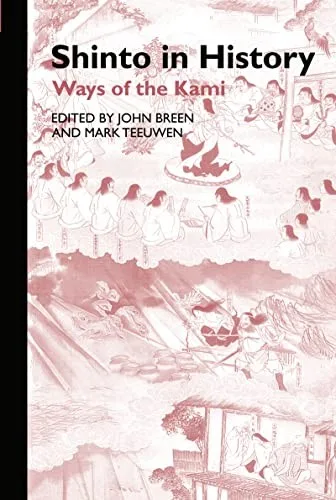
John Breen and Mark Teeuwen's 2000 book examines the historical development of Shinto.
Shinto in History, published in 2000, offers a detailed academic study of Japan's indigenous religious tradition. The authors move past simple definitions to show the complex historical changes in beliefs, rituals, and institutions tied to kami worship. The book traces how Shinto interacted with other religious and political forces across Japanese history, illustrating its capacity for change and adaptation. This work was written during a time of increased academic focus on Japanese religious history, aiming to question earlier nationalist views of Shinto. It engages with scholarship that follows Shinto's origins and changes over centuries, from its earliest forms to its role in the Meiji era and later. The book serves as a contrast to older, less critical accounts.
The book analyzes the relationship between Shinto and Buddhism, the influence of Confucianism, and the rise of state Shinto following the Meiji Restoration in 1868. It discusses how Shinto ideas were put into writing, how ritual practices became standardized, and how political regimes used these elements to support their power. The authors use textual analysis and historical evidence throughout their scholarly approach.
This book approaches Shinto not as a static set of beliefs, but as a dynamic tradition shaped by centuries of historical and political forces. It examines the ways Shinto's structures and doctrines were formed and adapted, often in relation to dominant political and religious systems. This perspective aligns with esoteric scholarship that looks beyond surface appearances to understand the historical construction and practical function of religious traditions.
💡 Why Read This Book?
• Learn how Shinto was actively shaped by political powers, particularly during the Meiji Restoration of 1868, offering a critical perspective beyond simplistic notions of indigenous faith. • Understand the complex, long-standing interactions between Shinto and Buddhism, moving beyond superficial distinctions to grasp their historical syncretism. • Gain insight into the scholarly debates surrounding Shinto's origins and development, appreciating the rigorous methodology employed by Breen and Teeuwen.
⭐ Reader Reviews
Honest opinions from readers who have explored this book.
❓ Frequently Asked Questions
When was Shinto in History first published?
Shinto in History by John Breen and Mark Teeuwen was first published in 2000, marking a significant contribution to academic studies of Japanese religion at the turn of the millennium.
What is the main focus of Shinto in History?
The book's primary focus is the historical evolution and complex development of Shinto, examining its doctrines, rituals, and institutional changes over centuries of Japanese history.
Does Shinto in History discuss the Meiji Restoration?
Yes, the work extensively discusses the Meiji Restoration (1868), detailing how Shinto was utilized and transformed into a state religion to foster national identity and imperial legitimacy.
Is Shinto in History suitable for beginners?
While comprehensive, the book is written for an academic audience. Beginners might find the dense scholarly approach challenging, but it offers unparalleled depth for serious students of the subject.
What is the relationship between Shinto and Buddhism discussed in the book?
The book explores the intricate historical syncretism between Shinto kami worship and Buddhist practices, demonstrating how these traditions influenced and integrated with each other over long periods.
Who are the authors of Shinto in History?
The authors are John Breen and Mark Teeuwen, both respected scholars whose collaborative work provides a detailed historical analysis of Shinto.
🔮 Key Themes & Symbolism
Shinto-Buddhist Syncretism
The work meticulously unpacks the historical entanglement of Shinto and Buddhism, challenging the notion of distinct, isolated religious spheres. It details how kami were often integrated into Buddhist cosmology, and Buddhist deities or concepts found expression within Shinto shrines. This syncretic tendency, particularly pronounced before the Meiji era, highlights Shinto's capacity for adaptation and absorption, demonstrating that 'pure' Shinto is largely a modern construct. The book explores how this fusion was not merely incidental but often a deliberate theological and political strategy to harmonize different spiritual influences within the Japanese archipelago.
State Shinto and Imperial Ideology
A significant portion of the analysis centers on the instrumentalization of Shinto during the Meiji Restoration (1868) and its subsequent development as State Shinto. Breen and Teeuwen illustrate how the Meiji government strategically elevated Shinto to promote national unity, imperial authority, and a distinct Japanese identity. This involved codifying rituals, establishing a hierarchy of shrines, and emphasizing the divine lineage of the Emperor. The work critically examines how this state-sponsored religious framework served to legitimize political power and shape public consciousness. It reveals Shinto as a tool of nation-building.
Evolution of Kami Worship
Shinto in History traces the transformation of kami worship from localized, often animistic practices to more formalized religious and political structures. The book examines how concepts of kami evolved, influenced by Chinese thought and Buddhism, and how rituals associated with these spirits developed over time. It emphasizes that the understanding and practice of Shinto were not static but underwent continuous reinterpretation and adaptation in response to social, political, and intellectual changes throughout Japanese history. This evolution underscores Shinto's dynamic nature.
Academic Historiography of Shinto
The book implicitly engages with and contributes to the scholarly historiography of Shinto. By presenting a detailed, critical, and evidence-based account, Breen and Teeuwen challenge earlier, potentially nationalistic or overly simplistic interpretations of Shinto's past. Their work represents a mature phase of academic inquiry into Japanese religions, prioritizing historical accuracy and nuanced analysis over mythologizing. The scholarship reflects a commitment to understanding Shinto through its historical context rather than through essentialist definitions. It offers a model for critical religious studies.
💬 Memorable Quotes
Direct passages from the work, attributed to the author.
“The relationship between Shinto and Buddhism was one of prolonged and intricate interaction, not simple opposition.”
— This statement captures the book's central argument that Shinto and Buddhism were deeply intertwined for centuries, influencing each other's practices and theology, rather than existing as separate, competing entities.
“State Shinto, particularly after the Meiji Restoration, was a deliberate construction designed to bolster imperial legitimacy.”
— This highlights the critical perspective on State Shinto, framing it not as an ancient, pure religious form, but as a modern political tool created to serve specific nationalistic and authoritarian goals.
“The concept of kami evolved significantly, absorbing influences from various philosophical and religious traditions.”
— This points to the dynamic nature of Shinto's core entities, the kami, illustrating how their understanding and veneration changed over time due to external intellectual currents.
“Understanding Shinto requires attention to its historical context, not just its doctrinal pronouncements.”
— This emphasizes the methodological approach of the book, prioritizing historical development and societal influence over abstract theological statements when analyzing Shinto.
“The separation of Shinto and Buddhism was largely a product of the modern nation-state's reorganization of religious life.”
— This interpretation underscores that the distinct categories we use today for Shinto and Buddhism were actively imposed and reinforced during the modern period, overriding centuries of syncretism.
🌙 Esoteric Significance
Tradition
While Shinto in History is primarily an academic historical text, it engages with themes that resonate within esoteric studies. Shinto's focus on kami, nature spirits, and the sacredness of place aligns with animistic and nature-veneration traditions found in various esoteric lineages. The book's exploration of how Shinto was codified and manipulated by the state offers parallels to how esoteric knowledge can be both preserved and distorted by institutional power structures. It provides a historical lens through which to view the institutionalization of spiritual practices, a common concern in esoteric philosophy.
Symbolism
The book implicitly touches upon the symbolic significance of the Shinto shrine (jinja) as a locus of spiritual power and community connection. The concept of kami itself, representing forces of nature, ancestors, and deities, serves as a potent symbol of the sacred immanent in the world. Furthermore, the ritualistic elements discussed, such as purification rites and offerings, represent symbolic acts of communion between the human and divine realms, key motifs in many spiritual traditions.
Modern Relevance
Contemporary practitioners of Shinto-inspired spiritual paths, as well as scholars of comparative religion and East Asian studies, continue to draw on the historical foundations laid out in Shinto in History. Thinkers interested in the intersection of religion and nationalism, or the construction of cultural identity through religious practice, find its analysis of State Shinto particularly relevant. The book's detailed examination of Shinto's historical adaptability also informs discussions on how ancient traditions can evolve and maintain relevance in the modern world, influencing movements seeking to reconnect with indigenous spiritualities.
👥 Who Should Read This Book
• Scholars of East Asian religions seeking a definitive historical account of Shinto's development, moving beyond nationalist narratives. • Students of Japanese history interested in the interplay between religious belief, cultural identity, and political power from ancient times to the modern state. • Comparative religion researchers examining how indigenous traditions interact with dominant religious and political ideologies over centuries.
📜 Historical Context
Published in 2000, Shinto in History emerged from a rich tradition of Japanese religious studies, yet it distinguished itself by offering a more critical and historically grounded perspective than some earlier works. The late 20th century saw a growing academic skepticism towards nationalistic interpretations of Shinto, particularly regarding its pre-modern history and its role in imperial ideology. Breen and Teeuwen's work arrived in this climate, building upon scholarship that began to deconstruct the Meiji-era narrative of Shinto. Key contemporaries like scholars focusing on the interactions between Shinto and Buddhism, or the socio-political functions of shrines, informed this re-evaluation. The book's rigorous analysis of textual sources and institutional development provided a robust counterpoint to more simplistic accounts, contributing to a nuanced understanding of Shinto's long and complex journey.
📔 Journal Prompts
The historical construction of State Shinto during the Meiji Restoration.
The long-term syncretism of Shinto kami and Buddhist deities.
Evolutionary patterns in the worship of kami across different historical periods.
The role of Shinto rituals in shaping Japanese national identity.
The academic historiography surrounding Shinto's origins and development.
🗂️ Glossary
Kami
A term in Shinto that refers to spirits, deities, or essences that inhabit the natural world, ancestors, or significant places. The concept is broad and can encompass a wide range of spiritual beings and forces.
Shinto
Japan's indigenous religious tradition, characterized by the worship of kami and a focus on rituals, purity, and harmony with nature. Its historical development is deeply intertwined with Japanese culture and politics.
Meiji Restoration
A key event in Japanese history occurring in 1868, which restored imperial rule and led to rapid modernization, industrialization, and the establishment of State Shinto.
State Shinto
A system of Shinto promoted by the Meiji government from 1868 onwards, emphasizing the divine lineage of the Emperor and national unity, often separating it from sectarian Shinto practices.
Syncretism
The merging or blending of different religious beliefs, rituals, and practices. In the context of Shinto, this often refers to its historical integration with Buddhism and other traditions.
Jinja
A Shinto shrine, a sacred space dedicated to the worship of kami. Jinja vary greatly in size and importance, from small local shrines to major national sanctuaries.
Historiography
The study of the writing of history, including the methods, theories, and biases of historians. In this context, it refers to how Shinto's history has been researched and interpreted.
🔮 Readers Also Liked
Browse all →







More by John Breen, Mark Teeuwen
All books →
More Free Witchcraft & Paganism Books
View all →