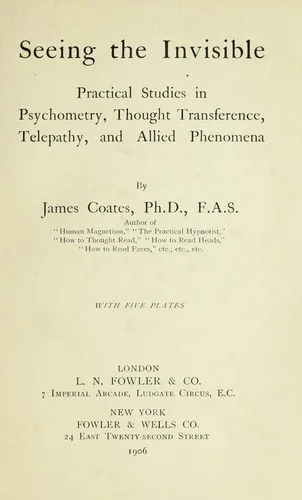
Seeing the Invisible
 72
72

Seeing the Invisible
James Coates's 'Seeing the Invisible' presents a determined effort to bring the study of psychical phenomena into the realm of serious investigation. The strength of the book lies in its methodical approach, treating telepathy and psychometry as subjects demanding systematic observation, akin to nascent scientific fields of its time. Coates's insistence on cataloging observations and seeking patterns is commendable, particularly when discussing the challenges of validating subjective experiences.
A notable limitation, however, is the inherent difficulty in verifying the precise nature of the 'evidence' presented. While Coates describes practical studies, the objective measurement of psychic phenomena in the early 20th century was—and remains—a significant hurdle. For instance, his discussions on thought transference, while detailed in their description of experiments, often rely on the interpretation of the participants' subjective reports, which can be prone to bias.
Read more ↓
Despite this, the work offers a valuable window into the discourse surrounding psychic science before the widespread adoption of digital recording and more sophisticated statistical analysis. The book serves as a record of earnest attempts to understand the unseen forces of consciousness.
📝 Description
72
James Coates's 2015 book examines psychometry and thought transference as observable phenomena.
Published in 2015, 'Seeing the Invisible' by James Coates presents a structured approach to psychic abilities like psychometry and telepathy. Coates treats these subjects not as fringe curiosities but as areas open to methodical inquiry, relating them to developments in psychology and psychical research around the turn of the 20th century. The book is for those who study esoteric phenomena seriously, especially those interested in the practical side and observable evidence of extrasensory perception. It offers a historical view of telepathy and psychometry studies, appealing to readers who approach the metaphysical with a critical eye, seeking systematic investigation over unsupported claims.
Coates's work delves into concepts such as psychometry, which is the capacity to glean information about a person or object through physical contact, and thought transference, the direct mental transfer of ideas between individuals. He also discusses telepathy as a particular instance of thought transference. Although acknowledging the difficulty in measurement, Coates argues that these phenomena are real, observable, and amenable to study within a framework he terms 'Psychic Science'. The book aims to document evidence for these capabilities, positioning them within the broader scientific and philosophical discussions of the era.
James Coates's work fits within the late 19th and early 20th century tradition of psychical research. This period saw the rise of Spiritualism and the establishment of organizations like the Society for Psychical Research in 1882. Coates's approach aligns with efforts to systematically study subjective experiences, aiming for empirical observation rather than relying solely on anecdote or abstract philosophy. His book seeks to codify and understand psychic abilities, placing them within a developing field of 'Psychic Science' that sought to bridge the gap between the observable and the spiritual.
💡 Why Read This Book?
• Gain practical methods for psychometry and thought transference, as detailed in Coates's studies, offering techniques not commonly found in contemporary psychic literature. • Understand the historical context of psychical research around the early 20th century, appreciating the scientific rigor Coates applied to subjects like telepathy when the field was still nascent. • Explore the concept of 'Psychic Science' as presented by Coates, providing a framework for viewing extrasensory perception as a field of study distinct from mere superstition.
⭐ Reader Reviews
Honest opinions from readers who have explored this book.
❓ Frequently Asked Questions
What is psychometry according to James Coates in 'Seeing the Invisible'?
Psychometry, as explored by James Coates, is the practice of acquiring information about an object's history or its owner by holding it. The book details methods for developing and applying this faculty.
Does 'Seeing the Invisible' provide examples of thought transference experiments?
Yes, James Coates presents practical studies and detailed observations of thought transference experiments. He aims to demonstrate its reality and explore the conditions under which it can occur.
When was James Coates's 'Seeing the Invisible' first published?
James Coates's 'Seeing the Invisible: Practical Studies in Psychometry, Thought Transference, Telepathy, and Allied Phenomena' was first published on June 2, 2015.
What is the historical period that informs the content of 'Seeing the Invisible'?
The book draws heavily from the late 19th and early 20th centuries, a period of significant development in psychical research and the study of phenomena like telepathy and clairvoyance.
Is this book suitable for beginners in psychic studies?
While it offers practical studies, its methodical and somewhat academic tone makes it best suited for readers with a serious interest in the historical and theoretical underpinnings of psychic phenomena.
What are 'Allied Phenomena' as mentioned in the book title?
Allied Phenomena refers to a range of psychic abilities and experiences beyond psychometry and thought transference, such as telepathy, clairvoyance, and other forms of extrasensory perception explored in the book.
🔮 Key Themes & Symbolism
Psychometry as Information Retrieval
The work looks at psychometry not as a mystical gift but as a faculty capable of systematic study. Coates details methods for individuals to develop their sensitivity to residual impressions left on objects, allowing for the retrieval of historical or personal data. He frames these 'impressions' as tangible, albeit subtle, energetic imprints that can be consciously accessed through focused attention and tactile engagement, moving the concept from folklore to a subject for practical investigation.
The Mechanics of Thought Transference
Coates meticulously examines thought transference, presenting it as a demonstrable process of mind-to-mind communication beyond conventional sensory channels. He illustrates this through various experimental setups, emphasizing the role of concentration, intent, and the receptive state of the 'receiver.' The book seeks to establish protocols for reliable transmission and reception, suggesting that this phenomenon is governed by principles that can be understood and potentially refined.
Telepathy as a Scientific Subject
This book champions telepathy as a legitimate area for scientific inquiry, challenging the skepticism prevalent in its historical context. Coates presents telepathy as a subset of thought transference, focusing on the direct transmission of thoughts and mental images. He argues for its existence based on observed phenomena, advocating for its study within the framework of 'Psychic Science'.
The 'Psychic Science' Paradigm
Coates advocates for a formal 'Psychic Science,' an empirical approach to understanding extrasensory perception and related phenomena. This paradigm emphasizes observation, experimentation, and the cataloging of evidence, seeking to establish a methodology distinct from spiritualistic claims or purely philosophical speculation. The work positions itself as a contribution to this emerging scientific domain.
💬 Memorable Quotes
Direct passages from the work, attributed to the author.
“Psychic Science has made great progress during the last fifty years, but the facts with which it has had to deal are as old as mankind.”
— This statement highlights the dual nature of psychic phenomena: they are ancient human experiences, yet their systematic study and scientific validation are relatively recent developments, marking a shift in how such abilities are perceived and investigated.
“Facts - albeit Psychological and Psychical - denied fifty years ago, or deemed only worthy the attention of the superstitious or the ignorant, have, after all, been found to be facts.”
— This underscores the historical struggle for acceptance of psychic phenomena. Coates points out that what was once dismissed as superstition is now increasingly recognized as factual evidence, validating the persistent study of these 'invisible' aspects of reality.
“The work explores practical studies in psychometry, thought transference, telepathy, and allied phenomena.”
— This concise summary from the original blurb indicates the book's focus on tangible, observable investigations rather than purely theoretical discussions, promising readers an exploration of actual experiments and their results.
“The phenomena, though denied, have been found to be facts worthy of scientific attention.”
— This interpretation emphasizes the book's argument for the scientific legitimacy of psychic abilities. Coates is asserting that claims previously dismissed have now accumulated enough evidence to warrant serious, empirical investigation.
💡 Key Ideas
Editorial paraphrase of the work's core concepts — not direct quotes.
The book aims to present evidence and methods for understanding these challenging subjects.
This paraphrase suggests that Coates's intention was not merely to assert the existence of psychic abilities but to provide readers with both the supporting evidence gathered and the methodologies employed in their study.
🌙 Esoteric Significance
Tradition
This work fits within the broader tradition of empirical occultism and early parapsychology, which sought to apply scientific methodology to subjects traditionally relegated to mysticism or superstition. It aligns with the late 19th and early 20th-century interest in understanding the mind's latent capacities, influenced by movements like Theosophy and Spiritualism, but striving for a more rigorous, observable framework distinct from purely spiritualistic dogma.
Symbolism
While not heavily symbolic in a traditional esoteric sense, the 'invisible' itself acts as a central motif, representing the unseen forces and faculties of consciousness that the book seeks to make visible through study. The phenomena discussed—psychometry, thought transference, telepathy—symbolize the interconnectedness of minds and the potential for consciousness to transcend physical limitations, hinting at deeper layers of reality beyond empirical measurement.
Modern Relevance
Coates's emphasis on practical studies and methodical investigation remains relevant for contemporary parapsychology and consciousness research. Modern thinkers exploring areas like remote viewing, intuition, and subtle energy fields can find value in his foundational attempts to codify experimental approaches. His work provides historical context for current debates on the scientific validation of psychic phenomena and the mind-body problem.
👥 Who Should Read This Book
• Aspiring investigators of psychic phenomena seeking historical methodologies for psychometry and telepathy. • Students of the history of consciousness studies interested in the empirical approaches to extrasensory perception from the early 20th century. • Readers who approach esoteric subjects with a scientific mindset and wish to understand the early attempts to bridge the gap between subjective experience and objective observation.
📜 Historical Context
Published in 2015, 'Seeing the Invisible' draws its intellectual lineage from the vibrant period of psychical research in the late 19th and early 20th centuries. This era saw figures like F.W.H. Myers and William James grappling with phenomena like telepathy and clairvoyance, often within the framework of the Society for Psychical Research, founded in 1882. Coates's work engages with the challenges of establishing empirical methods for studying subjective experiences, a pursuit also undertaken by contemporary authors such as Hereward Carrington. While psychic research faced considerable skepticism and was often contrasted with the more established physical sciences, it garnered attention from prominent intellectuals. Coates's approach of cataloging practical studies and seeking patterns aligns with the empirical aspirations of this foundational period in parapsychology, seeking to legitimize these pursuits beyond mere anecdotal accounts.
📔 Journal Prompts
Reflect on the concept of 'Psychic Science' as presented by Coates and its potential for empirical validation.
Consider the challenges in verifying subjective reports in thought transference experiments described in the book.
Analyze the methods proposed for developing psychometric abilities and their potential limitations.
How does Coates's view of telepathy as a 'fact' challenge conventional scientific understanding?
Explore the 'allied phenomena' and their relationship to the core subjects of psychometry and thought transference.
🗂️ Glossary
Psychometry
The purported ability to gain information about an object, person, or event through physical contact with it, often by sensing residual impressions or energies.
Thought Transference
The direct transmission of thoughts, ideas, or feelings from one mind to another without the use of the recognized sensory channels.
Telepathy
A specific form of thought transference involving the communication of thoughts or mental images between individuals, often considered a primary example of extrasensory perception.
Allied Phenomena
A category encompassing various psychic or extrasensory abilities that are related to or occur alongside psychometry, thought transference, and telepathy, such as clairvoyance or precognition.
Psychic Science
The term used by Coates and others to describe the empirical study of psychic phenomena, aiming to apply scientific methods to understand consciousness and its non-physical capabilities.
Residual Impressions
Subtle energetic imprints or psychic residues believed to be left on objects by people or events, which can potentially be perceived through psychometry.
Empirical Observation
The process of gathering information through direct sensory experience and systematic observation, a key method advocated by Coates for the study of psychic phenomena.