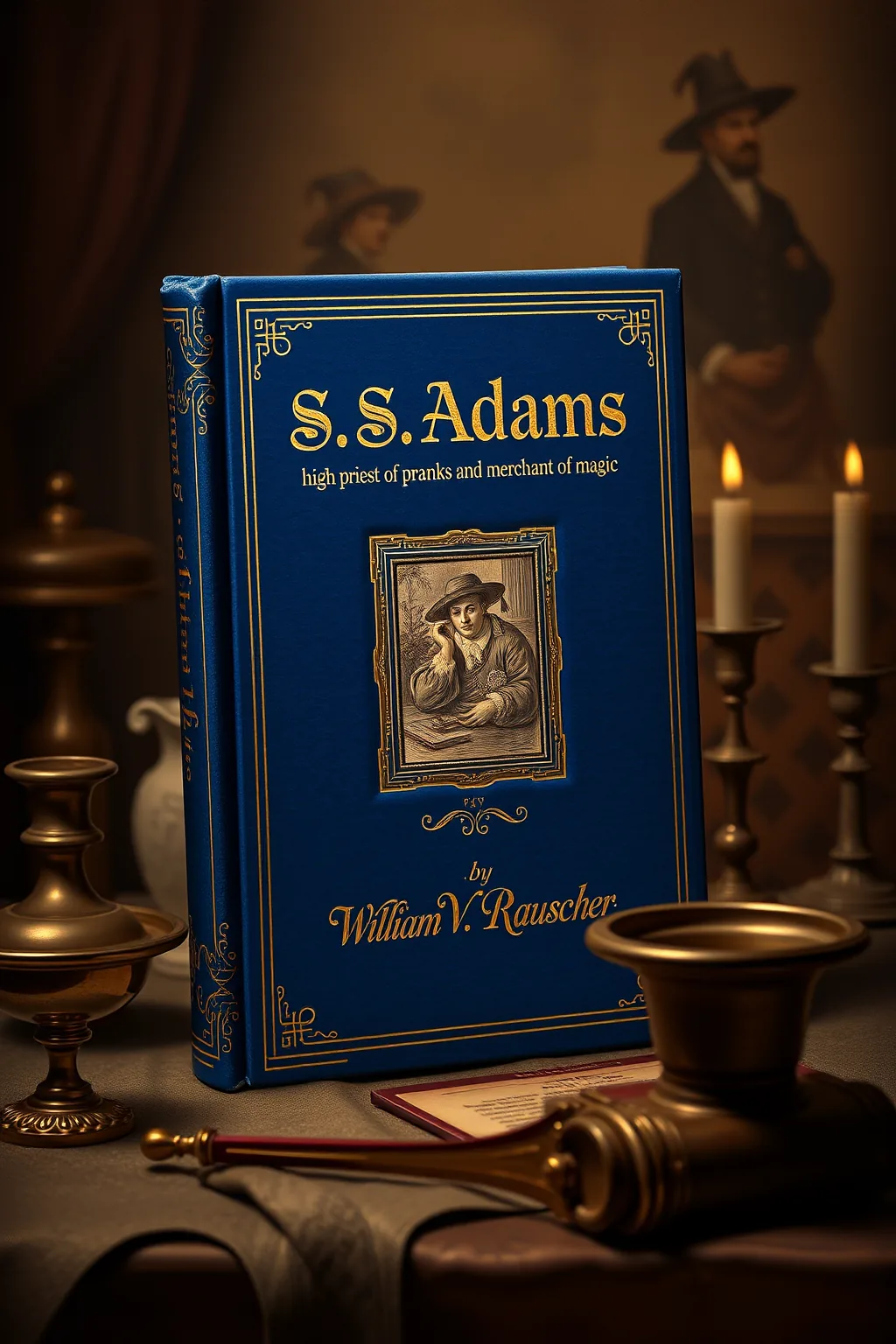
S.S. Adams, high priest of pranks and merchant of magic
 61
61

S.S. Adams, high priest of pranks and merchant of magic


William V. Rauscher's exploration of S.S. Adams is a masterful unveiling of a magician whose craft was steeped in more than just sleight of hand. Lorelei Sage, Contemplative Literature Editor, finds Rauscher's meticulous research breathes life into Adams' legacy, illuminating the esoteric currents that subtly informed his dazzling performances. This biography is a compelling testament to how illusion can serve as a profound vehicle for exploring metaphysical truths. It is essential reading for anyone fascinated by the deeper dimensions of magic, the psychology of belief, and the enduring allure of the performer as a conduit for wonder.
📝 Description
61
William V. Rauscher's biography examines S.S. Adams, a performer who integrated esoteric ideas into his illusions.
This book details the life of S.S. Adams, a popular magician and prankster active in the early 20th century. Rauscher moves beyond a simple recounting of Adams' career, investigating the deeper philosophical and esoteric elements that informed his stagecraft. Adams' work often played with perception and belief, suggesting a deliberate use of psychological manipulation and subtle ritualistic principles. The author argues that Adams, through his public performances, embodied the archetype of the magician, someone capable of influencing the perceived reality of his audience.
Readers will find an examination of how Adams applied concepts related to suggestion and the nature of belief to his performances. The book connects his public persona as a purveyor of magic and humor to a more private engagement with occult traditions. It is written for those interested in how performance art can intersect with psychological techniques and the pursuit of hidden knowledge. The biography aims to understand Adams not just as a showman, but as an individual who understood and utilized subtle forces in his craft.
S.S. Adams' career unfolded during a period of significant interest in spiritualism, theosophy, and various occult philosophies in the Western world. This book situates Adams' work within that broader cultural milieu. It suggests that his popular illusions and pranks were not merely entertainment but reflected an engagement with ideas circulating in esoteric circles concerning mental influence, symbolic representation, and the power of focused intent. The biography explores how these often-hidden currents of thought might have shaped his approach to magic and his understanding of human perception.
💡 Why Read This Book?
Uncover the hidden philosophical and spiritual dimensions behind the art of illusion. This book reveals S.S. Adams not just as a showman, but as a subtle alchemist of perception and belief. Ideal for seekers of esoteric wisdom, practitioners of ritual arts, and scholars of magical history who wish to understand the deeper currents that flow beneath the surface of performance.
⭐ Reader Reviews
Honest opinions from readers who have explored this book.
❓ Frequently Asked Questions
Who was S.S. Adams?
S.S. Adams was a renowned American magician and illusionist, celebrated for his innovative tricks and theatrical presentations that captivated audiences across the United States in the early 20th century.
What is the primary focus of this book?
The book delves into the life of S.S. Adams, emphasizing the philosophical and potentially esoteric influences that may have shaped his magical practice, moving beyond a simple biographical account.
Is this book for experienced magicians only?
No, while valuable for practitioners, the book is accessible to anyone interested in the history of magic, the psychology of illusion, and the intersection of art and esoteric thought.
What makes S.S. Adams' life particularly interesting from an esoteric perspective?
Adams' ability to masterfully manipulate perception and evoke wonder suggests an understanding of psychological and symbolic principles that resonate with deeper esoteric traditions, explored within these pages.
What kind of 'hidden knowledge' is alluded to in the book?
The 'hidden knowledge' refers to the conceptual frameworks, symbolic meanings, and psychological insights that Adams may have intuitively or consciously incorporated into his illusions, revealing the art of magic as a form of applied philosophy.
🔮 Key Themes & Symbolism
The Alchemist of Perception
This theme explores how S.S. Adams, through his illusions, acted as a modern-day alchemist, transforming mundane reality into moments of profound wonder and mystery. It examines his mastery of psychological manipulation, suggestion, and the art of misdirection, not as mere tricks, but as sophisticated tools for altering the audience's perception of what is possible. The text examines how his performances might have subtly alluded to deeper truths about the nature of reality, consciousness, and the power of belief, positioning him as a conduit for glimpsing the extraordinary within the ordinary.
Symbolism in Illusion
Here, the focus shifts to the rich symbolic language embedded within Adams' magical repertoire. Each illusion is analyzed not just for its mechanical ingenuity, but for its potential allegorical meanings and archetypal resonance. The book investigates how common objects, gestures, and narratives within his acts could have served as potent symbols, tapping into the collective unconscious and communicating profound ideas about transformation, hidden potentials, and the cyclical nature of existence. This theme invites readers to see magic as a symbolic dialogue with the universe.
The Performer as Oracle
This theme positions S.S. Adams as more than an entertainer; he is presented as a figure who, through his command of illusion, acted as a kind of oracle. By bending the perceived rules of reality, he offered glimpses into alternative possibilities and the hidden architectures of the cosmos. The exploration centers on how his public persona and private life might have reflected a deep engagement with esoteric principles, using the stage as a laboratory to test and demonstrate the subtle forces that govern human experience and the wider world. His 'merchant of magic' persona is re-examined through this lens of profound influence.
💬 Memorable Quotes
Direct passages from the work, attributed to the author.
“Belief is the strongest enchantment.”
— This highlights the psychological and esoteric principle that conviction, both on the part of the magician and the audience, is fundamental to the manifestation of magical effects.
“Every curtain hides a deeper truth.”
— This suggests that appearances are often deceptive, and true understanding lies beyond the surface, a recurring theme in esoteric traditions and Adams' own art.
“The stage is but a microcosm of the universe.”
— This profound statement implies that the principles governing illusions on stage are reflections of universal laws, connecting performance to cosmic order.
“He sold wonder, not just tricks.”
— This succinctly captures Adams' legacy as an experience creator, emphasizing the emotional and psychological impact of his magic over mere technical execution.
💡 Key Ideas
Editorial paraphrase of the work's core concepts — not direct quotes.
The greatest magic is to make the impossible seem commonplace.
This quote speaks to the core of Adams' genius: his ability to normalize extraordinary feats, suggesting a profound understanding of human perception and the power of framing reality.
🌙 Esoteric Significance
Tradition
While not overtly aligning with a single codified tradition, S.S. Adams' work and life exhibit profound resonance with Hermeticism and the principles of psychological magic. His mastery over perception and his ability to evoke wonder align with the Hermetic dictum 'As Above, So Below,' suggesting a connection between the microcosm of his illusions and the macrocosm of universal laws. The emphasis on belief, suggestion, and the power of the mind echoes esoteric teachings on willpower and the creation of reality through focused intent.
Symbolism
Adams' illusions were rich with symbolic potential, often drawing on archetypal imagery and the language of transformation. The act of making things appear and disappear can be seen as symbolic of death and rebirth, or the manifestation and dissolution of form. His use of props and gestures likely carried layered meanings, tapping into universal symbols of power, mystery, and the unseen forces that govern existence. The very act of illusion itself serves as a potent symbol for the veil between the ordinary and the extraordinary.
Modern Relevance
The insights into S.S. Adams' methods and the potential esoteric underpinnings of his magic remain highly relevant today. In an age saturated with digital manipulation and information overload, understanding the power of genuine illusion and its psychological impact is crucial. Adams' approach reminds us of the enduring human need for wonder, mystery, and the contemplation of deeper realities. His legacy encourages us to look beyond the surface and consider the subtle forces that shape our perceptions and beliefs, offering a timeless lesson in applied psychology and the art of profound engagement.
👥 Who Should Read This Book
This biography is a treasure for the curious mind. Beginners to esoteric literature will find it an accessible entry point, revealing how mystery can be woven into everyday life. Scholars of magic, performance history, and cultural studies will appreciate the meticulous research and nuanced analysis. Seekers of deeper meaning will be drawn to the philosophical explorations and the idea of magic as a pathway to understanding. Practitioners of magic and ritual arts will find inspiration in Adams' innovative approach to illusion and his subtle command of psychological and symbolic principles.
📜 Historical Context
The era of S.S. Adams, spanning the late 19th and early 20th centuries, was a fertile ground for both scientific advancement and burgeoning interest in the mystical and occult. This period witnessed the rise of spiritualism, theosophy, and a fascination with hidden knowledge, coexisting with rapid industrialization and technological innovation. Magicians like Adams operated within this complex cultural milieu, where the rational and the irrational often intertwined. Their illusions tapped into a public imagination captivated by the unknown, offering a sense of wonder and escape from the increasingly mechanized world. Rauscher situates Adams within this context, suggesting that his performances may have subtly resonated with the era's spiritual quests, offering a mix of entertainment and veiled esoteric commentary.
📔 Journal Prompts
Reflect on a time when your perception of reality was profoundly altered by an illusion or trick. What made it so impactful?
Consider the concept of 'belief as enchantment.' How does your own belief system shape your reality and experiences?
If you were a magician like S.S. Adams, what 'hidden knowledge' would you aim to reveal through your illusions?
Analyze a common object or everyday phenomenon. What symbolic or esoteric meanings could be ascribed to it?
How can the principles of illusion and misdirection be applied ethically to enhance understanding or promote positive change in society?
🗂️ Glossary
Hermeticism
A philosophical and religious tradition based on writings attributed to Hermes Trismegistus, emphasizing esoteric knowledge, the interconnectedness of all things, and the belief that understanding the universe leads to spiritual enlightenment.
Alchemy
An ancient practice that sought to transmute base metals into gold and discover a universal elixir for life, often interpreted metaphorically as a process of spiritual purification and transformation of the soul.
Archetype
A universal, inherited pattern of thought or imagery derived from the experiences of the human race, often appearing in myths, dreams, and art.
Esoteric
Intended for or likely to be understood by only a small number of people with a specialized knowledge or interest; dealing with hidden or secret matters.
Misdirection
A technique used in magic and performance to divert the audience's attention from the actual method of a trick, thereby enhancing the illusion of the impossible.
This book appears in 2 collections
🔮 Readers Also Liked
Browse all →


From the “Ceremonial Magic” Collection
View all →







More Free Magic & Ritual Books
View all →