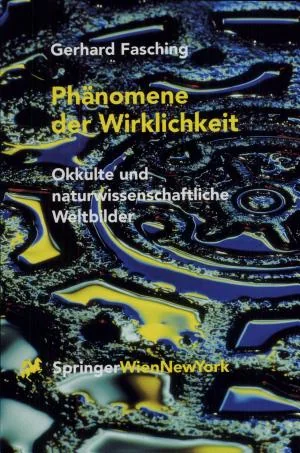
Phänomene der Wirklichkeit
 78
78

Phänomene der Wirklichkeit
Gerhard Fasching's 'Phänomene der Wirklichkeit' offers a rigorous deconstruction of our everyday assumptions about what constitutes reality. The early sections, particularly the analysis of "paradigmatic constructions" and the introduction of "reality pluralism," are compelling. Fasching’s methodical approach to dissecting how we arrive at our accepted versions of the world is particularly strong, moving beyond mere description to explore the active processes of "living realization." However, the transition into the "Color as Reality" section, while referencing Goethe, feels somewhat abrupt and less integrated than the initial philosophical scaffolding. The book's strength lies in its detailed examination of how subjective and collective frameworks shape our experience, but its dense prose can sometimes obscure the very phenomena it seeks to illuminate. It's a valuable, if demanding, text for those willing to scrutinize the foundations of their own perceived world.
📝 Description
78
Gerhard Fasching's 2000 book argues reality is not singular but plural.
Gerhard Fasching's 'Phänomene der Wirklichkeit,' published in 2000, examines how we construct, perceive, and experience reality. Fasching questions the idea of a single, objective reality. Instead, he proposes a model where multiple realities can exist and develop simultaneously. The book details the active processes through which these realities are 'lived,' emphasizing the rich diversity that arises from their interactions in everyday life.
This work is for those deeply interested in metaphysics, phenomenology, and occult philosophy. It challenges readers to reconsider their basic ideas about existence. The book will resonate with people who want to understand how personal experiences and shared beliefs shape different 'realities.' This includes perspectives often found in occult traditions or hidden teachings. Readers concerned about the potential problems of rigid or absolute worldviews will find substantial content here.
Emerging at the turn of the millennium, a time marked by increased global awareness and digital connection, 'Phänomene der Wirklichkeit' engages with philosophical traditions that question empirical positivism. Fasching's work connects to earlier studies of consciousness and perception, notably referencing Goethe's color theory. It speaks to a lineage of thought that explores subjective experience and the nature of being, including thinkers in phenomenology and hermeneutics who investigate how meaning is formed and understood.
💡 Why Read This Book?
• Gain a structured understanding of "reality pluralism," learning how multiple, distinct realities can be simultaneously perceived and enacted, challenging singular, objective viewpoints. • Explore the concept of "living realization" of realities, understanding the dynamic processes through which our worldviews are not static but actively constructed and maintained daily. • Analyze "dangerous absolutizations" by examining how rigidly held beliefs about reality can lead to limitations, contrasting them with the "fruitful diversity" that emerges from acknowledging multiple perspectives.
⭐ Reader Reviews
Honest opinions from readers who have explored this book.
❓ Frequently Asked Questions
What is the core philosophical stance of 'Phänomene der Wirklichkeit' regarding reality?
The book posits "reality pluralism," arguing against a single, objective reality. It suggests that multiple, distinct realities are constantly being constructed and experienced through individual and collective paradigms.
How does Gerhard Fasching address the emergence of different realities?
Fasching explores the "emergence of realities" through "paradigmatic constructions" and "living realization." He details how our beliefs, perceptions, and interactions actively shape and manifest these distinct realities in our lives.
What role does Goethe's color theory play in the book?
Goethe's "Color Theory" is presented as a specific case study within "Color as Reality," illustrating how perception and physiological responses contribute to the subjective experience and construction of reality.
What are "occult realities" according to Fasching's framework?
Within the context of "reality pluralism," "occult realities and other secret teachings" are discussed as distinct frameworks of understanding that operate parallel to conventional, empirical realities, distinct from "dangerous absolutizations."
When was 'Phänomene der Wirklichkeit' originally published?
The book was first published in the year 2000, marking its appearance at the turn of the millennium.
Does the book offer practical exercises for constructing reality?
While not a 'how-to' guide, the book provides a deep conceptual framework for understanding reality construction. The "living realization" and "fruitful diversity" concepts encourage readers to observe and reflect on their own perceptual frameworks.
🔮 Key Themes & Symbolism
Paradigmatic Constructions
This theme examines how our understanding of reality is not inherent but is actively built through "paradigmatic constructions." Fasching analyzes how societal norms, cultural beliefs, and individual frameworks create the very "reality" we perceive. The work critiques the assumption of a single, objective truth, instead proposing that our accepted worldviews are products of specific conceptual systems, leading to the idea of "reality pluralism."
Reality Pluralism
Central to Fasching's thesis is the concept of "reality pluralism," challenging the notion of a monolithic reality. The book explores how "simultaneous and sequential realities" can coexist, stemming from "paradigmatic constructions" and "living realization." It suggests that different belief systems, including "occult realities and other secret teachings," represent valid, albeit different, experiential frameworks, cautioning against the "dangerous absolutizations" that arise from rejecting these diverse perspectives.
Color as Reality
This section shifts focus to a sensory phenomenon to illustrate the construction of reality. By examining Goethe's "Color Theory," Fasching demonstrates how perception, physiology, and interpretation intertwine to create our experience of color. The discussion of "physiological colors," "colorless images," and "colored shadows" serves as a concrete example of how our interaction with the world is mediated by internal and external factors, contributing to the diverse "realities" we inhabit.
The Dangers of Absolutization
Fasching critically addresses "dangerous absolutizations," warning against the rigid adherence to a single worldview. He argues that enforcing one paradigm as the sole "reality" stifles "fruitful diversity" and limits understanding. By contrasting this with the "living realization" of "simultaneous and sequential realities," the book advocates for an open, pluralistic approach that acknowledges the validity of multiple perspectives, even those associated with "occult realities."
💬 Memorable Quotes
Direct passages from the work, attributed to the author.
“Our today's understanding of reality.”
— This phrase captures the starting point of Fasching's inquiry, suggesting that our current grasp of existence is a specific, perhaps limited, construction rather than an ultimate truth.
“Reality pluralism.”
— This core concept challenges monistic views of reality, proposing that multiple, distinct experiential frameworks can and do coexist, shaping our understanding of the world.
“Living realization of realities.”
— This highlights the dynamic, active process by which individuals and groups continuously manifest and experience their particular versions of reality through their beliefs and actions.
“Occult realities and other secret teachings.”
— Fasching includes these as examples of distinct reality frameworks, treating them not as fantasy but as alternative paradigms with their own internal logic and experiential validity within a pluralistic model.
“Dangerous absolutizations.”
— This serves as a warning against dogmatism, emphasizing the risks associated with rigidly adhering to one's own constructed reality and dismissing all others as invalid or false.
🌙 Esoteric Significance
Tradition
The work engages with broad philosophical traditions that underpin many esoteric systems, particularly phenomenology and Hermetic principles of correspondence. While not explicitly tied to a single lineage like Kabbalah or Theosophy, its exploration of "reality pluralism" and the construction of subjective worlds aligns with Gnostic ideas of varied perceptions of the divine and the material. It offers a philosophical framework for understanding how esoteric teachings might represent distinct, valid experiential realities.
Symbolism
The book utilizes "Color as Reality" as a symbolic exploration of perception. Goethe's color theory, with its emphasis on subjective experience and psychological impact, serves as a symbol for how even seemingly objective phenomena are filtered and constructed. "Occult realities" themselves function symbolically, representing the vast spectrum of human understanding beyond the empirically verifiable, hinting at hidden structures and correspondences.
Modern Relevance
Contemporary interest in consciousness studies, quantum physics interpretations, and the philosophy of mind often circles back to questions of observer-dependent reality. Fasching's concepts of "reality pluralism" and "living realization" are relevant to discussions in fields like transpersonal psychology, integral theory, and even certain branches of digital philosophy and simulation theory, offering a structured way to consider multiple valid worldviews.
👥 Who Should Read This Book
• Students of metaphysics and epistemology: Those seeking to deconstruct their understanding of "reality" and explore philosophical models beyond simple objectivism. • Practitioners of esoteric disciplines: Individuals interested in a rational framework for understanding the validity and distinct nature of "occult realities" and secret teachings. • Critical thinkers and philosophers of perception: Readers who want to examine the mechanisms of "paradigmatic constructions" and the potential for "dangerous absolutizations" in worldview formation.
📜 Historical Context
Published in 2000, 'Phänomene der Wirklichkeit' arrived at a cultural moment characterized by the rise of postmodern thought, which questioned grand narratives and objective truth. Gerhard Fasching's work engages with philosophical currents that challenge positivism and empiricism, echoing earlier explorations of consciousness and perception found in thinkers like Goethe, whose "Color Theory" is explicitly discussed. The book's exploration of "reality pluralism" and the construction of subjective worlds finds resonance with phenomenological and hermeneutic traditions. At the time, academic philosophy was often deeply divided between analytical and continental traditions, with esoteric subjects frequently relegated to the fringes. Fasching's text, by engaging with concepts like "occult realities," likely navigated a space between rigorous philosophical inquiry and the broader esoteric community, a dialogue that was not always welcomed by mainstream academia.
📔 Journal Prompts
The concept of "reality pluralism": how does acknowledging "simultaneous and sequential realities" alter your daily interactions?
"Living realization" of realities: identify one belief you hold and trace its active "manifestation" in your life.
"Dangerous absolutizations": reflect on a time you encountered a rigid worldview and how it contrasted with "fruitful diversity."
Goethe's "Color Theory": consider a specific color and analyze its "physiological colors" and subjective impact on your perception.
"Occult realities": how might these differ from your primary paradigm, and what does "dangerous absolutization" prevent you from seeing?
🗂️ Glossary
Paradigmatic Constructions
The underlying conceptual frameworks, beliefs, and assumptions that shape an individual's or group's understanding and experience of reality.
Reality Pluralism
The philosophical stance that multiple, distinct realities can exist simultaneously and be validly experienced, challenging the notion of a single objective truth.
Living Realization
The dynamic, ongoing process through which individuals and communities actively construct, maintain, and experience their particular versions of reality.
Fruitful Diversity
The positive outcome of acknowledging and embracing multiple perspectives and realities, leading to greater understanding and creative potential.
Simultaneous and Sequential Realities
Refers to the coexistence of different experiential frameworks at the same time, and how these frameworks unfold or are experienced over time.
Occult Realities
Distinct frameworks of understanding and experience associated with esoteric traditions, considered valid within a pluralistic model of reality.
Dangerous Absolutizations
The tendency to rigidly adhere to one's own constructed reality, dismissing all other perspectives as false or invalid, leading to dogmatism and conflict.
🔮 Readers Also Liked
Browse all →









More Free Occult Philosophy Books
View all →