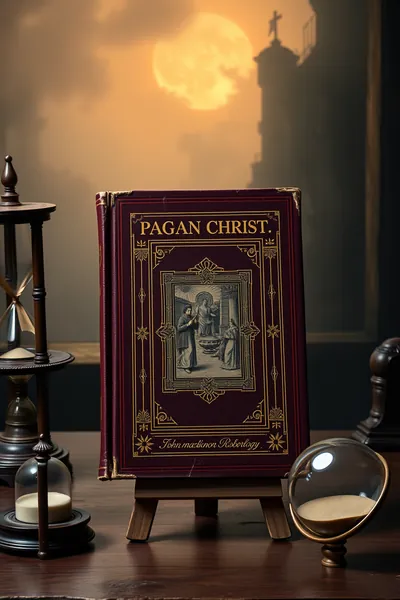
Paganism and Christianity

 80
80

Paganism and Christianity
Farrer's "Paganism and Christianity" offers a rigorous, if at times dense, exploration of the spiritual currents that shaped early Western religion. Its signal strength lies in its meticulous tracing of conceptual lineage, demonstrating how Christianity inherited and reinterpreted pagan motifs rather than merely supplanting them. A particular passage discussing the pre-Christian understanding of divine intermediation, for example, provides a compelling counterpoint to later orthodoxies. However, the book's academic prose can occasionally obscure its more compelling arguments, making it a challenging read for those not already steeped in the subject matter. Farrer presents a vital, scholarly examination of religious evolution.
📝 Description
80
James Anson Farrer's 1986 book argues Christianity absorbed and transmuted pagan elements.
Published in 1986, James Anson Farrer's "Paganism and Christianity" examines the historical overlap between ancient pagan beliefs and early Christianity. The book avoids presenting a simple conflict narrative. Instead, it details the continuities and transformations that occurred as these cultures and spiritualities merged. Farrer's work emerged during a period of renewed interest in pre-Christian European religions and Gnosticism. It acknowledges the complex syncretism and philosophical debates of the time, referencing figures like Celsus who critiqued early Christianity. Farrer contends that Christianity did not emerge in isolation but incorporated and reshaped elements from existing Hellenistic and Roman religious traditions. He investigates shared cosmologies, ethical frameworks, and ritual practices to show how the new faith adapted to its spiritual environment. The book analyzes concepts such as divinity, sacrifice, and salvation as they appeared in both pagan and Christian contexts.
Farrer's book engages with the esoteric tradition by reconsidering dominant narratives of religious history. It highlights how seemingly distinct spiritual systems share underlying patterns and influences, a common theme in esoteric scholarship. By focusing on syncretism and cultural absorption, the work aligns with esoteric approaches that see continuity and hidden connections between diverse religious expressions rather than absolute breaks. This perspective challenges conventional religious history and offers a view of spiritual evolution as a process of integration and adaptation.
💡 Why Read This Book?
• Understand the pre-Christian conceptual landscape, such as the Hellenistic understanding of divine mediation, that provided fertile ground for Christianity's emergence. • Grasp the specific ways early Christianity adopted and adapted existing pagan motifs, moving beyond simplistic narratives of conquest as detailed in Farrer's analysis. • Engage with the historical arguments concerning figures like Celsus, offering a critical perspective on the early dialogue between pagan philosophy and Christian doctrine.
⭐ Reader Reviews
Honest opinions from readers who have explored this book.
❓ Frequently Asked Questions
When was James Anson Farrer's Paganism and Christianity first published?
James Anson Farrer's "Paganism and Christianity" was first published in 1986, reflecting scholarly interests of the late 20th century in comparative religion and esoteric traditions.
Does the book argue Christianity replaced paganism?
No, Farrer's work explores the complex interaction and mutual influence, arguing that Christianity absorbed and transformed many elements from existing pagan beliefs and practices.
What historical figures are discussed in Paganism and Christianity?
The book engages with the intellectual climate surrounding early Christianity, referencing critics like Celsus and examining the broader philosophical dialogues of the Hellenistic and Roman periods.
What is the core argument about pagan and Christian similarities?
Farrer posits that Christianity did not emerge in a vacuum but inherited and reinterpreted shared cosmologies, ethical frameworks, and ritualistic practices from the pagan spiritual milieu.
Is this book suitable for beginners in religious studies?
While informative, the book's academic rigor and dense prose make it more appropriate for advanced students or those with a foundational understanding of religious history and esoteric studies.
What kind of spiritual traditions does Farrer's work engage with?
The book primarily engages with ancient Hellenistic, Roman, and early Christian traditions, focusing on the philosophical and religious continuities between them.
🔮 Key Themes & Symbolism
Syncretism and Transformation
This theme examines how Christianity, rather than being a wholly new phenomenon, integrated and reshaped elements from the diverse pagan religious field of the Greco-Roman world. Farrer details how concepts of divinity, salvation, and cosmology present in mystery cults and philosophical schools found new expression within Christian doctrine. The work highlights the dynamic process of cultural and spiritual exchange that characterized the period, illustrating how the new faith adapted to and was shaped by its environment.
The Pagan Philosophical Underpinnings
Farrer explores the philosophical currents of Hellenistic thought that informed both paganism and early Christianity. This includes an exploration of Platonic and Neoplatonic ideas concerning the divine, the soul, and the intermediary realms. The text scrutinizes how concepts like the Logos, divine intermediation, and ethical frameworks were debated and understood by thinkers like Celsus, providing context for Christian theological development.
Continuity in Ritual and Belief
The work identifies specific continuities in ritualistic practices and core beliefs that bridged pagan and Christian traditions. This might include shared symbolic language, ideas about sacrifice, initiation rites, or the veneration of divine figures. By highlighting these parallels, Farrer challenges simplistic notions of religious rupture, instead presenting a view of gradual evolution and adaptation in spiritual expression.
Critique and Dialogue
Central to Farrer's analysis is the intellectual dialogue and criticism that occurred between pagan thinkers and early Christians. The book examines critiques leveled by figures such as Celsus, who questioned the uniqueness and validity of Christian claims by comparing them to existing pagan traditions. This highlights the polemical and apologetic exchanges that helped define early Christian theology and self-understanding.
💬 Memorable Quotes
Direct passages from the work, attributed to the author.
“Christianity did not arise in a vacuum.”
— This core idea underscores Farrer's argument that the emergence of Christianity was deeply influenced by the existing religious and philosophical traditions of the Greco-Roman world, rather than being an entirely isolated event.
“The work explores the pagan understanding of divine intermediation.”
— This points to Farrer's examination of how concepts of mediators between the divine and human realms, prevalent in pagan thought, relate to similar ideas within early Christian theology and Christology.
“Shared cosmologies and ethical frameworks are evident.”
— This highlights Farrer's focus on identifying commonalities in worldview and moral principles between pagan traditions and nascent Christianity, suggesting a more complex relationship than simple opposition.
“Celsus critiqued early Christianity by referencing pagan precedents.”
— This refers to Farrer's engagement with the writings of Celsus, a key pagan critic, illustrating the intellectual debates and comparisons made between Christianity and older religious systems.
“The book dissects concepts like sacrifice and salvation.”
— This indicates Farrer's analytical approach to fundamental religious themes, tracing how notions of atonement, redemption, and divine favor were understood and reinterpreted across different traditions.
🌙 Esoteric Significance
Tradition
Farrer's work sits within the broader tradition of Western Esotericism's engagement with historical origins, particularly concerning the relationship between pagan antiquity and later monotheistic faiths. While not strictly a practitioner's text, it informs esoteric interpretations by providing scholarly grounding for ideas of cyclical religion, divine immanence, and the perennial philosophy, suggesting Christianity's roots are intertwined with older, nature-based spiritualities.
Symbolism
The work implicitly engages with symbols of divine mediation, common in Hellenistic traditions, such as intermediary beings or emanations from the divine source. It also touches upon the symbolism of sacrifice, exploring its varied meanings in pagan cults and its transformation within Christian eucharistic theology, highlighting the continuity of archetypal motifs.
Modern Relevance
Contemporary Neopagan movements and scholars of esoteric history often draw upon works like Farrer's to support arguments for the historical depth and continuity of pre-Christian spiritual practices. It provides a scholarly counterpoint to purely mythic or idealized views of paganism, offering a grounded perspective on its interaction with developing Christianity, relevant for modern comparative spirituality studies.
👥 Who Should Read This Book
• Students of comparative religion seeking to understand the historical dialogue between paganism and early Christianity, gaining insight into shared philosophical concepts. • Esoteric practitioners interested in the roots of Western spiritual traditions, exploring how ancient motifs were reinterpreted within the Christian framework. • Academic researchers in religious studies or classical history looking for a nuanced analysis of religious syncretism and intellectual exchange in the Roman Empire.
📜 Historical Context
Published in 1986, James Anson Farrer's "Paganism and Christianity" entered a scholarly landscape marked by extensive research into Hellenistic religions and the social history of early Christianity. Scholars like Ramsay MacMullen and Peter Brown were redefining understandings of religious change in the Roman Empire. Farrer's work engaged with this tradition, pushing back against simplistic narratives of pagan decline and Christian ascendancy. It acknowledged the complex syncretism and the intellectual challenges posed by pagan critics, notably Celsus, whose critiques were central to early Christian apologetics. Unlike works focused solely on theological development, Farrer's book emphasized the broader cultural and philosophical continuities, contributing to a more nuanced view of religious transmission in antiquity.
📔 Journal Prompts
The pagan understanding of divine intermediation, as explored by Farrer.
Continuities in ethical frameworks between paganism and early Christianity.
The specific critiques offered by Celsus regarding Christian claims.
The concept of sacrifice as it appears in both traditions.
How Christian cosmology adapted pre-existing pagan ideas.
🗂️ Glossary
Hellenistic
Pertaining to the period of Greek history and culture from the death of Alexander the Great (323 BCE) to the rise of the Roman Empire (around 31 BCE). Characterized by the spread of Greek language, culture, and ideas across a wide area.
Syncretism
The merging or attempted merging of different religions, cultures, or schools of thought. In this context, it refers to the blending of pagan and Christian beliefs and practices.
Cosmology
The study or theory of the origin and development of the universe. In religious contexts, it refers to a belief system's understanding of the structure, order, and nature of the cosmos.
Logos
A Greek term meaning 'word,' 'reason,' or 'plan.' In philosophy and theology, it has been used to refer to the divine reason or creative principle that orders the universe, notably in Stoicism and later in Christian theology (John 1:1).
Mystery Cults
Ancient religions, primarily in the Hellenistic and Roman periods, characterized by secret rites and initiations that promised a deeper spiritual experience or afterlife to adherents.
Apologetics
The branch of theology and literature concerned with the defense of the doctrines of the Christian faith, particularly in response to criticism or opposition.
Perennial Philosophy
The idea that all major religions and spiritual traditions throughout history share a common, underlying truth or wisdom, often attributed to a divine source.
🔮 Readers Also Liked
Browse all →








More Free Witchcraft & Paganism Books
View all →