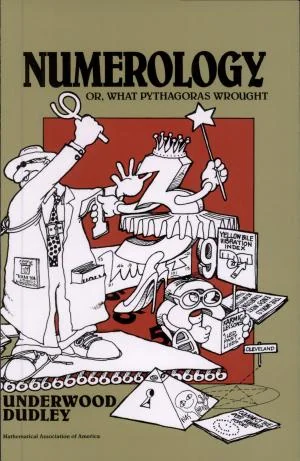
Numerology, Or, What Pythagoras Wrought
 76
76

Numerology, Or, What Pythagoras Wrought
Underwood Dudley approaches numerology not as a practice to be learned, but as a fascinating psychological and historical phenomenon to be dissected. His central thesis – that numbers hold power over minds, not events – is compellingly argued throughout the text. Dudley’s critical stance is evident early on, noting that numerology is a "delusion that numbers have power over events." He skillfully navigates the historical lineage, tracing its roots back to ancient thinkers like Pythagoras. A strength lies in his accessible prose, which demystifies complex historical arguments without resorting to jargon. However, the book’s relentless focus on debunking can, at times, feel overly dismissive of the genuine comfort or sense of order individuals derive from such systems. The chapter discussing the historical use of numerical symbolism in various cultures offers a particularly strong example of his analytical approach. Ultimately, *Numerology, Or, What Pythagoras Wrought* serves as a sharp, albeit dry, examination of a persistent human tendency.
📝 Description
76
Underwood Dudley's 2002 book, *Numerology, Or, What Pythagoras Wrought*, debunks the idea that numbers govern human lives.
Underwood Dudley’s *Numerology, Or, What Pythagoras Wrought* is not a guide to calculating birth numbers or predicting futures. Instead, it is a critical history of numerology, examining the belief that numbers hold power over human affairs. Dudley traces the roots of this belief back to ancient Greek philosophy, showing how numbers transitioned from mathematical concepts to perceived cosmic forces.
The book contrasts this historical development with modern, less historically informed interpretations of numerology. Dudley argues that while numbers themselves lack inherent power, they possess a significant psychological influence on the human mind. This perceived power is what drives numerological systems, leading people to find patterns and meaning where none objectively exist. He analyzes how this phenomenon has been historically perpetuated, whether through genuine belief or deliberate manipulation.
Dudley aims this work at readers interested in the history of ideas, particularly the convergence of mathematics, belief systems, and psychology. It is for those who enjoy examining popular notions and understanding the roots of collective conviction. No advanced math is required, only an interest in how humans perceive and interpret the world.
This book examines numerology, a tradition that assigns mystical or symbolic significance to numbers. Its roots are often traced to figures like Pythagoras, who saw numbers as fundamental principles of the universe. Dudley situates this practice within a long intellectual lineage, showing how the attribution of numerical power has persisted across cultures and eras. He contrasts this historical perspective with contemporary, often simplified, versions of numerology that lack a grounding in deeper philosophical or historical inquiry.
💡 Why Read This Book?
• Understand the historical evolution of numerological thought, tracing its lineage from Pythagorean philosophy to modern interpretations, a narrative not commonly found in practical numerology guides. • Grasp the psychological mechanism behind belief in numerology, recognizing how numbers influence human perception and decision-making, distinct from mere calculation. • Analyze the historical reception and intellectual critique of numerology, appreciating the scholarly engagement with this subject since its early philosophical roots.
⭐ Reader Reviews
Honest opinions from readers who have explored this book.
❓ Frequently Asked Questions
What is the primary argument of Underwood Dudley's "Numerology, Or, What Pythagoras Wrought"?
The book argues that numbers possess power over human minds, not over external events. Dudley presents numerology as a delusion rooted in psychological influence and historical tradition, rather than a factual system for predicting outcomes.
Does this book teach readers how to perform numerological calculations?
No, this book does not provide instructions on calculating personal numerology charts. Its focus is on the critical analysis of numerology as a belief system and its historical development, not on its practical application.
What historical figures or concepts are discussed in relation to numerology?
The work frequently references Pythagoras and Pythagoreanism, exploring how early philosophical ideas about numbers as cosmic principles contributed to later numerological beliefs.
Is prior knowledge of mathematics or philosophy required to read this book?
Underwood Dudley states that no mathematical knowledge beyond basic arithmetic is necessary. The book is intended for anyone interested in human psychology and the history of belief systems.
When was "Numerology, Or, What Pythagoras Wrought" first published?
The book was first published in 1997. This edition provides a historical perspective on numerology from a critical academic viewpoint.
What is the author's stance on the efficacy of numerology?
Dudley maintains a skeptical stance, classifying numerology as a delusion. He contends that any perceived power of numbers stems from their influence on human psychology, not from inherent properties affecting reality.
🔮 Key Themes & Symbolism
The Psychology of Belief
Dudley meticulously dissects how the human mind is susceptible to perceiving patterns and causal links where none objectively exist. The book explores the psychological allure of numerology, suggesting that its persistence stems from a deep-seated need for order, meaning, and control in a chaotic world. This theme examines the cognitive biases and heuristics that make individuals prone to accepting numerical correlations as evidence of deeper truths, irrespective of empirical verification.
Historical Roots of Numerical Mysticism
The work traces the lineage of numerological thinking back to ancient philosophical traditions, most notably Pythagoreanism. It highlights how early thinkers viewed numbers not merely as abstract quantities but as fundamental constituents of reality and divine principles. This section details the evolution of these ideas through various historical periods, showing how the attribution of mystical or predictive power to numbers became embedded in certain intellectual and spiritual currents.
Numbers as Symbols of Power
A core concept is the distinction between objective mathematical properties and subjective perceived power. Dudley argues that numbers exert a significant influence over human minds by acting as potent symbols. This symbolic power is then misinterpreted as an external force governing events. The book analyzes how societies and individuals have historically assigned significance and authority to numerical patterns, using them to interpret the world and make decisions.
Critique of Pseudoscientific Systems
Underwood Dudley positions numerology as a prime example of a pseudoscientific system that persists due to psychological rather than empirical validation. The book functions as a critical examination, scrutinizing the logical fallacies and historical distortions that underpin numerological claims. It encourages readers to apply critical thinking to systems that present themselves as having objective predictive power, especially when they lack rigorous methodology.
💬 Memorable Quotes
Direct passages from the work, attributed to the author.
“Numerology is about numerology, which is the delusion that numbers have power over events.”
— This direct statement sets the critical tone of the book, immediately framing numerology not as a valid system, but as a pervasive misconception about the influence of numerical relationships.
“The message of the book is that numbers indeed have power, but the power is not over events, it is over the human minds.”
— This clarifies Dudley's central argument: the influence of numbers is psychological. It suggests that the perceived effects of numerology are due to how humans interpret and react to numbers, rather than any inherent causal force.
“Pythagoras believed that number was the essence of all things.”
— This historical anchor points to the ancient philosophical origins of numerical mysticism, showing how early metaphysical ideas about numbers laid the groundwork for later, more elaborate numerological systems.
“The power of numbers is not over events, but over the human mind.”
— This concise reiteration of the core thesis emphasizes the psychological dimension of numerology. It suggests that understanding this distinction is key to critically evaluating claims of numerical influence.
💡 Key Ideas
Editorial paraphrase of the work's core concepts — not direct quotes.
It is intended for anyone interested in human folly and requires no mathematical knowledge beyond arithmetic to understand.
This quote highlights the book's accessibility and its focus on the psychological aspects of belief. It positions the work as an exploration of human irrationality, making it approachable for a broad audience.
🌙 Esoteric Significance
Tradition
While not aligning with a specific esoteric lineage like Hermeticism or Kabbalah, Dudley's work engages with the historical roots of numerology that are often interwoven with these traditions. It examines how Pythagorean concepts, which influenced Neoplatonism and subsequently various Western esoteric schools, were later adapted into modern numerological practices. The book functions as an external critique of the application and interpretation of numerical symbolism within esoteric contexts, focusing on its psychological impact rather than its spiritual efficacy.
Symbolism
The primary symbol explored is the number itself, which Dudley deconstructs from a mystical principle to a psychological tool. He examines how numbers, from the primal unity of '1' to the completion of '9' or the spiritual potential of '0', are imbued with meaning far beyond their mathematical value. The book also touches upon the symbolic significance of numerical patterns and cycles, showing how their perceived regularity is interpreted as evidence of cosmic order, a common motif in esoteric systems.
Modern Relevance
Dudley's analysis remains relevant for contemporary discussions surrounding misinformation and the appeal of deterministic systems. Thinkers and practitioners interested in the psychology of belief, critical thinking, and the history of pseudoscientific ideas find value in his work. It informs discussions in fields ranging from cognitive psychology to the sociology of belief, providing a historical and analytical framework for understanding why numerical systems continue to exert influence in the digital age.
👥 Who Should Read This Book
• Skeptical readers interested in the historical and psychological roots of numerology, seeking to understand its appeal without engaging in its practice. • Students of intellectual history or the history of science and pseudoscience, wanting to analyze how numerical beliefs evolved from ancient philosophy to modern interpretations. • Individuals curious about the mechanisms of human belief and delusion, who enjoy dissecting popular phenomena from a critical, analytical perspective.
📜 Historical Context
Published in 1997, Underwood Dudley’s *Numerology, Or, What Pythagoras Wrought* emerged during a period of renewed public interest in New Age spirituality and occult practices, often disseminated through popular media. The book stands in contrast to the burgeoning self-help and popular numerology market of the late 20th century, offering a scholarly, critical perspective. Its intellectual lineage can be traced to philosophical traditions that questioned the validity of pseudoscientific claims, a lineage that includes earlier critiques of occultism and mysticism. While not a direct engagement, Dudley’s work implicitly critiques the uncritical acceptance of systems like astrology and numerology that gained traction in the latter half of the century, much like the skepticism leveled against such practices by figures in the Enlightenment. The book offers a historical counterpoint to the widespread embrace of esoteric beliefs, grounding its analysis in the historical development of numerical symbolism and the psychology of belief.
📔 Journal Prompts
Pythagoreanism's conception of number as essence, and its divergence from modern numerology.
The psychological power numbers wield over human minds versus their power over events.
Historical instances where numerical patterns were interpreted as omens or divine messages.
The enduring appeal of numerology despite its lack of empirical validation.
The author's distinction between arithmetic and the perceived mystical power of numbers.
🗂️ Glossary
Pythagoreanism
An ancient Greek philosophical and religious movement founded by Pythagoras of Samos. It is characterized by the belief that numbers are the fundamental principle of all things, influencing music, astronomy, and cosmology.
Numerology
A belief system that attributes mystical or predictive significance to numbers, often derived from a person's name or birth date, and claims these numbers influence events or personal characteristics.
Arithmetic
The branch of mathematics dealing with the properties and manipulation of numbers, particularly the basic operations of addition, subtraction, multiplication, and division.
Delusion
A fixed, false belief that is resistant to reason or confrontation with actual fact. Dudley applies this term to the core tenets of numerology.
Symbolism
The use of symbols to represent ideas or qualities. In the context of numerology, numbers are treated as symbols with profound meanings beyond their quantitative value.
Human Folly
A term used by Dudley to describe irrational or misguided human behavior and belief systems, particularly those lacking logical or empirical foundation, such as numerology.
Causality
The relationship between cause and effect. Dudley's work questions the perceived causality between numbers and external events in numerology.
This book appears in 1 collection
🔮 Readers Also Liked
Browse all →









From the “Numerology” Collection
View all →








More Free Occult Philosophy Books
View all →