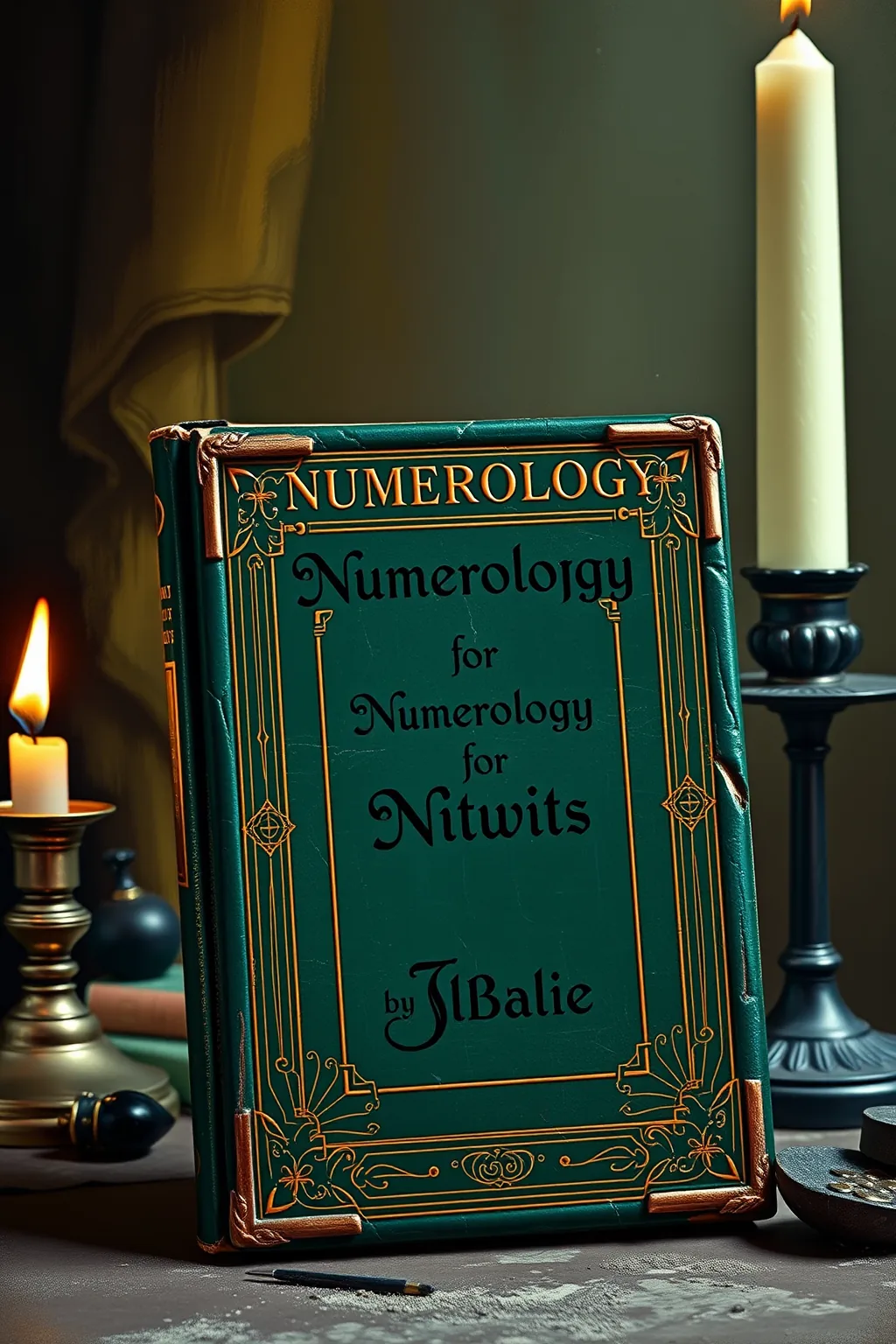
Numerology for Nitwits
 83
83

Numerology for Nitwits
Jil Balie's "Numerology for Nitwits" tackles the often-convoluted world of numerology with a refreshing directness. The author’s stated goal of simplifying a subject she found obscured by too much academic noise is largely achieved. Her comparison of the Fadic system against others, validated over years of personal study, lends a grounded authority to her conclusions. The strength here is Balie's commitment to clarity, avoiding the pseudoscientific embellishments that plague lesser works. However, the book’s primary limitation lies in its brevity; while it offers a good starting point, readers seeking deeper theoretical exploration or advanced applications might find it wanting. A particularly effective section is the straightforward explanation of how to calculate the Life Path number, stripped of unnecessary astrological or occult jargon. "Numerology for Nitwits" succeeds as an unpretentious introduction to a complex symbolic system.
📝 Description
83
Jil Balie published Numerology for Nitwits in December 2000 to simplify numerology's core principles.
Author Jil Balie wrote Numerology for Nitwits to clarify numerology's basic tenets. She noted a general lack of clear explanations on the subject and synthesized information from many sources. Her aim was to present these foundational elements in a clear and easy way. The book specifically contrasts the Fadic system with other common numerological methods. Balie spent years comparing names and birth dates, testing different systems to confirm the Fadic method's reliability. This empirical testing supports her presentation.
The author suggests that understanding reincarnation can help, but it is not required to grasp the main ideas of numerology. The book is designed for a general audience, making complex topics accessible by removing specialized language. The primary aim is to help readers understand the meaning of their personal numbers. By deciphering messages within birth dates and names, individuals can learn about their life path, challenges, and potential.
This book fits within the Western esoteric tradition of numerology, which views numbers as symbolic keys to understanding the universe and human experience. It draws on systems that assign meaning to digits derived from names and birth dates. While not explicitly referencing Kabbalah or Pythagorean traditions, its focus on numerical correspondences aligns with these broader currents of thought. The mention of reincarnation places it within a spiritual framework that often accompanies such divinatory practices.
💡 Why Read This Book?
• You will learn the specific method for calculating your Life Path number using the Fadic system, a core concept Balie meticulously tested. • You will gain an understanding of how Jil Balie compared the Fadic system to other numerological methods over several years, offering a unique perspective on system validation. • You will discover how to interpret the basic meanings of your personal numbers without needing prior knowledge of reincarnation, as Balie emphasizes accessibility.
⭐ Reader Reviews
Honest opinions from readers who have explored this book.
❓ Frequently Asked Questions
What is the Fadic system mentioned in Numerology for Nitwits?
The Fadic system is a numerological method highlighted in "Numerology for Nitwits." Jil Balie found it to be the most accurate after years of comparing name and birthday calculations with other systems.
Does Numerology for Nitwits require belief in reincarnation?
No, "Numerology for Nitwits" states that while belief in reincarnation can help, it is not a requirement to understand the basic principles of numerology as presented in the book.
When was Numerology for Nitwits first published?
Numerology for Nitwits by Jil Balie was first published in December 2000, aiming to offer a clearer introduction to numerology.
How does Jil Balie approach explaining numerology?
Jil Balie explains numerology by simplifying its basics, drawing on her study of hundreds of books and years of personal validation of the Fadic system.
What is the main goal of Numerology for Nitwits?
The main goal is to provide a simple, easy-to-understand explanation of numerology, clarifying common confusions and making the subject accessible to beginners.
What is the historical context of the Fadic system discussed in the book?
The Fadic system is described as an ancient method. Jil Balie's research in 2000 compared it to other systems, finding it consistently accurate for personal number analysis.
🔮 Key Themes & Symbolism
Number System Clarity
Balie's core contribution in "Numerology for Nitwits" is her attempt to distill the often-confusing field of numerology into understandable principles. She contrasts various systems, ultimately championing the Fadic method as described in the book. Her approach prioritizes practical application over dense theoretical frameworks, making the information digestible for individuals new to esoteric studies. The emphasis is on explaining the numbers that appear in names and birth dates, presenting them as tools for self-understanding rather than arcane mysteries.
Empirical Validation
A significant aspect of Balie's work is her stated commitment to empirical validation. Before presenting the Fadic system as superior, she reportedly spent years cross-referencing names and birthdays with outcomes. This methodical approach, though personal, lends a unique credibility to her conclusions within the book. It suggests a desire to move beyond mere assertion, grounding numerological interpretation in observed correlations, which is a rare feature in introductory texts on the subject.
Personalized Insight
The ultimate aim of "Numerology for Nitwits" is to equip readers with the knowledge to uncover personal insights through their numbers. Balie posits that birth dates and names are not arbitrary but contain encoded information about an individual's life path, challenges, and potential. The book serves as a practical manual for decoding these personal numerical signatures, fostering self-awareness and a deeper connection to one's inherent characteristics and destiny.
💬 Memorable Quotes
Direct passages from the work, attributed to the author.
“After finding more confusion than clarification in hundreds of books, she has tried to set down the basics in a simple, easy-to-understand manner.”
— This accurately reflects the author's motivation and the book's primary objective: to cut through the complexity that often surrounds numerology and offer a clear, foundational understanding.
“Comparing the ancient Fadic system with other numerology systems, she checked names and birthdays for several years before concluding the Fadic system was the most accurate.”
— This highlights Balie's methodical approach. Her dedication to empirical testing over a significant period, rather than simply relaying information, is presented as the basis for her endorsement of the Fadic system.
“Our numbers tell”
— This brief, declarative statement serves as a powerful hook, implying that numbers hold significant, personal information waiting to be revealed through the methods described in the book.
“The author has studied hundreds of books on the subject”
— This emphasizes the author's deep immersion and extensive research into numerology, suggesting that her distillation of the subject matter is well-informed and comprehensive.
💡 Key Ideas
Editorial paraphrase of the work's core concepts — not direct quotes.
You don't have to accept reincarnation to understand numerology, but it helps.
This quote addresses a common philosophical hurdle for newcomers to esoteric subjects. Balie makes it clear that the practical application of numerology, as she presents it, is accessible regardless of one's metaphysical beliefs.
🌙 Esoteric Significance
Tradition
While not explicitly aligning with a specific historical esoteric lineage like Kabbalah or Hermeticism, "Numerology for Nitwits" draws from the broader Western esoteric tradition that views numbers as fundamental organizing principles of the cosmos. Its focus on practical, personal application aligns with the modern New Age movement's emphasis on self-discovery and empowerment through symbolic systems, departing from more rigidly defined traditional practices.
Symbolism
The primary symbolism in the book revolves around the numbers themselves (1-9, and Master Numbers), each representing distinct energies, personality traits, and life lessons. The 'Life Path number,' derived from one's birth date, is a central symbolic motif, representing the core journey and challenges an individual is destined to encounter.
Modern Relevance
This work finds relevance today within the digital range of self-help and personal growth content. Its clear, no-nonsense approach appeals to a generation seeking practical tools for self-understanding, resonating with online communities focused on mindfulness, personal development, and accessible esoteric knowledge.
👥 Who Should Read This Book
['• Individuals new to numerology seeking a straightforward introduction without overwhelming jargon or complex theory.', '• Readers interested in practical self-assessment tools who want to understand the basic calculations and meanings of their personal numbers.', '• Those who have encountered other numerology systems but found them confusing and are looking for a more accessible explanation, particularly of the Fadic system.']
📜 Historical Context
Published in December 2000, "Numerology for Nitwits" emerged at a time when interest in esoteric subjects was experiencing a resurgence, partly fueled by the burgeoning internet providing access to diverse spiritual and occult information. The late 20th and early 21st centuries saw a proliferation of self-help and New Age literature, where numerology often featured as a tool for personal development. Balie's work positioned itself against a backdrop of existing numerological texts, some of which relied heavily on complex astrological associations or less transparent calculation methods. While not directly engaging with major academic debates, Balie's approach implicitly addressed a perceived need for clarity that authors like Dane Rudhyar, a significant figure in modern psychological astrology and numerology, had also explored, albeit with a more psychologically oriented lens. Balie's specific focus on the Fadic system and her empirical validation process offered a distinct, practical alternative to more esoteric or theoretical treatments popular at the time.
📔 Journal Prompts
Your calculated Life Path number and its primary characteristics.
The comparison of the Fadic system to other numerology systems as described by Balie.
Personal reflections on the accuracy of your core numbers as presented in the book.
The meaning of the number 9 in the Fadic system.
How understanding your numbers might influence daily decisions.
🗂️ Glossary
Fadic System
A specific method of numerological calculation, favored by the author for its perceived accuracy in determining personal characteristics and life paths based on name and birth date.
Life Path Number
The primary number calculated from a person's birth date, believed to represent their main life journey, challenges, and opportunities.
Personal Numbers
The numerical values derived from an individual's full birth name and birth date, each offering insights into different facets of their personality and destiny.
Core Numbers
Refers to the most significant numerological calculations for an individual, typically including the Life Path number, Expression number, and Soul Urge number.
Esoteric
Relating to or concerned with the occult or mystical; intended for or understood by only a small number of people with a specialized knowledge or interest.
Numerology
The study of the mystical relationship between numbers and events or the supposed influence of numbers on human life.
Reincarnation
The rebirth of a soul in a new body; a concept that the author notes can aid understanding but is not essential for learning numerology.