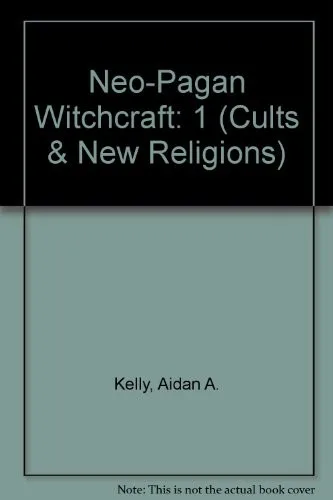
Neo-Pagan Witchcraft I (Cults and New Religions)
 71
71

Neo-Pagan Witchcraft I (Cults and New Religions)
Aidan A. Kelly's Neo-Pagan Witchcraft I presents a sober, early attempt to map the diverse landscape of late 20th-century Neo-Paganism. Unlike later, more celebratory works, Kelly’s approach is analytical, focusing on categorization and sociological observation. His strength lies in situating these movements within the broader academic discourse on new religious phenomena, treating them as subjects for study rather than mere curiosities. However, the book’s primary limitation is its age; the field has evolved considerably since 1990, with many of the "new" religions discussed now having established histories and broader cultural penetration. A particularly insightful section examines the self-definition of these groups, highlighting the tension between external labels like "cult" and internal identities. Kelly’s work remains valuable as a historical document of early academic engagement with Neo-Paganism, offering a baseline for understanding subsequent developments.
📝 Description
71
Aidan A. Kelly's 1990 book examined Neo-Pagan movements as new religions.
Published in 1990, Aidan A. Kelly's Neo-Pagan Witchcraft I (Cults and New Religions) offers an early academic look at the developing Neo-Pagan movements of the late 20th century. The book categorizes and analyzes various groups that emerged during a period of spiritual change, moving away from mainstream religious paths. Kelly's aim was to understand these new religious expressions with an analytical approach, avoiding sensationalism to present a more balanced view of their structure, beliefs, and practices. The work is suited for academics and serious students of modern spirituality and alternative religious traditions. It addresses the social, cultural, and philosophical forces that influenced these movements' beginnings and growth.
At the time of its release, Neo-Paganism was becoming more visible, transitioning from smaller circles into wider public awareness. The late 20th century saw increased interest in nature-based spirituality, Wicca, and witchcraft, partly as a response to what some saw as spiritual emptiness in established religions and the societal shifts of the 1960s and 70s. Kelly's research joined that of other scholars like Margot Adler and J. Gordon Melton, who were also documenting and studying these emerging communities. This book captures a moment when the academic study of these spiritual paths was still in its early stages.
This book falls within the academic study of modern paganism and new religious movements. It approaches the subject from a sociological and historical perspective, attempting to define and classify phenomena that were rapidly changing and gaining attention in the late 20th century. Kelly's work situates these spiritual expressions within broader trends of religious divergence and the search for alternative belief systems, distinct from historical occult traditions but part of the larger modern spiritual marketplace.
💡 Why Read This Book?
• Gain insight into the academic categorization of early Neo-Pagan movements, understanding the sociological frameworks used by scholars like Kelly in 1990 to analyze "cults" and "new religions." • Grasp the specific historical context of Neo-Paganism’s emergence into public discourse during the late 20th century, moving beyond anecdotal accounts to a structured analysis. • Understand the foundational debates and definitions surrounding early Neo-Pagan identities, as explored in the text’s examination of how practitioners constructed belief systems and communal structures.
⭐ Reader Reviews
Honest opinions from readers who have explored this book.
❓ Frequently Asked Questions
What is the primary focus of Aidan A. Kelly's Neo-Pagan Witchcraft I?
The book primarily focuses on the academic study and categorization of Neo-Pagan movements and other new religious phenomena that emerged in the late 20th century, examining their beliefs, practices, and social structures.
When was Neo-Pagan Witchcraft I first published?
Neo-Pagan Witchcraft I was first published in 1990, providing an early academic perspective on the development of these spiritual traditions.
Who are some contemporary scholars mentioned in relation to this work?
The book's context places it alongside the work of scholars like Margot Adler and J. Gordon Melton, who were also documenting and analyzing emergent spiritual communities during the same period.
What kind of reader would benefit most from this book?
Scholars of religion, historians of modern spirituality, and students seriously interested in the academic analysis of Neo-Paganism and new religious movements will find this book beneficial.
Does the book provide practical instructions for Neo-Pagan practices?
No, Neo-Pagan Witchcraft I is an academic and sociological examination of the movements, not a practical guide to performing rituals or engaging in witchcraft.
How does this book differ from later works on Neo-Paganism?
Published in 1990, it offers an early, foundational analysis. Subsequent decades have seen significant evolution in Neo-Paganism and its academic study, making Kelly's work a historical snapshot rather than a current overview.
🔮 Key Themes & Symbolism
Defining New Religious Movements
Kelly’s work grapples with the contentious labels of "cult" and "new religion," analyzing how these terms were applied to emergent Neo-Pagan groups in the late 20th century. The text explores the criteria used for classification, often highlighting the sociological and political factors influencing these definitions. It examines the internal self-perception of practitioners versus external societal perceptions, a crucial element in understanding the early discourse surrounding these spiritual paths and their place in the broader religious landscape.
Structure and Practice of Early Neo-Paganism
This volume investigates the organizational frameworks and ritualistic expressions of various Neo-Pagan traditions as they existed around 1990. Kelly details how groups developed distinct cosmologies, ethical systems, and communal practices, often drawing from reconstructed or invented traditions. The focus is on the functional aspects of these religions—how they provided meaning, community, and spiritual fulfillment for their adherents in a period of significant societal change and spiritual seeking.
Sociological and Historical Context
Neo-Pagan Witchcraft I places these movements within their specific socio-historical milieu. It considers the factors that contributed to their rise, such as counter-cultural influences, a desire for alternative spiritualities, and a renewed interest in pre-Christian European traditions. By situating these groups academically, the book offers a critical lens through which to understand their development and reception, distinguishing it from devotional or purely historical accounts.
Identity Formation in Alternative Religions
A significant theme is the process by which individuals and groups forged new religious identities. Kelly examines how Neo-Paganism offered alternatives to dominant religious paradigms, allowing adherents to construct personal and collective spiritualities often centered on nature, polytheism, or magical practices. The book explores the challenges and opportunities faced by these groups in establishing their identities and gaining recognition in a predominantly secular or monotheistic society.
💬 Memorable Quotes
Direct passages from the work, attributed to the author.
“The categorization of these movements often reflects societal anxieties more than their internal realities.”
— This interpretation highlights Kelly's critical stance on how external labels like 'cult' were applied, suggesting that such classifications often reveal more about the prejudices or fears of the classifiers than the actual nature or beliefs of the groups being labeled.
“Practitioners actively constructed their mythologies and cosmologies, drawing from diverse historical and cultural sources.”
— This interpretation emphasizes the creative and syncretic nature of Neo-Pagan belief systems. It suggests that these traditions are not simply revivals of ancient practices but are often modern constructions, consciously assembled from various elements to form coherent spiritual narratives.
“Academic analysis must distinguish between the sociological phenomenon and the subjective spiritual experience.”
— This interpretation reflects Kelly's methodological approach. It advocates for a dual perspective in studying religion: understanding the external social and historical forces shaping a movement, while also acknowledging and respecting the internal, lived spiritual experiences of its adherents.
💡 Key Ideas
Editorial paraphrase of the work's core concepts — not direct quotes.
Early Neo-Paganism sought to rebuild spiritual connections often severed by industrialization and secularization.
This paraphrased concept points to the core impulse behind many Neo-Pagan revival movements: a desire to re-establish a perceived lost connection with nature, the divine feminine, or ancient traditions that were seen as suppressed or forgotten by modern Western society.
The social structure of many new religious groups prioritizes decentralized authority and experiential learning.
This paraphrased concept underscores a common organizational principle observed in emerging spiritual communities. It suggests a move away from hierarchical, dogmatic structures towards more egalitarian models that emphasize individual spiritual experience and communal consensus.
🌙 Esoteric Significance
Tradition
While not strictly adhering to a single lineage like Hermeticism or Gnosticism, Neo-Pagan Witchcraft I is situated within the broader field of the academic study of Western Esotericism and New Religious Movements. It examines phenomena that often draw upon pre-Christian European mythologies and magical traditions, seeking to understand their modern manifestations. The work's contribution lies in its rigorous, scholarly approach to a subject often relegated to folklore or sensationalism, providing a critical framework for understanding spiritual paths that depart from Abrahamic traditions.
Symbolism
The book implicitly analyzes the symbolic language and cosmologies developed by various Neo-Pagan groups. While not focusing on specific symbols in great detail, it discusses how practitioners construct meaning through their engagement with nature-based cycles, reconstructed deities (such as the Horned God or Triple Goddess), and ritual actions that evoke ancient or archetypal patterns. These elements serve to create a sense of continuity with the past and a connection to the immanent divine in the natural world.
Modern Relevance
Kelly's foundational work continues to be relevant for contemporary scholars and practitioners of Neo-Paganism. It provides essential context for understanding the historical development and early academic reception of movements like Wicca, Asatru, and various forms of modern witchcraft. Thinkers and groups today that engage with the sociology of religion, the history of esotericism, or the evolution of alternative spiritualities can use this book as a benchmark for tracing the trajectory of Neo-Paganism from its formative years to its current diverse expressions.
👥 Who Should Read This Book
• Academic researchers of religion and sociology who need to understand the early academic discourse surrounding "cults" and "new religions" in the late 20th century. • Students of Neo-Paganism seeking a foundational text that provides historical and sociological context for the movements' emergence and early organization. • Comparative religion scholars interested in how spiritual identities and belief systems are constructed outside of mainstream religious frameworks during periods of social change.
📜 Historical Context
Published in 1990, Aidan A. Kelly's Neo-Pagan Witchcraft I emerged during a central moment for new religious movements. The late 20th century saw a significant increase in public awareness and academic interest in groups diverging from traditional Western religions. This era was marked by the continued impact of the counterculture of the 1960s and 70s, which fostered experimentation in spirituality and a rejection of established norms. Kelly's work engaged with a burgeoning academic field, contributing to discussions alongside scholars like Margot Adler, whose "Drawing Down the Moon" (1979) was already a key text in popularizing and documenting these movements. While groups like Wicca were gaining visibility, they were often still being critically examined through the lens of "cult" studies, a perspective Kelly sought to refine with a more nuanced sociological approach. The reception of such works was often mixed, with some scholars praising their analytical rigor while others debated the very definitions and classifications being employed. This book represents an early, structured attempt to understand these evolving spiritual landscapes before they became more widely integrated into mainstream discourse.
📔 Journal Prompts
The construction of Neo-Pagan mythologies: analyze the diverse sources Kelly identifies.
Societal anxieties surrounding "cults" in the late 20th century, as explored by Kelly.
How did early Neo-Pagan groups establish their distinct spiritual identities?
Reflect on the tension between external labels and internal self-definition in religious movements.
Compare the organizational structures of early Neo-Pagan groups with contemporary spiritual communities.
🗂️ Glossary
Neo-Paganism
A modern religious movement characterized by a revival of, or inspiration drawn from, pre-Christian European pagan or polytheistic beliefs and practices, often with an emphasis on nature worship and ecological awareness.
New Religious Movement (NRM)
A religious or spiritual group that has emerged relatively recently, often presenting beliefs and practices distinct from established religions. The term is generally preferred over 'cult' in academic contexts.
Cult
A term historically used to describe a religious or social group with deviant beliefs and practices. In academic study, it is often considered pejorative and replaced by NRM, though Kelly analyzes its usage.
Cosmology
The understanding of the origin, evolution, and structure of the universe, often including the nature of deities, humanity's place within it, and the relationship between the physical and spiritual realms.
Syncretism
The blending of beliefs and practices from different religious or philosophical systems, resulting in new or hybrid forms of religious expression.
Counterculture
A culture whose values and norms of behavior differ substantially from those of mainstream society, often in opposition to conventional social norms.
Esotericism
Belief systems, spiritual traditions, or practices that are concerned with the 'inner' nature of reality and the human being, often involving hidden knowledge or mystical insights accessible only to initiates.
🔮 Readers Also Liked
Browse all →






More by Aidan A. Kelly
All books →
More Free Witchcraft & Paganism Books
View all →