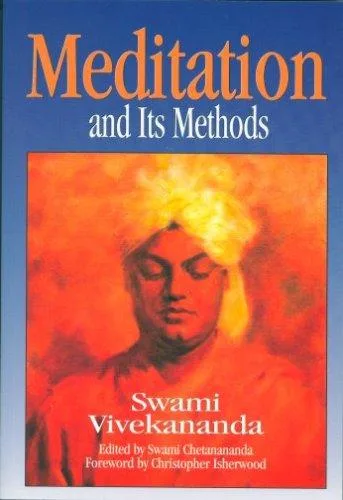
Meditation and its methods according to Swami Vivekananda
 83
83

Meditation and its methods according to Swami Vivekananda
Swami Chetanananda's compilation offers a focused distillation of Swami Vivekananda's profound discourse on meditation. The strength lies in its direct lineage, presenting Vivekananda's thought with minimal interpolation. However, the lack of explicit chapter citations for certain passages can leave the reader wishing for direct access to the original lecture sources. A particularly illuminating section discusses the subtle energy centers, *chakras*, and their role in higher meditative states, a concept Vivekananda explored extensively. While Chetanananda's work provides a solid framework, it sometimes feels like a secondary interpretation rather than an unadulterated primary source. It serves as an accessible entry point to Vivekananda's complex meditative philosophy.
📝 Description
83
Swami Chetanananda compiled Swami Vivekananda's teachings on meditation methods in 1976.
This volume gathers Swami Vivekananda's insights into meditation and its various techniques, as compiled by Swami Chetanananda. It draws directly from Vivekananda's lectures and writings, forming a guide to his approach to yogic practices. The book aims to explain the theoretical basis and practical use of meditation within the Advaita Vedanta tradition.
It is suited for serious students of yoga and Vedanta who want to apply philosophical ideas. The work appeals to those who see meditation as more than just relaxation; they seek it as a systematic path to self-understanding and spiritual development. Readers familiar with Vivekananda's philosophy will find this a useful resource for deepening their practice.
The book's central theme is *Dhyana*, or meditation, understood as a way to quiet the mind's fluctuations (*Chitta Vritti Nirodhah*). It covers preparatory steps like ethical conduct (*Yama* and *Niyama*), concentration (*Dharana*), and the state of deep absorption (*Samadhi*). The text also stresses the importance of a qualified teacher (*Guru*) and the structured, disciplined nature of the yogic path.
Swami Vivekananda was instrumental in bringing Vedanta and Yoga to the West, notably at the 1893 Parliament of Religions. His teachings, blending philosophical depth with practical guidance, have influenced many spiritual seekers. This compilation places his ideas within the context of 19th and early 20th-century Indian spiritual reform. It addresses meditation not just as a technique but as a systematic path rooted in the Advaita Vedanta philosophy.
💡 Why Read This Book?
• Gain a structured understanding of *Dhyana* as outlined by Swami Vivekananda, moving beyond superficial techniques to grasp its role in achieving *Samadhi*, as detailed in the foundational chapters. • Learn about the preparatory practices, including *Yama* and *Niyama*, crucial for mental discipline before advancing to *Dharana* and *Dhyana*, a key sequence emphasized throughout the work. • Explore the concept of controlling *Chitta Vritti* (mind fluctuations) through systematic practice, a central tenet of Vivekananda's yogic philosophy, offering a practical method for mental mastery.
⭐ Reader Reviews
Honest opinions from readers who have explored this book.
❓ Frequently Asked Questions
What is the primary goal of meditation according to Swami Vivekananda's teachings in this book?
The primary goal, as presented by Swami Vivekananda, is *Chitta Vritti Nirodhah*, the cessation of the mind's fluctuations, leading to the realization of the true Self. This is achieved through systematic practice and concentration.
Does the book explain different types of meditation techniques?
Yes, the book discusses various methods and approaches to meditation, drawing from Vivekananda's extensive lectures. It covers preparatory steps, concentration exercises, and the deeper states of absorption (*Samadhi*).
Who was Swami Vivekananda and why are his teachings on meditation significant?
Swami Vivekananda was a key disciple of Sri Ramakrishna and a prominent figure in introducing Vedanta and Yoga to the West, notably at the 1893 Parliament of Religions. His teachings are significant for their blend of philosophical depth and practical applicability.
What is the role of a Guru in the meditative path described?
The book emphasizes the critical role of a qualified Guru. A Guru provides guidance, corrects errors, and helps the disciple navigate the complexities of spiritual practice, ensuring progress toward self-realization.
Is this book suitable for beginners in meditation?
While it offers foundational concepts, the book assumes a certain level of intellectual engagement with philosophical ideas. Beginners might find it more beneficial after an initial introduction to meditation or Vedanta.
What is 'Samadhi' as discussed in relation to Vivekananda's meditation methods?
Samadhi is the state of profound meditative absorption, where the mind becomes one with the object of meditation, leading to a state of blissful awareness. Vivekananda describes it as the ultimate goal of yogic practice.
🔮 Key Themes & Symbolism
Mind Control (Chitta Vritti Nirodhah)
The central theme is the systematic control of the mind's constant fluctuations, termed *Chitta Vritti Nirodhah*. Vivekananda posits that by stilling these mental waves, one can achieve clarity and perceive the true nature of reality. The book details practical exercises for concentration (*Dharana*) and sustained meditation (*Dhyana*) aimed at achieving this mental stillness. This control is presented not as suppression, but as a redirection of mental energy towards higher consciousness.
The Path to Samadhi
This work elaborates on *Samadhi*, the state of complete absorption and spiritual realization, as the ultimate aim of meditative practice. It outlines the progressive stages leading to this state, starting with ethical disciplines (*Yama*, *Niyama*) and moving through concentration (*Dharana*) and meditation (*Dhyana*). Vivekananda's approach emphasizes that *Samadhi* is not a mystical accident but the natural outcome of diligent, disciplined, and focused effort on the yogic path.
Practical Vedanta in Practice
The book translates the philosophical tenets of Advaita Vedanta into actionable meditative techniques. It stresses that the abstract concepts of unity and non-duality are to be realized through direct experience, facilitated by meditation. Vivekananda's teachings bridge the gap between intellectual understanding and embodied spiritual realization, making the profound philosophy accessible through disciplined inner work.
The Role of the Guru
A recurring emphasis is placed on the necessity of guidance from a qualified teacher or *Guru*. The text explains that the path of meditation involves subtle internal experiences and potential pitfalls. A Guru's instruction is vital for proper technique, overcoming obstacles, and ensuring the practitioner progresses safely and effectively towards spiritual liberation.
💬 Memorable Quotes
Direct passages from the work, attributed to the author.
“The goal is to stop the mind from its ordinary outward activity and turn it inwards.”
— This highlights Vivekananda's core teaching that true spiritual progress involves redirecting mental energy away from sensory distractions and towards introspective awareness, a fundamental principle of yogic meditation.
“Concentration is the one key to all knowledge.”
— This statement underscores the power of focused attention. Vivekananda presents *Dharana* not just as a meditative technique, but as a fundamental tool for unlocking deeper understanding across all domains of experience.
“Meditation is the first step towards realizing the divine within.”
— This interpretation emphasizes the immanent nature of the divine as taught by Vivekananda. Meditation is the practical method by which individuals can directly experience their own inherent spiritual essence.
“All knowledge is within us; we do not learn anything, we only remember.”
— This reflects the Advaita Vedanta concept of innate consciousness. Meditation, by clearing away mental obstructions, allows this inherent knowledge to surface, a process Vivekananda describes as recollection rather than acquisition.
“The power of the mind is the greatest power.”
— Vivekananda believed in the immense potential of the human mind. Through disciplined yogic practices, this latent power can be harnessed for profound self-transformation and spiritual attainment.
🌙 Esoteric Significance
Tradition
This work is firmly rooted in the Advaita Vedanta tradition, a major school of Hindu philosophy that emphasizes the non-dual nature of reality. It aligns with the broader yogic lineage, particularly Raja Yoga as systematized by Patanjali, but filtered through Vivekananda's unique synthesis of Eastern wisdom and Western intellectual rigor. It departs from purely devotional or ritualistic paths by focusing intensely on the mind's direct experience and control as the primary means of spiritual realization.
Symbolism
Key symbols explored include the *Om* (Aum) mantra, representing the primordial sound and the ultimate reality, often used as a focal point in meditation. The concept of *chakras*, subtle energy centers within the body, is also significant, with practices aimed at awakening and balancing them to facilitate the ascent of spiritual energy (*Kundalini*). The subtle body and its energetic pathways are central to understanding the mechanics of advanced meditative states.
Modern Relevance
Vivekananda's systematic approach to meditation and mind control continues to influence contemporary mindfulness practices, secularized forms of yoga, and modern Vedanta centers worldwide. Thinkers and practitioners in fields ranging from psychology interested in contemplative practices to self-help gurus seeking frameworks for mental discipline often draw upon his accessible yet profound teachings.
👥 Who Should Read This Book
• Aspiring yogis and Vedantists seeking a foundational understanding of Vivekananda's practical philosophy, particularly concerning meditation techniques and their theoretical basis. • Students of comparative religion interested in the introduction of Hindu philosophy to the West and the impact of figures like Swami Vivekananda. • Individuals looking for structured methods to achieve mental concentration and self-mastery through disciplined introspective practices.
📜 Historical Context
Published in 1976, "Meditation and its methods according to Swami Vivekananda" emerges from a sustained Western fascination with Indian spiritual traditions, a wave significantly propelled by Vivekananda himself following his influential address at the 1893 Parliament of Religions in Chicago. This period saw numerous interpretations and compilations of yogic and Vedantic texts. Vivekananda’s work, often presented by figures like Christopher Isherwood in the mid-20th century, offered a more philosophical and less ritualistic approach compared to some contemporary popularizations of Hinduism. While movements like Theosophy had already introduced Eastern concepts, Vivekananda's emphasis on Advaita Vedanta and practical Raja Yoga provided a distinct intellectual and spiritual framework that resonated deeply with seekers looking for a rational yet mystical path. His teachings contrasted with the more devotional or ritualistic practices sometimes associated with other Indian gurus of the era.
📔 Journal Prompts
The practice of *Chitta Vritti Nirodhah* and its application to daily challenges.
Turning the mind inwards: identifying obstacles and facilitators.
The role of concentration (*Dharana*) in achieving deeper meditative states.
Interpreting the symbolism of *Om* within your personal meditation practice.
How the concept of *Samadhi* informs your understanding of consciousness.
🗂️ Glossary
Dhyana
The Sanskrit term for meditation, referring to a sustained and unbroken flow of attention towards a single object or concept.
Chitta Vritti Nirodhah
A key concept from Patanjali's Yoga Sutras, meaning the cessation or control of the modifications (fluctuations) of the mind.
Samadhi
A state of profound meditative consciousness or absorption, considered the highest goal of yogic practice, leading to spiritual realization.
Dharana
The practice of concentration, focusing the mind on a single point or object, considered a preparatory stage for meditation.
Yama
Ethical restraints or moral disciplines in yoga, such as non-violence, truthfulness, and non-stealing, forming the foundational principles.
Niyama
Observances or disciplines in yoga, including purity, contentment, and self-study, complementing the Yamas.
Advaita Vedanta
A prominent school of Hindu philosophy teaching the non-dual nature of reality, asserting that the individual soul (Atman) is identical with the supreme consciousness (Brahman).
🔮 Readers Also Liked
Browse all →









More by Swami Chetanananda, Swami Vivekananda
All books →
More Free Occult Philosophy Books
View all →