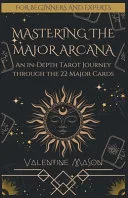
Mastering the Major Arcana
 76
76

Mastering the Major Arcana
Valentine Mason’s "Mastering the Major Arcana" offers a commendable, if conventional, deep dive into Tarot’s foundational twenty-two cards. Its strength lies in the methodical unpacking of each card’s symbolism, presenting them not as isolated images but as a cohesive narrative of personal development. Mason’s interpretation of The Tower, for instance, as a necessary dismantling of egoic structures rather than mere destruction, provides a valuable reframing. However, the work occasionally leans into a familiar interpretive language, which, while accurate, lacks a certain spark of novelty for seasoned readers. The first-time publication date of 2023 feels somewhat disconnected from the established discourse Mason engages with. Despite this, for students seeking a solid, well-organized reference for the Major Arcana, this book serves as a reliable guide.
📝 Description
76
Valentine Mason's 2023 book examines the 22 archetypal cards of the Tarot.
"Mastering the Major Arcana" by Valentine Mason, published in 2023, systematically examines the 22 archetypal cards central to Tarot. The book moves past simple definitions, aiming for a deeper understanding of the symbolism and narrative within these cards. It is written for serious students and practitioners who wish to go beyond surface meanings. The work will interest those drawn to the psychological and spiritual dimensions of the Major Arcana, including individuals pursuing self-awareness, esoteric studies, or wanting to enhance their divination skills with a more thorough grasp of these core symbols.
Mason presents each of the 22 Major Arcana cards as distinct phases in a spiritual or psychological progression. Specific concepts discussed include the Fool's initiation into new experiences, the Magician's ability to shape reality, the High Priestess's intuitive knowledge, and the World card signifying completion. The author highlights how these cards connect, illustrating them as life lessons, rites of passage, and archetypal forces influencing human experience.
The study of the Major Arcana has a history dating back to 18th-century France, with early figures like Antoine Court de Gébelin linking them to ancient Egyptian traditions. By the late 19th and early 20th centuries, occultists such as Eliphas Lévi and Arthur Edward Waite developed more formal esoteric correspondences. Mason's work builds on this lineage, incorporating interpretive frameworks from psychologists like Carl Jung, who saw Tarot cards as symbolic representations of universal human experiences.
💡 Why Read This Book?
• Gain a structured understanding of the 22 Major Arcana, moving from The Fool’s initiation to The World’s completion, as detailed in the chapter structure. • Explore the psychological depth of each card, understanding archetypes like The Hermit and Justice as distinct developmental stages. • Learn to interpret the interconnectedness of the Major Arcana, seeing them as a progression of life lessons rather than isolated symbols, as Mason demonstrates.
⭐ Reader Reviews
Honest opinions from readers who have explored this book.
❓ Frequently Asked Questions
When was "Mastering the Major Arcana" first published?
"Mastering the Major Arcana" by Valentine Mason was first published on June 30, 2023. This recent publication brings a contemporary perspective to the study of these ancient symbols.
What is the primary focus of "Mastering the Major Arcana"?
The book focuses exclusively on the 22 cards of the Major Arcana, offering an in-depth exploration of their individual meanings, symbolism, and their collective narrative arc.
Is this book suitable for beginners in Tarot?
While it offers a comprehensive look, its depth is particularly beneficial for those with some foundational knowledge seeking to deepen their understanding beyond basic interpretations.
Who is Valentine Mason?
Valentine Mason is the author of "Mastering the Major Arcana." Information about their background and other works is not widely available, but this publication marks their entry into esoteric literature.
What makes this book different from other Tarot guides?
It aims for a structured, almost curriculum-like approach to the Major Arcana, emphasizing their sequential nature and psychological resonance, distinguishing it from more generalized decks guides.
Does the book discuss specific Tarot decks?
The book primarily focuses on the archetypal meanings of the Major Arcana, applicable across various decks, rather than detailing specific deck aesthetics or variations.
🔮 Key Themes & Symbolism
Archetypal Journey
The central theme is viewing the Major Arcana as a unified journey, charting a path from primal innocence (The Fool) through trials and wisdom (The Hierophant, The Hermit) to ultimate completion (The World). This narrative framework helps readers understand the cards not in isolation, but as interconnected stages of personal and spiritual evolution, reflecting common initiatory structures found in myth and psychology.
Symbolic Language
Mason meticulously dissects the visual and symbolic language of each Major Arcana card. This includes exploring recurring motifs like keys, swords, cups, wands, and the numerical significance of each card. The book guides readers to decode these symbols, understanding how they convey complex ideas about human experience, destiny, and the forces that shape our lives.
Psychological Resonance
Drawing implicitly from psychological interpretations of archetypes, the book explores how the Major Arcana mirror internal states and developmental challenges. Cards like The Lovers, The Chariot, and Strength are presented as representations of internal conflicts, choices, and the cultivation of inner fortitude, making the Tarot a tool for self-understanding and growth.
Esoteric Wisdom
The work situates the Major Arcana within a broader esoteric tradition, suggesting they hold keys to understanding universal laws and spiritual truths. It encourages readers to see the cards as more than just fortune-telling tools, but as a system of esoteric wisdom that can illuminate the path to self-mastery and spiritual enlightenment.
💬 Memorable Quotes
Direct passages from the work, attributed to the author.
“The Fool’s journey begins not with a plan, but with a step into the unknown.”
— This highlights the essence of The Fool card as representing pure potential, faith, and the courage required to begin any new path without fully understanding the destination.
“The Magician holds the tools of creation, demonstrating the power of focused intent.”
— This emphasizes the active, manifestational energy of The Magician, illustrating the principle that conscious will and directed energy are key to shaping reality.
“Understanding The High Priestess requires looking beyond the veil of the obvious.”
— This points to the intuitive, subconscious, and hidden knowledge associated with The High Priestess, suggesting that true wisdom often lies beneath the surface.
“The Tower's destruction is often the necessary prelude to authentic rebuilding.”
— This reframes The Tower card not as purely catastrophic, but as a catalyst for breaking down false structures to allow for a more truthful foundation.
“The World signifies the culmination of a cycle, a harmonious integration of experience.”
— This captures the essence of The World card as representing completion, fulfillment, and the successful integration of lessons learned throughout the Major Arcana's progression.
🌙 Esoteric Significance
Tradition
This work aligns with the Western Esoteric tradition, particularly drawing from Hermetic and Kabbalistic influences that have shaped Tarot interpretation since the 18th century. It views the Major Arcana as a symbolic map of spiritual initiation and psychological unfolding, akin to pathways on the Tree of Life, though it may not explicitly detail Kabbalistic correspondences.
Symbolism
Key symbols like the Ankh (often associated with The Hierophant or The Emperor), the Caduceus (linked to The Magician or The Lovers), and the Ouroboros (representing The World or cycles of existence) are explored. These symbols function as shorthand for profound concepts: The Ankh for life and authority, the Caduceus for balance and communication, and the Ouroboros for eternity and the cyclical nature of existence.
Modern Relevance
Contemporary Tarot practitioners, spiritual counselors, and depth psychologists continue to draw upon the archetypal framework of the Major Arcana as presented in works like Mason's. Its structured approach appeals to those seeking a systematic method for self-exploration and understanding life's challenges through an esoteric lens.
👥 Who Should Read This Book
• Dedicated Tarot students aiming to achieve mastery over the 22 Major Arcana, moving beyond introductory guides. • Individuals interested in psychological archetypes and their manifestation in life, seeking a symbolic language for personal growth. • Esoteric practitioners looking to deepen their understanding of Tarot as a system of spiritual wisdom and self-initiation.
📜 Historical Context
Valentine Mason's "Mastering the Major Arcana," published in 2023, enters a field rich with interpretive history dating back centuries. Early associations with ancient Egypt and Kabbalah emerged in the 18th century, notably with Antoine Court de Gébelin. The late 19th and early 20th centuries saw the formalization of esoteric Tarot by figures like Eliphas Lévi and Arthur Edward Waite, whose Rider-Waite deck became a standard. Mason's work engages with this lineage, including the psychological interpretations pioneered by Carl Jung in the mid-20th century, who saw Tarot archetypes as reflections of the collective unconscious. Unlike earlier occultists who might have focused solely on ritualistic or divinatory applications, modern works like Mason's often emphasize the psychological and self-developmental aspects, reflecting a broader shift in esoteric studies.
📔 Journal Prompts
The Fool's leap: What unknown path are you currently contemplating?
The Magician's tools: How can you better focus your intent to manifest your desires?
The High Priestess's intuition: What inner wisdom have you been overlooking?
The Tower's upheaval: What foundational beliefs need dismantling for your growth?
The World's completion: What cycle are you bringing to a close and what have you learned?
🗂️ Glossary
Major Arcana
The set of 22 trump cards in a traditional Tarot deck, representing significant life events, archetypal figures, and spiritual lessons.
Archetype
A universal, archaic symbol or motive pattern that recurs in the literature, art, and mythology of humanity, often representing fundamental human experiences or character types.
Symbolism
The use of symbols to represent ideas and qualities, especially in art and literature; in Tarot, the imagery and iconography of the cards convey deeper meanings.
Initiation
A process of ritual or spiritual transition, often marking a passage from one stage of life or understanding to another, frequently represented by the Major Arcana sequence.
Esoteric
Intended for or likely to be understood by only a small number of people with a specialized knowledge or interest; relating to mystical or occult truths.
Divination
The practice of seeking knowledge of the future or the unknown by supernatural means, for which Tarot cards are often used.
Manifestation
The process by which a spiritual or abstract concept becomes a tangible reality, often associated with the energies of The Magician card.