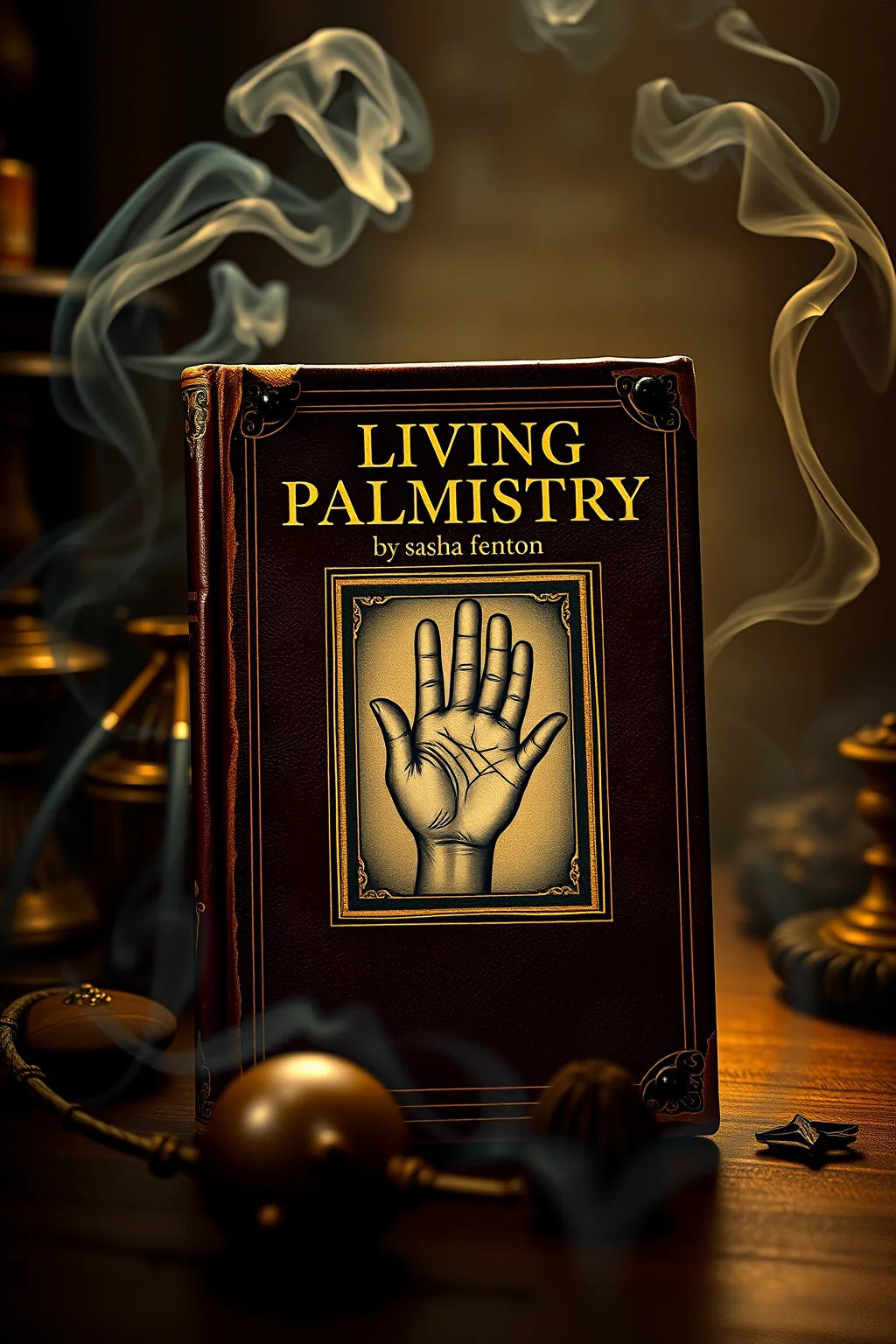
Living Palmistry
 78
78

Living Palmistry
Sasha Fenton's Living Palmistry navigates the intricate landscape of hand-reading with a clarity that is often missing in more esoteric texts. Unlike works that lean heavily on jargon, Fenton grounds the practice in observable detail, making the study of palmistry feel less like arcane guesswork and more like a disciplined art. Her explanation of the relationship between the mounts and the planetary influences, for instance, is particularly well-articulated, offering a cohesive framework for interpretation. A notable strength is the book's organization, which allows for a step-by-step understanding of complex concepts. However, the text occasionally suffers from a slight dryness; while informative, it could benefit from more illustrative case studies to truly bring the subject matter to life. The section on minor lines, while thorough, can feel overwhelming without more visual aids or detailed examples. Fenton’s approach is undoubtedly knowledgeable, but a touch more narrative flair would elevate it further. Despite this, Living Palmistry remains a solid, practical resource for anyone serious about learning the craft.
📝 Description
78
Sasha Fenton's 1990 book, Living Palmistry, offers a systematic method for reading hands.
Living Palmistry provides a structured guide to the practice of palm reading. Published in 1990, the book moves beyond simple interpretations to detail the meanings of hand lines, mounts, and overall shape. It serves as an introduction for newcomers and a reference for those already familiar with chiromancy. The text builds understanding step by step, aiming to give readers a practical grasp of this divinatory art. The book is intended for individuals interested in self-understanding, personal development, and esoteric studies. Beginners will find a clear starting point, while experienced readers can refine their techniques or examine Fenton's specific approach. It offers insights into character, potential, and life paths through palmistry.
The work systematically breaks down the components of palm reading. It covers the significance of the major and minor lines, such as the Life Line, Head Line, and Heart Line, along with their variations and what they indicate regarding health, intellect, and emotions. The text also addresses the mounts on the palm, their meaning, and how they interact with the lines. Fenton's approach emphasizes the interconnectedness of these elements in forming a complete reading.
Living Palmistry appeared in 1990, a time when interest in metaphysical subjects had resurfaced after the New Age era. While other authors were updating chiromancy, Fenton's book stood out for its methodical structure. The late 20th century saw a split in esoteric thought, with some branches becoming more academic and others more accessible. Fenton's work found a place by presenting palmistry as a practical discipline, understandable to a broad audience without being rigidly dogmatic.
💡 Why Read This Book?
• Gain a structured understanding of palmistry, moving beyond common myths by learning the specific meanings of the major and minor lines as detailed in Fenton's systematic approach. • Explore the connection between hand shape, finger proportions, and mount development, as explained through Fenton's interpretative framework for understanding personality traits. • Develop practical skills in reading palms by studying Fenton's detailed explanations of various markings, such as stars and crosses, and their significance.
⭐ Reader Reviews
Honest opinions from readers who have explored this book.
❓ Frequently Asked Questions
What is the primary focus of Sasha Fenton's Living Palmistry?
Living Palmistry by Sasha Fenton focuses on providing a comprehensive and structured approach to palmistry, covering the interpretation of hand shapes, lines, mounts, and markings to understand personality and potential life paths.
When was Living Palmistry first published, and does this affect its content?
Living Palmistry was first published in 1990. This publication date places it within a period of renewed interest in esoteric subjects, offering a modern yet grounded perspective on traditional palmistry practices.
Does the book offer insights into the dynamic nature of palmistry?
Yes, Fenton's work explores the dynamic nature of palmistry, suggesting that the lines on the hand can change over time, reflecting personal growth and shifts in life circumstances.
Is Living Palmistry suitable for complete beginners?
Absolutely. The book is structured progressively, making it an accessible entry point for beginners curious about palmistry, while also offering depth for those with some prior knowledge.
What are the key elements of palm reading discussed in the book?
The book details the significance of major and minor hand lines (like the Life Line and Head Line), the various mounts on the palm (e.g., Mount of Venus), hand and finger shapes, and specific markings.
What is the historical context of Living Palmistry's publication?
Published in 1990, the book emerged during a resurgence of interest in occult and metaphysical topics, positioning itself as a practical guide amidst diverse esoteric explorations of the era.
🔮 Key Themes & Symbolism
The Language of Hand Lines
The work meticulously dissects the primary and secondary lines of the palm, such as the Heart Line, Head Line, and Fate Line. It posits that each line is a script detailing aspects of an individual's mental, emotional, and spiritual journey. Fenton emphasizes observing the depth, clarity, and breaks within these lines, interpreting them not as fixed destinies but as indicators of tendencies, challenges, and potentials. The book treats these lines as a dynamic map, offering insights into character and life trajectory.
Mounts and Planetary Correspondences
Living Palmistry explores the significance of the fleshy mounds on the palm, known as mounts (e.g., Mount of Jupiter, Mount of Saturn, Mount of Venus). Fenton links these mounts to specific planetary influences and character traits. For instance, a well-developed Mount of Jupiter might indicate ambition and leadership qualities, while a prominent Mount of Venus suggests passion and sensuality. The interplay between the mounts and the lines is crucial for a holistic reading, providing a layered understanding of the individual.
Hand and Finger Anatomy
Beyond lines and mounts, the book dedicates substantial attention to the shape of the hand and fingers. Fenton categorizes hand types (e.g., Earth, Air, Fire, Water hands) and discusses the implications of finger length, shape (spatula, conic, square), and the presence of specific markings like crosses, stars, or islands. These physical characteristics are presented as foundational elements that provide context for the interpretations derived from the lines and mounts, offering a complete picture of the querent.
Dynamic Interpretation of Palms
A central tenet explored in Living Palmistry is that the palm is not a static document but a living map that can evolve. Fenton suggests that the lines and markings can change over time, reflecting personal development, significant life events, and shifts in consciousness. This perspective moves palmistry away from fatalism, positioning it as a tool for self-awareness and personal transformation, encouraging readers to actively engage with their potential rather than passively accepting a predetermined fate.
💬 Memorable Quotes
Direct passages from the work, attributed to the author.
“The lines on the palm are not fixed pronouncements of fate, but rather indications of tendencies and potentials.”
— This interpretation highlights Fenton's perspective that palmistry is a tool for understanding possibilities and character, rather than a rigid prediction of future events, emphasizing personal agency.
“Each mount on the palm corresponds to a planet and influences specific character traits.”
— This emphasizes the astrological underpinnings of palmistry as presented in the book, linking physical palm features to celestial energies and their impact on personality.
“The shape of your hand provides a fundamental blueprint for your personality.”
— This concept underscores the foundational importance Fenton places on the overall hand type and its inherent characteristics before exploring the more detailed analysis of lines and mounts.
“Observe the clarity and depth of the lines for accurate interpretation.”
— This practical advice points to the methodological approach Fenton advocates, stressing that the condition of the lines themselves is a key factor in deriving meaningful insights.
“Palmistry can serve as a guide for self-understanding and personal growth.”
— This reflects the book's underlying philosophy: that chiromancy is a practical tool for introspection and development, empowering individuals to navigate their lives more consciously.
🌙 Esoteric Significance
Tradition
Living Palmistry aligns with the Western Esoteric tradition, specifically drawing from the long lineage of chiromancy that has roots in ancient Greece and India. While not strictly Hermetic or Kabbalistic, it shares the esoteric principle of correspondence – the idea that the microcosm (the human hand) reflects the macrocosm (the universe or divine order). Fenton's work fits within the practical, divinatory branch of Western esotericism, focusing on tangible methods for self-knowledge and prediction, rather than purely theoretical or mystical pursuits.
Symbolism
Key symbols in Living Palmistry include the major lines (Life, Head, Heart) representing fundamental aspects of human experience: vitality, intellect, and emotion. The mounts, associated with planets like Venus (love, beauty) and Saturn (discipline, karma), act as symbolic indicators of dominant energies. Markings such as stars and crosses function as specific symbolic signposts, often interpreted as points of sudden change, challenge, or significant influence within the broader narrative of the palm.
Modern Relevance
Contemporary practices in self-help, psychology, and even life coaching sometimes incorporate principles reminiscent of palmistry's focus on self-awareness and potential identification. While not always explicitly cited, Fenton's systematic approach to interpreting hand features as indicators of personality and life path speaks to modern interest in personality typing and psychological profiling, albeit through an esoteric lens. It serves as a foundational text for those exploring embodied divination and somatic wisdom.
👥 Who Should Read This Book
• Individuals seeking a practical introduction to palmistry: Beginners will benefit from Fenton's clear, step-by-step methodology for understanding hand lines, mounts, and shapes. • Students of esoteric arts interested in divination: Those exploring Western esoteric traditions will find this a valuable resource for learning a tangible divinatory system. • Readers interested in self-discovery and character analysis: Anyone looking for a unique framework to understand personal strengths, weaknesses, and potentials will find insightful guidance.
📜 Historical Context
Living Palmistry emerged in 1990, a period when esoteric studies were experiencing a resurgence, fueled by the lingering effects of the New Age movement and a growing academic interest in comparative religion and occult traditions. Unlike the more mystical or overtly spiritualist texts popular in earlier decades, Fenton's work offered a structured, almost scientific approach to palmistry. It arrived at a time when figures like the anthropologist Margaret Mead had previously commented on the potential of palmistry as a cultural artifact, though not necessarily as a divinatory tool. The book distinguished itself by providing a clear, systematic guide that avoided overly esoteric jargon, making it accessible to a broader audience than highly specialized occult literature. It found its niche by balancing traditional chiromantic concepts with a practical, modern sensibility, contrasting with the more astrological-centric approaches also prevalent at the time.
📔 Journal Prompts
The Mount of Venus and its expression of love and passion.
Variations in the Head Line and their impact on thought processes.
The significance of the Fate Line in charting life's direction.
Interpreting the texture and temperature of the hand.
The meaning of a clear versus a broken Life Line.
🗂️ Glossary
Mounts
Fleshy, raised areas on the palm, named after planets (e.g., Mount of Jupiter, Mount of Venus), believed to influence character traits and life experiences.
Life Line
The curved line running from near the thumb towards the wrist, traditionally interpreted as indicating vitality, physical health, and significant life events.
Head Line
The line running horizontally across the palm, typically associated with intellect, communication style, and mental abilities.
Heart Line
The line running horizontally across the upper palm, generally interpreted as relating to emotional nature, relationships, and romantic life.
Fate Line
A vertical line running up the palm, often from the Mount of Luna or the wrist towards the Mount of Saturn, indicating influences and direction in career and life purpose.
Markings
Specific symbols appearing on the palm, such as stars, crosses, squares, or islands, which modify the interpretation of the lines and mounts they appear on.
Chiromancy
The practice of reading palms; an ancient form of divination focused on interpreting the lines, shapes, and features of the hand.
🔮 Readers Also Liked
Browse all →







More by Sasha Fenton
All books →





More Free Occult Philosophy Books
View all →