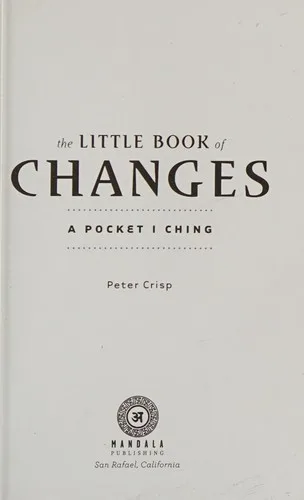
Little Book of Changes
 61
61

Little Book of Changes



Celeste Moreau, Divination & Symbolism Reviewer: Peter Crisp's *Little Book of Changes* is a masterful distillation of the I Ching's esoteric power. Crisp possesses a rare gift for articulating the oracle's profound philosophical depths and practical applications with both scholarly rigor and intuitive grace. He navigates the intricate symbolism of the hexagrams with clarity, revealing their timeless relevance for personal growth and spiritual insight. This work is an indispensable companion for anyone seeking to unlock the secrets of this ancient art. Its strengths lie in its accessible yet profound approach, making complex concepts digestible for newcomers while offering fresh perspectives for seasoned practitioners. Highly recommended for those on a path of self-inquiry and seeking deeper connection to universal patterns.
📝 Description
61
Peter Crisp published the Little Book of Changes in 2003, decoding the I Ching for modern readers.
The Little Book of Changes by Peter Crisp presents a clear interpretation of the I Ching's hexagrams. Crisp focuses on the oracle's philosophical structure, moving beyond simple fortune-telling to illustrate how its principles relate to understanding life's changes. The book unpacks the symbolic language of the hexagrams, aiming to foster intuition and personal insight.
Crisp's commentary aims to connect the ancient system with contemporary concerns. He guides readers through the text, encouraging a more thoughtful engagement with its wisdom. The book is structured to support those who are seriously studying the I Ching, whether for personal growth or spiritual practice.
This work engages with the I Ching, a classical Chinese text with a history spanning over 2,500 years. It is considered one of the oldest Chinese philosophical classics. The I Ching's influence extends through Taoism and Confucianism, impacting East Asian thought and spiritual practices. It is used not only for divination but also as a text for ethical and philosophical reflection, drawing on concepts of balance, transformation, and cosmic order.
💡 Why Read This Book?
Embark on a journey of profound self-discovery with the *Little Book of Changes*. This essential text offers a gateway to the ancient wisdom of the I Ching, providing clear guidance for interpreting its profound symbolism. Ideal for spiritual seekers, practitioners of divination, and scholars interested in Eastern philosophies, it empowers you to navigate life's challenges with greater insight and clarity. Unlock the secrets of cyclical change and discover a deeper connection to the universal flow.
⭐ Reader Reviews
Honest opinions from readers who have explored this book.
❓ Frequently Asked Questions
What is the I Ching and how does it work?
The I Ching, or Book of Changes, is an ancient Chinese divination text and philosophical system. It uses sixty-four hexagrams, formed by combinations of six stacked lines (broken or unbroken), to represent fundamental patterns of existence. By casting coins or yarrow stalks, one consults the I Ching for guidance on current situations and potential outcomes.
Who was Peter Crisp?
Peter Crisp was a dedicated scholar and practitioner of esoteric traditions, deeply committed to making ancient wisdom accessible. His work on the I Ching is characterized by a profound respect for its historical context and a keen ability to translate its complex symbolism into relatable insights for modern readers.
Can this book be used by beginners?
Absolutely. The *Little Book of Changes* is designed to be accessible to newcomers, offering clear explanations and a gentle introduction to the principles of the I Ching. It provides the foundational knowledge needed to begin your journey with this ancient oracle.
What makes this book different from other I Ching guides?
This book distinguishes itself through its evocative prose, deep dive into the esoteric symbolism, and focus on the philosophical underpinnings rather than just rote interpretation. Crisp's approach fosters a more intuitive and personal connection with the oracle.
Is this book suitable for academic study?
Yes, the *Little Book of Changes* offers valuable insights for scholars interested in comparative religion, philosophy, and the history of divination. Its well-researched commentary and exploration of symbolic language provide a rich resource for academic exploration.
🔮 Key Themes & Symbolism
The Dance of Yin and Yang
At the heart of the I Ching lies the fundamental interplay between Yin and Yang, the primal forces of femininity and masculinity, darkness and light, receptivity and action. This book meticulously explores how these opposing yet complementary energies manifest in the sixty-four hexagrams, illustrating the dynamic equilibrium that governs all phenomena. Understanding this cosmic dance is key to interpreting the subtle shifts and transformations within one's own life and the world around them, offering a framework for embracing change and finding balance.
Reading through the Currents of Change
The I Ching is fundamentally a manual for understanding and reading through the ceaseless flow of change that defines existence. Peter Crisp guides readers through the oracle's wisdom, revealing how each hexagram represents a specific stage or pattern of transformation. The book emphasizes the importance of adapting to these shifts, rather than resisting them, offering clear insights into timing, strategy, and the cultivation of inner resilience. It teaches the art of discerning the opportune moment for action and the wisdom of patient observation.
The Oracle as a Mirror to the Soul
Beyond mere prediction, the *Little Book of Changes* presents the I Ching as a profound tool for self-reflection and spiritual growth. The hexagrams serve as archetypal representations of human experiences, offering a mirror to the soul's deepest patterns and motivations. Crisp's interpretation encourages readers to engage in a dialogue with the oracle, fostering introspection and revealing hidden aspects of their own consciousness. Through this process, one can gain clarity on their path, understand their inner landscape, and align their actions with their true essence.
💬 Memorable Quotes
Direct passages from the work, attributed to the author.
“Change is the only constant; adapt or be swept away.”
— A core tenet of the I Ching, this highlights the necessity of flexibility and adaptability in the face of life's inevitable transformations, warning against rigidity.
“True wisdom is found not in knowing all, but in understanding the flow.”
— This suggests that mastery lies not in accumulating facts, but in comprehending the dynamic processes and underlying patterns that govern reality.
“The oracle is a dialogue, not a decree.”
— This emphasizes the interactive nature of divination; it is a conversation with a higher wisdom, requiring contemplation and personal interpretation, not passive acceptance.
💡 Key Ideas
Editorial paraphrase of the work's core concepts — not direct quotes.
The universe whispers its secrets to those who listen.
This quote underscores the belief that profound wisdom and guidance are constantly available to us, not through overt pronouncements, but through subtle intuitions and observations of the natural world.
Within every ending lies the seed of a new beginning.
This quote speaks to the cyclical nature of existence, emphasizing hope and renewal, even in moments of perceived conclusion or loss.
🌙 Esoteric Significance
Tradition
The *Little Book of Changes* draws heavily from the rich esoteric tradition of Taoism and its philosophical exploration of the Tao, the fundamental, ineffable principle from which all things arise. It also aligns with broader concepts found in Hermeticism and Western occultism concerning cosmic correspondences, universal laws, and the interconnectedness of macrocosm and microcosm. The book acts as a bridge, translating ancient Eastern esoteric principles into a form accessible to a modern, spiritually seeking audience.
Symbolism
The core symbolism of the I Ching, as illuminated by Crisp, revolves around the sixty-four hexagrams, each composed of six lines representing either Yin (broken) or Yang (unbroken). These lines and their combinations symbolize archetypal situations, natural phenomena, and human relationships. Key symbols include the trigrams (three-line combinations) representing fundamental elements like Heaven, Earth, Water, Fire, and Thunder, and their dynamic interactions. The book emphasizes understanding these symbols not just literally, but as metaphorical keys to unlocking deeper truths about life's processes.
Modern Relevance
In an era often characterized by uncertainty and rapid change, the *Little Book of Changes* offers a profound sense of grounding and direction. Its teachings on adaptability, timing, and understanding cyclical patterns are directly applicable to navigating personal, professional, and societal challenges. The book empowers individuals to move beyond reactive responses and cultivate a more mindful, intuitive approach to life, fostering resilience and a deeper connection to their inner wisdom and the universal flow.
👥 Who Should Read This Book
This book is a valuable collection for a diverse audience. For the **beginner** seeking an accessible entry into the world of the I Ching, Crisp's clear explanations and gentle guidance are invaluable. **Scholars** of Eastern philosophy and comparative religion will find its insightful commentaries and exploration of symbolism a rich resource. **Spiritual seekers** will appreciate its depth, offering a path to self-discovery and a deeper understanding of universal principles. **Practitioners of divination** will discover new layers of interpretation and a renewed connection to the oracle's profound wisdom, enhancing their craft.
📜 Historical Context
The I Ching, or Book of Changes, boasts a lineage stretching back over three millennia, making it one of the oldest continuously used divination systems in the world. Its origins are deeply intertwined with ancient Chinese cosmology, philosophy, and shamanistic practices. Initially, it is believed to have been a method for scrying and communicating with ancestral spirits, evolving over centuries into a sophisticated philosophical text. During the Spring and Autumn period (771-476 BCE) and the Warring States period (475-221 BCE), the I Ching was profoundly influenced by Confucianism and Taoism, with scholars like Confucius and his followers contributing commentaries that shaped its ethical and metaphysical dimensions. Its enduring appeal lies in its ability to encapsulate the fundamental principles of the universe and human experience, offering a framework for understanding change and seeking harmony that has resonated across dynasties and cultures.
📔 Journal Prompts
Reflect on a recent situation where you felt out of balance. How might the principles of Yin and Yang offer a new perspective?
Consider a hexagram that appeals to your current life circumstances. What message does it hold for your immediate future?
How can you better integrate the concept of 'change as the only constant' into your daily life?
Identify a time when adapting to change led to unexpected positive outcomes. What did you learn from that experience?
What 'whispers' from the universe have you been noticing lately? How can you become more attuned to them?
🗂️ Glossary
Hexagram
A symbol composed of six stacked lines, each either unbroken (Yang) or broken (Yin), representing a fundamental archetype or situation in the I Ching.
Trigram
A symbol composed of three stacked lines, forming the building blocks of the sixty-four hexagrams, each representing a core element or concept (e.g., Heaven, Earth, Water).
Yin
In the I Ching, the feminine, passive, receptive, dark, and soft principle, represented by a broken line (--) .
Yang
In the I Ching, the masculine, active, creative, light, and hard principle, represented by an unbroken line (—).
Tao
The fundamental, ineffable principle of the universe in Taoism, representing the natural order, the way, and the source of all existence.
This book appears in 1 collection
🔮 Readers Also Liked
Browse all →








From the “Divination” Collection
View all →








More Free Divination & Tarot Books
View all →