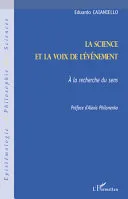
La science et la voix de l'événement
 71
71

La science et la voix de l'événement
Eduardo Caianiello's *La science et la voix de l'événement* presents a stark critique of contemporary scientific thought, arguing for a return to foundational principles of humanistic education. The author’s central contention – that science has lost its 'Sense' – is forcefully articulated, positioning the book as a call to reorient scientific endeavor toward societal progress and peace. A notable strength lies in Caianiello's direct challenge to the perceived detachment of scientific discourse from meaningful human application. However, the work's abstract nature, while aiming for philosophical depth, sometimes lacks concrete examples of the 'luminous fruit' science ought to provide. The passage discussing science's role in 'the education of men' is particularly compelling, urging a re-evaluation of scientific purpose beyond mere empirical accumulation. Ultimately, Caianiello offers a vital, if sometimes unsparing, perspective on science's potential and its current malaise.
📝 Description
71
### What It Is
Eduardo Caianiello's *La science et la voix de l'événement*, first published in 2010, critically examines the trajectory of modern science. The author posits that scientific discourse has drifted from its fundamental purpose: the education and betterment of humanity. Caianiello argues that science, in its current state, has become alienated from 'Sense' (Sens), losing its guiding orientation and the capacity to meaningfully inform new generations. This work seeks to re-establish science's connection to its origins and its natural role in fostering progress and peace.
### Who It's For
This book is intended for scholars, students, and critical thinkers who question the prevailing paradigms in scientific inquiry. It will appeal to those interested in the philosophy of science, the history of ideas, and the potential for integrating scientific understanding with broader humanistic and esoteric concerns. Readers seeking to understand how scientific methodology might be reoriented towards holistic education and societal well-being will find this text particularly relevant. It is for individuals who believe science should serve as a luminous fruit for the nourishment of future generations.
### Historical Context
Published in 2010, *La science et la voix de l'événement* emerged during a period of intense debate about the limits and responsibilities of scientific advancement. The early 21st century saw significant discussions on the societal impact of technology, the ethics of research, and the perceived disconnect between scientific specialization and public understanding. Caianiello's work can be seen in dialogue with critical traditions that, since the Enlightenment, have questioned the unchecked positivism and reductionism in scientific thought. The book implicitly addresses the legacy of figures who advocated for a more humanistic science, such as those influenced by early 20th-century philosophical movements seeking to reintegrate knowledge domains.
### Key Concepts
The central thesis revolves around the concept of 'Sens' (Sense/Meaning) as the lost compass of science. Caianiello argues that science has become detached from its purpose of 'educating men,' a function that should guide its progress towards peace. The 'event' (l'événement) in the title likely refers to moments of profound insight or reorientation, suggesting a need for a decisive shift in scientific direction. The book advocates for science to once again become a source of 'luminous fruit,' metaphorically representing knowledge that nourishes and enlightens humanity, thereby enabling new generations to thrive.
💡 Why Read This Book?
• Understand the concept of 'Sens' as a lost guiding principle in science, as presented in Caianiello's critique, to re-evaluate your own relationship with scientific knowledge. • Grasp the argument for science to fulfill its original purpose of 'educating men' by reconnecting with humanistic goals for societal progress, as detailed in the book's early chapters. • Explore the metaphor of science as a 'luminous fruit' that should nourish new generations, prompting reflection on how current scientific outputs contribute to human enlightenment and peace.
⭐ Reader Reviews
Honest opinions from readers who have explored this book.
❓ Frequently Asked Questions
What is the primary argument of Eduardo Caianiello's *La science et la voix de l'événement*?
The book's core argument is that modern science has lost its orientation and connection to 'Sense' (Sens), its original purpose of educating humanity for progress and peace, and needs to be reconnected with these foundational goals.
When was *La science et la voix de l'événement* first published?
Eduardo Caianiello's *La science et la voix de l'événement* was first published on March 1, 2010.
What does Caianiello mean by science losing its 'Sens'?
By losing 'Sens,' Caianiello implies that science has become detached from its meaningful purpose, which he argues should be the holistic education of individuals and the advancement of societal well-being and peace.
Who is the intended audience for this book?
The book is aimed at those interested in the philosophy of science, critical thinkers, academics, and anyone concerned with the societal role and ethical direction of scientific inquiry beyond purely technical applications.
What is the significance of 'l'événement' (the event) in the book's title?
The 'event' likely signifies a critical juncture or a moment of profound realization, suggesting the need for a decisive shift or reorientation in the scientific paradigm, moving it back towards its humanistic origins.
Does the book offer practical solutions for reorienting science?
While the book is primarily a philosophical critique and a call to reorientation, its emphasis on 'educating men' and reconnecting with 'Sense' provides a conceptual framework for rethinking scientific purpose and practice.
🔮 Key Themes & Symbolism
Science and Humanistic Education
Caianiello champions a return to science's original mandate: the education of individuals. He posits that contemporary science has strayed from this path, becoming overly specialized and detached from the goal of fostering human progress and peace. The 'luminous fruit' metaphor highlights the ideal of science as a source of enlightenment that should nourish future generations, rather than simply accumulating data or advancing technology in isolation.
The Lost 'Sens' of Science
A central theme is the perceived loss of 'Sens' (Sense or Meaning) within scientific discourse. Caianiello argues that without this guiding orientation, science operates without a true compass, its direction dictated by expediency rather than a profound understanding of its purpose. The book calls for a re-establishment of this 'Sens' to restore science's natural destination and its capacity to contribute meaningfully to human development.
The 'Event' as Reorientation
The title's reference to 'l'événement' (the event) suggests a need for a significant shift or turning point in the scientific paradigm. It implies that mere incremental changes are insufficient; rather, a more fundamental reorientation is required to reconnect science with its humanistic roots. This 'event' signifies a potential moment of awakening, where the inherent purpose of science is rediscovered and reasserted for the benefit of humanity.
💬 Memorable Quotes
Direct passages from the work, attributed to the author.
“Le Sens est devenu son ennemi...”
— This stark statement signifies science's current alienation from meaning, suggesting that its pursuit of empirical knowledge has inadvertently positioned 'Sense' as an obstacle rather than a guide.
“aucune voix d'homme n'a plus le droit de retentir dans ses mots.”
— This phrase conveys the author's view that scientific language has become sterile, devoid of human voice, wisdom, or ethical consideration, leading to a loss of connection with the broader human experience.
“redonner sa destination naturelle - l'éducation des hommes...”
— This points to the book's core thesis: that science's inherent purpose is to educate humanity, fostering progress and peace, a role it has allegedly abandoned in its current trajectory.
“commencer à se nourrir de ce fruit lumineux”
— This metaphor suggests that science should produce knowledge that is not only functional but also informative and nourishing, providing essential sustenance for the growth and well-being of new generations.
“La science a depuis trop longtemps perdu toute orientation.”
— This opening declaration immediately sets a critical tone, asserting that science has been adrift for an extended period, lacking a clear and purposeful direction.
🌙 Esoteric Significance
Tradition
While not explicitly aligned with a single esoteric tradition like Hermeticism or Gnosticism, Caianiello's work draws from a philosophical lineage that seeks to restore meaning and purpose to knowledge systems. It speaks to the Hermetic principle of 'As Above, So Below,' suggesting that the 'orientation' of science should reflect a higher, more integrated understanding of the cosmos and humanity's place within it. The critique of science's detachment from 'Sens' echoes esoteric traditions that emphasize inner gnosis and holistic understanding over purely materialist analysis.
Symbolism
The 'luminous fruit' serves as a potent symbol for knowledge that nourishes and enlightens, contrasting with potentially sterile or harmful scientific outputs. The concept of 'orientation' itself functions symbolically, representing a connection to a guiding principle or cosmic order that science has lost. The 'voice of man' represents the essential human element, wisdom, and ethical consideration that Caianiello believes should be intrinsic to scientific discourse.
Modern Relevance
Caianiello's call for science to regain its 'Sens' and focus on 'educating men' is highly relevant to contemporary movements in transdisciplinarity, integral theory (as espoused by Ken Wilber), and philosophy of mind. Thinkers and educators concerned with the societal impact of AI, climate science communication, and the ethical dimensions of biotechnology find resonance in his plea for science to serve human progress and peace.
👥 Who Should Read This Book
• Students and scholars of the philosophy of science questioning the limitations of empirical methods and seeking alternative frameworks for understanding knowledge. • Critical thinkers interested in the societal role of science and its ethical responsibilities beyond technological application and economic growth. • Individuals exploring the intersection of science, spirituality, and humanistic education, looking for arguments that advocate for a more integrated and purposeful scientific endeavor.
📜 Historical Context
Published in 2010, *La science et la voix de l'événement* emerged within a complex intellectual landscape. The early 21st century was marked by widespread discussions on the societal implications of scientific and technological advancements, including debates on ethics in research and the perceived gap between scientific expertise and public understanding. Caianiello's work engages with a long-standing critique of positivism and reductionism in science, echoing concerns raised by thinkers from the Frankfurt School (like Theodor Adorno and Max Horkheimer) who questioned the instrumental rationality of modern thought. While not directly citing a contemporary author who engaged with this specific text, Caianiello's critique aligns with broader philosophical currents seeking to re-humanize scientific inquiry, questioning its perceived neutrality and advocating for a reintegration of values and purpose. The publication date places it after significant shifts in postmodern philosophy and within a period increasingly concerned with the 'crisis' in scientific explanation and its societal relevance.
📔 Journal Prompts
The concept of 'Sens' as science's lost compass.
Science's role in the 'education of men'.
The metaphor of the 'luminous fruit' of knowledge.
Reconciling scientific orientation with humanistic goals.
The lost 'voice of man' in scientific discourse.
🗂️ Glossary
Sens
The French word 'Sens' translates to 'Sense,' 'Meaning,' or 'Direction.' In Caianiello's work, it represents the fundamental purpose and guiding orientation that he argues contemporary science has lost, leading to a detachment from humanistic goals.
L'événement
Literally 'the event.' In the context of the book's title, it suggests a critical turning point or a moment of profound realization and reorientation needed within the scientific paradigm.
Fruit lumineux
Translated as 'luminous fruit,' this metaphor represents the ideal outcome of scientific endeavor: knowledge that is not only functional but also enlightening and nourishing for humanity, particularly for future generations.
Éducation des hommes
Meaning 'the education of men' (in the sense of humankind). Caianiello posits this as the natural and essential destination of science, which he believes has been neglected in favor of specialization and technical advancement.
Orientation
Referring to direction and purpose. Caianiello argues that science has lost its proper 'orientation,' becoming adrift without a clear sense of its fundamental role in human progress and peace.
Voix de l'homme
The 'voice of man.' This signifies the human element—wisdom, ethical consideration, and subjective experience—that Caianiello feels is absent from contemporary scientific discourse.