Killing time
 81
81

Killing time
Patricia Windsor’s Killing Time presents a challenging yet rewarding engagement with subjective temporality. The novel’s strength lies in its fearless depiction of how personal experience can warp chronological flow, a concept explored through its disorienting yet evocative prose. Windsor masterfully captures the feeling of being trapped in a moment or having years dissolve into insignificance through the protagonist’s fractured mental state. However, the book’s deliberate ambiguity, while thematically consistent, can sometimes verge on opacity, making certain passages difficult to anchor. A particularly striking sequence involves the blurring of a childhood memory with present anxieties, illustrating the work's deep dive into how the past actively inhabits the present. For those willing to surrender to its unique rhythm, Killing Time offers a potent, if occasionally elusive, meditation on existence. It is a text that demands patience but rewards it with uncommon psychological depth.
📝 Description
81
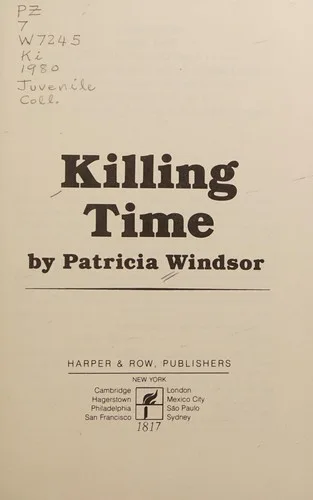
Patricia Windsor's 1987 novel Killing Time examines how individual consciousness warps the perception of time.
Killing Time, first published in 1987, is a novel that questions the nature of time and how we experience its passage. It does not follow a typical story arc. Instead, it looks at how our minds interact with moments, often using dreamlike scenes and broken viewpoints. The book considers the mental weight of memories and what we expect in the future, showing how these inner states can twist or halt a person's sense of linear time.
This book suits readers interested in philosophical stories that mix genres, especially those who like looking at consciousness and how we perceive things. It is for people who enjoy literature that asks questions about life and what is real, without offering simple answers. Those who prefer clear plots or easy stories might find its structure difficult. It is for readers comfortable with uncertainty and who enjoy exploring the inner worlds of characters.
Published in 1987, Killing Time emerged during a time when postmodern ideas challenged traditional storytelling and the concept of objective reality. While not tied to one specific occult practice, the novel's deep dive into subjective time and consciousness resonates with philosophical discussions from the late 20th century. It echoes inquiries into altered states of mind and the malleability of perception found in certain esoteric traditions that explore the inner world as much as the external one, influenced by writers who focused on psychological states and temporal distortion.
💡 Why Read This Book?
• Gain a profound understanding of subjective temporality, moving beyond clock-time to explore how emotional states and memory fracture chronological progression, as exemplified by the protagonist's fragmented experiences. • Experience a literary style that mirrors its themes of fractured consciousness and temporal distortion, offering a unique narrative structure that challenges conventional storytelling. • Examine the psychological impact of memory and anticipation, learning how these internal forces actively shape our perception of reality, a core concern explored throughout the 1987 publication.
⭐ Reader Reviews
Honest opinions from readers who have explored this book.
❓ Frequently Asked Questions
What is the primary theme of Patricia Windsor's Killing Time?
The primary theme is the subjective experience of time. The book explores how personal consciousness, memory, and emotional states can distort or suspend linear chronological progression, presenting a fluid and often fragmented perception of reality.
When was Killing Time first published?
Killing Time was first published in 1987. This places it within a literary period influenced by postmodernism and a growing interest in exploring subjective realities and narrative deconstruction.
Is Killing Time a science fiction novel?
While it deals with concepts of time, Killing Time is generally classified as philosophical or psychological fiction rather than science fiction. It focuses on the internal, subjective experience of time rather than external, speculative technological or cosmic scenarios.
What kind of narrative structure does Killing Time employ?
The book employs a fragmented and non-linear narrative structure. It uses dreamlike sequences, shifting perspectives, and internal monologues to mirror the subjective and often disorienting nature of the protagonist's perception of time.
Who would benefit most from reading Killing Time?
Readers interested in philosophical explorations of consciousness, memory, and the nature of reality, particularly those who enjoy experimental or unconventional literary styles, would benefit most from this work.
Does the book offer solutions to the problem of subjective time perception?
No, the book does not offer solutions. Instead, it serves as an exploration and depiction of subjective time perception, inviting readers to contemplate its nature and implications rather than find definitive answers.
🔮 Key Themes & Symbolism
Subjective Temporality
The core of Killing Time lies in its dissection of how individuals experience time. It posits that chronological, clock-measured time is secondary to a deeply personal, often fluid, perception shaped by internal states. Moments can stretch into eternities, or entire years can vanish, depending on the psychological weight of experience. This exploration challenges the notion of a universal, objective flow of time, suggesting instead that our reality is constructed through the lens of consciousness, memory, and anticipation.
Memory as Active Force
Memory in Killing Time is not a passive archive but a dynamic, often intrusive, element that actively shapes the present. The past is not merely recalled; it intrudes, merges, and reconfigures current perceptions and emotional landscapes. This theme looks at how traumatic or significant memories can create temporal loops or alter an individual's sense of continuity, effectively making the past a co-present reality that dictates present experience.
Liminal States and Consciousness
The book frequently navigates liminal states, blurring the boundaries between waking life and dreams, sanity and altered perception. These states are depicted as crucial junctures where the ordinary rules of reality, including linear time, can bend or break. The exploration of consciousness in these threshold moments suggests that reality is not fixed but is a fluid construct, particularly when the mind operates outside conventional awareness.
The Weight of Existence
Killing Time also grapples with the existential burden of consciousness and the passage of time. The characters, or the narrative voice, often convey a sense of being overwhelmed by the sheer duration of existence and the accumulation of experiences. This theme touches upon feelings of ennui, the desire for stasis, or the struggle to find meaning within a seemingly endless or disjointed temporal flow.
💬 Memorable Quotes
Direct passages from the work, attributed to the author.
“Time is not a river, but a stagnant pool.”
— This interpretation suggests that time, for the individual experiencing it subjectively, does not flow continuously forward but can become trapped or still. It emphasizes the psychological experience over the physical concept of temporal progression.
“The past is a room I keep returning to, whether I want to or not.”
— This highlights the invasive nature of memory. It frames the past not as a distant memory but as a tangible, inescapable space that the psyche revisits, influencing present thoughts and emotions.
“Minutes can feel like centuries, and years disappear in a blink.”
— This directly addresses the core theme of subjective temporality, illustrating how emotional intensity or psychological states can drastically alter the perceived duration of time, making objective measurement irrelevant to personal experience.
“Waking is just another form of dreaming, with stricter rules.”
— This provocative statement blurs the line between conscious reality and the dream state. It implies that even our perceived 'real' world is a construct, perhaps no less arbitrary or subjective than a dream.
“Anticipation can be a heavier burden than memory.”
— This suggests that the dread or expectation of future events can exert a more profound and debilitating psychological pressure than dwelling on past experiences, further complicating the individual's relationship with time.
🌙 Esoteric Significance
Tradition
While not explicitly aligned with a named esoteric tradition, Killing Time can be seen as engaging with Gnostic themes of illusory reality and the subjective nature of perception. The Gnostic emphasis on escaping a flawed material world through gnosis (knowledge) finds a parallel in the protagonist's struggle to navigate a perceived reality that is distorted by internal states. The work explores how consciousness itself can be a form of prison or liberation, a concept explored in various mystical philosophies.
Symbolism
The concept of "stagnant time" serves as a potent symbol, representing psychological inertia or being trapped in memory or trauma, a departure from the common esoteric symbol of time as a flowing river of cosmic evolution. The recurring motif of "rooms" or confined spaces can symbolize the mind's internal architecture, where memories and emotions are stored and revisited, creating a self-imposed labyrinth.
Modern Relevance
Contemporary interest in mindfulness, consciousness studies, and the psychology of perception can find echoes in Killing Time. Thinkers and practitioners exploring the power of the mind to shape reality, or those interested in the therapeutic potential of reframing one's relationship with past experiences, may draw insights from its depiction of subjective temporality. Its exploration of how consciousness constructs reality remains relevant to ongoing debates in philosophy and psychology.
👥 Who Should Read This Book
• Students of experimental literature: Those interested in narrative deconstruction and unconventional storytelling will appreciate how Windsor uses structure to embody themes of fractured consciousness and temporal distortion. • Explorers of philosophical psychology: Readers fascinated by the interplay of memory, consciousness, and the subjective experience of reality will find depth in the book's introspective approach. • Esoteric and metaphysical readers: Individuals drawn to concepts of subjective reality, the malleability of perception, and the inner workings of the mind will connect with the book's exploration of how consciousness shapes existence.
📜 Historical Context
Published in 1987, Patricia Windsor’s Killing Time arrived during a literary landscape increasingly shaped by postmodernism’s skepticism towards grand narratives and objective reality. This era saw authors experimenting with fragmented structures and exploring the subjective nature of experience. While not directly tied to a specific occult revival, the book’s focus on the malleability of time and consciousness resonated with broader intellectual currents that questioned established perceptions. Its introspective, psychological focus stands in contrast to more externally-oriented speculative fiction of the time. Contemporaries like Angela Carter, though stylistically different, were also pushing boundaries in narrative and exploring psychological depths. The reception of such experimental works in the late 80s was often niche, appealing to readers seeking more challenging literary engagements beyond mainstream conventions, reflecting a growing interest in interiority and deconstructed realities.
📔 Journal Prompts
The protagonist's experience of "stagnant time": how does this relate to moments of personal inertia?
Reflect on a memory that feels more present than the current moment.
Analyze the "rooms" of your own consciousness as depicted in the book.
Consider the "stricter rules" of waking reality versus dream states.
How does the anticipation of a future event alter your perception of the present?
🗂️ Glossary
Subjective Temporality
The concept that the perception of time's passage is unique to each individual, influenced by psychological states, emotions, and memories, rather than being a universally constant, linear flow.
Liminal State
A transitional or threshold state of consciousness, often characterized by ambiguity, where boundaries between different realities (e.g., waking/dreaming, past/present) become blurred.
Psychological Inertia
A state where an individual's mental or emotional state becomes fixed, preventing progress or change, akin to being stuck in a particular time or experience.
Narrative Deconstruction
A literary technique that breaks down traditional storytelling structures, often challenging conventional notions of plot, character, and reality to explore deeper themes.
Fragmented Consciousness
A state where awareness and perception are broken into disconnected pieces, often experienced as disjointed thoughts, shifting realities, or a lack of coherent self-awareness.
Internal Labyrinth
A metaphor for the complex and often confusing inner world of the mind, filled with memories, emotions, and thoughts that can trap or disorient an individual.
Existential Burden
The psychological weight associated with the awareness of one's existence, freedom, and the search for meaning in a seemingly indifferent universe.
🔮 Readers Also Liked
Browse all →









More by Patricia Windsor
All books →


More Free Occult Philosophy Books
View all →