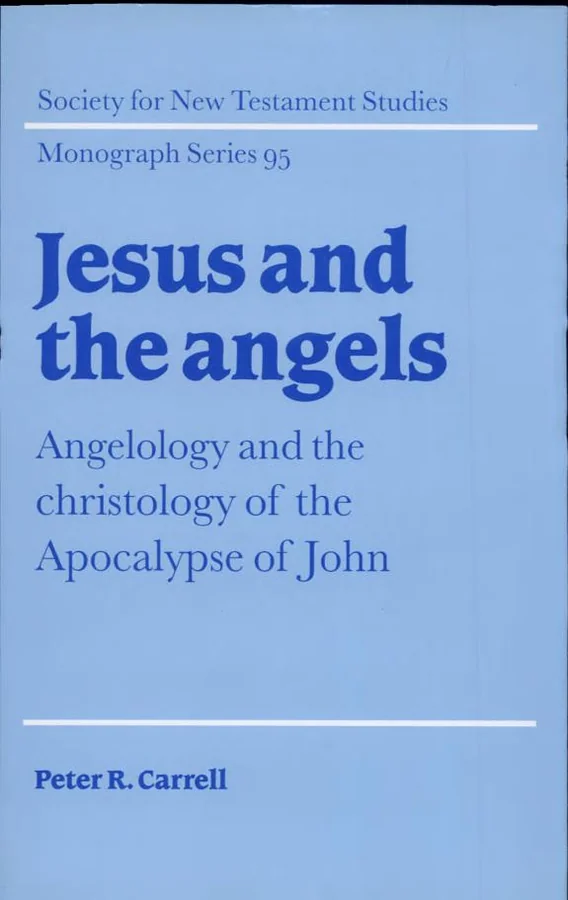
Jesus and the Angels
 72
72

Jesus and the Angels
Carrell's "Jesus and the Angels" offers a meticulously researched argument that the Apocalypse of John employs angelological motifs to articulate its understanding of Christ. The author effectively demonstrates how Jesus' glorious, authoritative presence in Revelation mirrors descriptions of angelic beings prevalent in the preceding centuries. A particular strength lies in Carrell's careful analysis of the textual evidence linking Jesus' form and function to angelic roles. However, the book's dense academic prose may present a barrier for readers unfamiliar with critical biblical scholarship, occasionally obscuring the broader theological implications. For instance, the extended discussion on the "angel of the Lord" tradition could have been more directly tied to the implications for Jesus' unique divine status. Despite this, the work provides a valuable perspective on the christological distinctiveness within the Apocalypse.
📝 Description
72
Peter R. Carrell's 1997 book examines Jesus' christology in Revelation alongside angelology.
Published in 1997, Peter R. Carrell's "Jesus and the Angels" offers a scholarly look at the Book of Revelation's presentation of Jesus. The study focuses on how angelology connects Jesus to figures in Jewish and Christian writings from roughly 200 BCE to 200 CE. Carrell places this analysis in the context of the late second century CE, a time of varied theological ideas about Christ and angels.
The book engages with scholarship on the Second Temple period and early Christian texts. It seeks to understand the specific christological claims in Revelation by comparing them to developing angelic hierarchies and messianic hopes of that era. The work investigates how Revelation portrays Jesus with traits similar to celestial beings, clarifying his divine authority.
This work engages with texts from the Second Temple period and early Christianity, a time when ideas about angelic hierarchies and divine intermediaries were fluid. The portrayal of Jesus in Revelation, presented with characteristics analogous to celestial beings, touches upon how early Christians understood divine authority and mediation. The study situates these developments within a broader history of Jewish and Christian literature that explored the boundaries between the human and the divine, and the roles of angelic figures in mediating God's presence and will.
💡 Why Read This Book?
• Gain a nuanced understanding of how early Christian authors, specifically in the Apocalypse of John, utilized angelological concepts to articulate the divine nature and authority of Jesus, a perspective crucial for interpreting Revelation's unique christology. • Explore the intellectual landscape between 200 BCE and 200 CE, understanding how Jewish and Christian literature conceived of angelic beings, which provides essential context for Carrell's analysis of Jesus' portrayal. • Appreciate the specific christological claims made in the Apocalypse, recognizing how Jesus is depicted with angelic form and function while simultaneously affirming his divinity, a key theological tension addressed by Carrell.
⭐ Reader Reviews
Honest opinions from readers who have explored this book.
❓ Frequently Asked Questions
What is the primary focus of Peter R. Carrell's "Jesus and the Angels"?
The book examines the influence of angelology on the christology of the Apocalypse of John. It investigates how Jesus is portrayed in glorious, angelic-like forms and what this signifies for understanding his divine role within that text.
When was "Jesus and the Angels" first published?
The book was first published on July 10, 1997. This publication date places it within late 20th-century biblical scholarship.
Which historical period does the book draw comparisons from for angelic figures?
Carrell compares the portrayal of Jesus to angels described in Jewish and Christian literature from the period between 200 BCE and 200 CE.
What is the significance of Jesus having 'form and function of an angel' in the Apocalypse, according to the book?
According to Carrell's analysis, this portrayal upholds Jesus' divinity while simultaneously linking him to celestial authority, a key aspect of the Apocalypse's christology.
Who is the author of "Jesus and the Angels"?
The author is Peter R. Carrell. He is known for his scholarly work in biblical studies, particularly concerning the New Testament and its historical context.
What specific biblical text is central to the analysis in "Jesus and the Angels"?
The primary biblical text examined is the Apocalypse of John, also known as the Book of Revelation. Carrell focuses on its unique presentation of Jesus.
🔮 Key Themes & Symbolism
Angelic Christology
The core theme is how the Apocalypse of John presents Jesus Christ through the lens of angelology. Carrell argues that Jesus' depiction, with its radiant glory and authoritative presence, deliberately mirrors descriptions of celestial beings found in contemporaneous Jewish and Christian texts. This approach aims to illuminate how early Christians understood Jesus' divine nature and his role as a mediator, distinct yet connected to the angelic realm.
Apocalypse of John
This prophetic text serves as the primary source for Carrell's analysis. The work studies the specific ways the author of Revelation constructs Jesus' identity, focusing on the theological implications of presenting him with attributes often associated with archangels or divine messengers. The book seeks to understand the christological message embedded within the apocalyptic imagery and symbolism.
Second Temple Angelology
The study critically examines angelological concepts prevalent in Jewish literature from roughly 200 BCE to 200 CE. By understanding the prevailing ideas about angelic hierarchies, powers, and roles during this period, Carrell establishes a framework for interpreting the angelic characteristics attributed to Jesus in the New Testament, particularly in Revelation.
Divine Authority and Mediation
A significant aspect explored is how the portrayal of Jesus as having angelic form and function serves to articulate his unique position as both divine and a mediator between God and humanity. The book questions the extent to which this angelic framing enhances or modifies the understanding of Jesus' supreme authority and salvific role within the Christian message.
💬 Memorable Quotes
Direct passages from the work, attributed to the author.
“Jesus appears in glorious form reminiscent of angels.”
— This observation highlights the visual and functional parallels drawn between Jesus and angelic beings in the Apocalypse, suggesting a deliberate theological strategy by the author.
“Influence of angelology on the christology of the Apocalypse of John.”
— This statement expresses the book's central thesis: that an understanding of contemporary angelology is essential for grasping the specific way Jesus' divinity and authority are presented in Revelation.
“Jesus has the form and function of an angel, yet is also divine.”
— This highlights the core paradox Carrell explores: how the Apocalypse presents Jesus with angelic characteristics without diminishing his unique divine status, thereby shaping its specific christological claims.
“Portrayal of Jesus in literature between 200 BCE and 200 CE.”
— This refers to the comparative literature Carrell uses, which includes Jewish and early Christian writings, to contextualize the angelic imagery found in the Apocalypse of John.
“What significance does this have for the christology of the Apocalypse?”
— This question frames the author's inquiry, indicating the book's purpose is to analyze the theological meaning and implications of Jesus' angelic portrayal within the specific context of the Apocalypse.
🌙 Esoteric Significance
Tradition
While not explicitly aligned with a single esoteric lineage like Hermeticism or Gnosticism, "Jesus and the Angels" engages with themes resonant in esoteric traditions. Its focus on celestial beings, divine mediation, and the symbolic interpretation of sacred texts aligns with broader Neoplatonic and mystical approaches to understanding divinity and spiritual hierarchies. The work's scholarly rigor, however, grounds it in biblical studies, offering a bridge between academic theology and esoteric interpretations of Christological symbolism.
Symbolism
Key symbols explored implicitly include the 'angel of the Lord,' representing divine messengers and intermediaries, and the imagery of divine glory and authority. The 'Apocalypse of John' itself is a rich symbolic text, and Carrell's work unpacks how the portrayal of Jesus within it draws upon established angelic symbolism to convey his unique status as both heavenly messenger and divine Son.
Modern Relevance
Contemporary esoteric thinkers and practitioners interested in comparative angelology, the mystical interpretations of the New Testament, or alternative Christologies may find Carrell's analysis relevant. His work provides a scholarly foundation for understanding the historical roots of certain angelic concepts that continue to appear in modern spiritual movements and discussions about consciousness and divine presence.
👥 Who Should Read This Book
• Students of New Testament theology seeking to understand the historical development of Christology and the influence of Jewish angelology on early Christian writings. • Comparative religion scholars interested in the intersection of Jewish and Christian beliefs regarding celestial beings and divine intermediaries during the Second Temple period. • Readers of apocalyptic literature who wish to gain a deeper, context-aware appreciation for the symbolic language and theological arguments presented in the Book of Revelation.
📜 Historical Context
Published in 1997, Peter R. Carrell's "Jesus and the Angels" emerged during a period of sustained scholarly interest in the historical Jesus and the development of early Christian thought. The late 20th century saw extensive work on Second Temple Judaism and its influence on nascent Christianity, including detailed studies of angelology and demonology. Carrell's work engages with this scholarly milieu, particularly the ongoing debates surrounding the christological interpretations within apocalyptic literature. At the time, scholars like John J. Collins were actively exploring the diverse messianic expectations and celestial hierarchies in Jewish texts preceding and contemporary with Christianity. Carrell's specific focus on the Apocalypse of John positions his research within the ongoing discourse on how early Christians adapted and reinterpreted existing religious motifs to articulate the unique identity of Jesus, contrasting with purely human messianic figures or solely divine emanations.
📔 Journal Prompts
The Apocalypse of John's depiction of Jesus with angelic form and function.
How does the 200 BCE - 200 CE angelology inform the christology of Revelation?
Significance of Jesus being portrayed as both angelic and divine.
The author's interpretation of Jesus' glorious form in Revelation.
The relationship between Jewish and Christian angelology in the early centuries CE.
🗂️ Glossary
Apocalypse of John
The final book of the New Testament, also known as the Book of Revelation. It is an apocalyptic text filled with symbolic visions concerning the end times, divine judgment, and the ultimate triumph of Christ.
Christology
The branch of Christian theology that deals with the nature, person, and work of Jesus Christ. It explores questions about his divinity, humanity, and salvific role.
Angelology
The study of angels, including their nature, roles, hierarchies, and significance within religious and theological contexts. It examines beliefs about celestial beings in various traditions.
Second Temple Period
The era of Jewish history from the rebuilding of the Second Temple in Jerusalem around 516 BCE to its destruction by the Romans in 70 CE. This period saw significant development in Jewish religious thought.
Messianic Expectations
Beliefs and hopes concerning the coming of a Messiah, a divinely appointed savior figure. These expectations varied widely among Jewish groups during the Second Temple period.
Form and Function
In the context of the book, 'form' refers to the appearance or nature of a being, while 'function' refers to its role or purpose. Carrell examines how Jesus' appearance and actions in Revelation align with angelic characteristics.
Christian Literature (200 BCE - 200 CE)
Encompasses writings produced by early Christians and Jewish authors during the period leading up to and immediately following the life of Jesus, providing crucial context for New Testament interpretation.
This book appears in 1 collection
🔮 Readers Also Liked
Browse all →








From the “Angelology” Collection
View all →







More Free Occult Philosophy Books
View all →