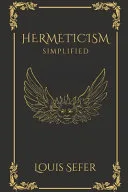
Hermeticism Simplified
 84
84

Hermeticism Simplified
Louis Sefer’s "Hermeticism Simplified" tackles the formidable task of rendering complex esoteric philosophy accessible, a feat it largely achieves. The book’s primary strength lies in its methodical unpacking of core Hermetic principles. For instance, the explanation of "As Above, So Below" is particularly lucid, illustrating the principle of correspondence with relatable examples that bridge the ancient text and modern understanding. However, the work sometimes errs on the side of oversimplification, potentially glossing over the deeper philosophical nuances that have occupied scholars for centuries. While the 2023 publication date makes it a contemporary entry, its reliance on established interpretations means it offers little that is radically new to seasoned practitioners. Despite this, for the uninitiated, Sefer provides a clear and encouraging entry point into a vast philosophical landscape. It serves as a competent primer, not a definitive treatise.
📝 Description
84
Louis Sefer's Hermeticism Simplified, published in 2023, aims to clarify Hermetic philosophy for a new audience.
This book breaks down the core ideas of the Hermetic tradition, a system of thought attributed to Hermes Trismegistus. It traces these concepts from their origins in ancient Egypt and Greece to their later impact on various esoteric movements. Sefer's writing prioritizes clarity, making complex philosophical and religious ideas accessible to those unfamiliar with them. The work is intended for individuals interested in alchemy, astrology, and occult philosophy who find traditional texts difficult to approach. It offers a gentle entry point without requiring prior expertise, serving as a starting place for those exploring spiritual concepts.
The Hermetic tradition itself has roots in Hellenistic Egypt, with significant texts like the Corpus Hermeticum. Sefer’s book connects this ancient lineage to its influence on Renaissance thinkers and later occultists. Key principles discussed include "As Above, So Below," a concept of correspondence between the human and cosmic levels. The book also explains ideas like Mentalism, the universal nature of mind, and the principles of vibration, polarity, and gender as fundamental forces. These concepts are presented in a way that helps the reader grasp the perceived underlying order of existence.
The Hermetic tradition, attributed to the legendary figure Hermes Trismegistus, emerged from Hellenistic Egypt, blending Greek philosophical thought with Egyptian religious ideas. Its primary texts, the Corpus Hermeticum, propose a cosmology centered on divine intellect and the correspondence between different levels of reality. This tradition profoundly influenced Western esotericism, impacting Renaissance philosophy, alchemy, and various occult practices. Sefer's work situates these ancient teachings within a modern framework, making them understandable for contemporary readers interested in the historical development and core tenets of Hermetic thought.
💡 Why Read This Book?
• Gain a clear understanding of "As Above, So Below," a foundational Hermetic axiom, by examining its role in understanding cosmic and personal correspondences as presented in Sefer's accessible explanations. • Explore the concept of Mentalism, as detailed in the book, to grasp how the Hermetic view posits the universe as fundamentally mental, influencing one's perception of reality. • Demystify the Seven Hermetic Principles, including the Law of Vibration and Polarity, through the book's simplified breakdowns, offering practical insights into universal energetic laws.
⭐ Reader Reviews
Honest opinions from readers who have explored this book.
❓ Frequently Asked Questions
What is the historical origin of Hermeticism as discussed in "Hermeticism Simplified"?
The book traces Hermeticism's origins to Hellenistic Egypt, around the 2nd century CE, linking it to Hermes Trismegistus and the philosophical texts known as the Corpus Hermeticum.
Is "Hermeticism Simplified" suitable for someone with no prior knowledge of esotericism?
Yes, the book is specifically designed for beginners, aiming to demystify complex concepts and provide a clear, accessible introduction to Hermetic principles.
What are the key Hermetic principles covered in Louis Sefer's book?
The book covers core principles such as "As Above, So Below," Mentalism, Vibration, Polarity, Rhythm, and Gender, explaining their significance within the Hermetic tradition.
Does "Hermeticism Simplified" discuss the practical application of Hermeticism?
While primarily focused on principles, the book's clear explanations of concepts like Mentalism and Vibration can inform a practitioner's understanding and approach to esoteric studies.
When was "Hermeticism Simplified" first published?
The book was first published on January 10, 2023, making it a recent addition to literature on Hermetic philosophy.
What is the significance of Hermes Trismegistus in Hermeticism?
Hermes Trismegistus is the legendary figure to whom the Hermetic texts are attributed. He is considered a syncretic deity blending the Greek Hermes and Egyptian Thoth, a divine messenger and scribe.
🔮 Key Themes & Symbolism
The Hermetic Axiom
The book elaborates extensively on the principle "As Above, So Below," a central to Hermetic philosophy. This concept, deeply rooted in the idea of universal correspondence, suggests that the macrocosm (the universe) is reflected in the microcosm (humanity and the material world). Sefer explains how this principle underpins various esoteric disciplines, from alchemy to astrology, providing a framework for understanding the interconnectedness of all things and the underlying order of existence. Its exploration is central to grasping the Hermetic worldview.
The Seven Principles
A significant portion of "Hermeticism Simplified" is dedicated to dissecting the Seven Hermetic Principles, which form the bedrock of this esoteric system. These include Mentalism, Correspondence, Vibration, Polarity, Rhythm, Cause and Effect, and Gender. Sefer aims to present these often abstract laws in a comprehensible manner, illustrating how they manifest in both the spiritual and physical realms. Understanding these principles is presented as key to unlocking the secrets of the universe and personal transformation.
Origins and Influence
The work situates Hermeticism within its historical and philosophical context, tracing its lineage from ancient Egypt and Greece. Sefer highlights the enduring impact of Hermetic thought on Western esotericism, including its influence on Renaissance thinkers and subsequent occult movements. By grounding the philosophy in its historical development, the book provides readers with a sense of the tradition's depth and its continuous relevance across centuries, bridging ancient wisdom with contemporary spiritual inquiry.
Practical Application
While the book focuses on theoretical principles, it implicitly guides the reader toward practical application. By simplifying concepts like Mentalism (the universe is mental) and Vibration (all things vibrate), Sefer encourages a shift in perspective. This offers a foundation for individuals seeking to apply Hermetic insights to their personal lives, spiritual practices, or understanding of occult phenomena. The emphasis is on cultivating a Hermetic mindset for greater self-awareness and mastery.
💬 Memorable Quotes
Direct passages from the work, attributed to the author.
“As Above, So Below; as Below, So Above.”
— This iconic Hermetic maxim highlights the principle of correspondence. It asserts a fundamental connection and similarity between different levels of reality, from the celestial to the terrestrial, implying that understanding one can illuminate the other.
💡 Key Ideas
Editorial paraphrase of the work's core concepts — not direct quotes.
The principle of Mentalism states that the All is Mind; the Universe is Mental.
This quote expresses the Hermetic view of consciousness as primary. It suggests that reality is not fundamentally material but is a manifestation of a universal mind, implying that our thoughts and perceptions play an important role in shaping our experience.
Everything flows out and in; everything has its tides; all things rise and fall; the swing of the pendulum is mirrored in everything; the measure of the swing to the right is the measure of the swing to the left; rhythm compensates.
This passage paraphrases the Law of Rhythm, illustrating the cyclical nature of existence. It suggests that change is constant and that apparent extremes are part of a larger, balancing oscillation inherent in the universe.
In the Male and Female, Sex resides in everything and in all things.
This quote refers to the Hermetic Principle of Gender, asserting that duality and complementary forces are present in all creation, not just in biological sex. It speaks to the dynamic interplay of masculine and feminine energies in the universe.
The principle of Vibration states that nothing rests; everything moves; everything vibrates; everything is in motion.
This paraphrase of the Law of Vibration emphasizes the dynamic nature of reality. It posits that even seemingly solid objects are in constant motion at a vibrational level, a concept crucial for understanding energetic principles in esoteric traditions.
🌙 Esoteric Significance
Tradition
This work firmly resides within the Western Esoteric Tradition, specifically focusing on Hermeticism. It draws directly from the philosophical and mystical teachings attributed to Hermes Trismegistus, a foundational figure. The book aims to make accessible the core principles of this lineage, which has historically informed alchemy, astrology, and various occult philosophies. It serves as a modern gateway, attempting to bridge the gap between ancient texts like the Corpus Hermeticum and contemporary seekers, positioning itself as an introductory text within this established stream of esoteric thought.
Symbolism
Central to Hermetic symbolism, as explored in the book, is the figure of Hermes Trismegistus himself, representing wisdom and divine knowledge. The concept of "As Above, So Below" is a symbolic representation of universal correspondence, visually or conceptually linking the celestial realms with earthly existence. Furthermore, the duality inherent in principles like Gender (masculine/feminine) and Polarity (extremes attracting) serves as symbolic language for understanding the dynamic forces that govern creation and manifest in all phenomena, from the smallest atom to the largest galaxy.
Modern Relevance
The principles outlined in "Hermeticism Simplified" continue to resonate with modern spiritual seekers and practitioners of various esoteric disciplines. Contemporary movements in New Age spirituality, consciousness studies, and even some branches of psychology draw upon Hermetic ideas concerning the power of the mind (Mentalism) and the interconnectedness of all things (Correspondence). Thinkers and authors exploring mindfulness, manifestation techniques, and the nature of reality often implicitly or explicitly engage with these ancient concepts, demonstrating the enduring appeal and applicability of Hermetic philosophy in the 21st century.
👥 Who Should Read This Book
• Beginning students of Hermeticism and Western esotericism who require a clear, foundational text to understand core concepts like "As Above, So Below" and the Seven Principles. • Individuals interested in comparative religion and philosophy seeking an accessible entry point into the historical and intellectual currents that shaped esoteric thought through the ages. • Aspiring practitioners of alchemy, astrology, or divination who wish to grasp the underlying philosophical framework before exploring specialized practices.
📜 Historical Context
Louis Sefer's "Hermeticism Simplified" enters a discourse that has captivated minds since antiquity. The Hermetic tradition, largely codified in the Corpus Hermeticum around the 2nd century CE in Hellenistic Egypt, experienced a significant revival during the Renaissance. Figures like Marsilio Ficino translated these texts, influencing thinkers such as Giordano Bruno and Pico della Mirandola, who integrated Hermetic concepts into their Neoplatonic and Christian philosophies. This period saw a flourishing of Hermeticism as a vital intellectual current, often intertwined with alchemy and astrology, standing in contrast to the burgeoning empirical sciences. While Sefer’s work is a 2023 publication, its subject matter connects to a lineage that saw intense study and debate throughout the centuries. The intellectual range of the Renaissance, for instance, was marked by a fascination with ancient wisdom traditions, including Hermeticism, Kabbalah, and Gnosticism, often viewed through a syncretic lens, a stark difference from the more specialized academic disciplines that emerged later.
📔 Journal Prompts
The principle of Mentalism: How does the universe being fundamentally mental shape your perception of daily events?
Reflect on the concept of 'As Above, So Below' as it applies to a personal relationship.
Analyze a recent challenge through the lens of the Law of Rhythm; identify the ebb and flow.
Consider the principle of Vibration: What aspects of your life might be influenced by unseen energetic movements?
Explore the Hermetic Principle of Gender: How do complementary forces manifest in your creative pursuits?
🗂️ Glossary
Hermes Trismegistus
A legendary, syncretic figure combining the Greek god Hermes and the Egyptian god Thoth, credited with originating Hermetic philosophy and texts.
Corpus Hermeticum
A collection of Greco-Egyptian philosophical and religious writings attributed to Hermes Trismegistus, forming a core text of Hermeticism.
As Above, So Below
The fundamental Hermetic axiom stating that the principles governing the macrocosm (universe) are reflected in the microcosm (individual/Earth).
Mentalism
The first Hermetic Principle, positing that the All is Mind and the Universe is Mental, meaning reality is fundamentally of a mental nature.
Vibration
The fourth Hermetic Principle, stating that everything in the universe is in constant motion and emits a unique vibratory frequency.
Polarity
The fifth Hermetic Principle, which states that everything has an opposite, that opposites are identical in nature but differ in degree, and that extremes meet.
Gender
The seventh Hermetic Principle, asserting that Gender exists in all things, with masculine and feminine principles operating universally.