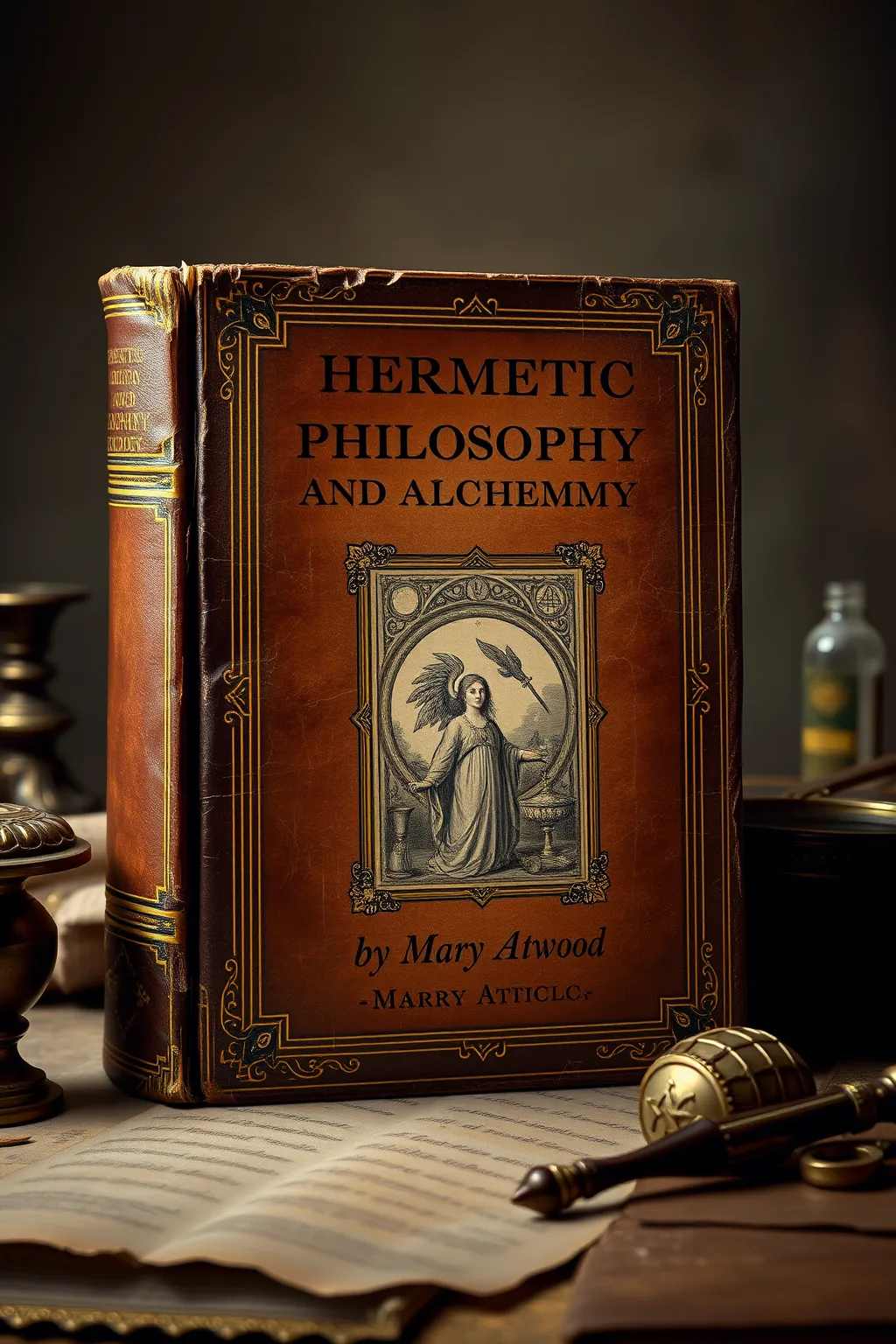
Hermetic Philosophy and Alchemy
 71
71

Hermetic Philosophy and Alchemy
Mary Atwood’s *Hermetic Philosophy and Alchemy* avoids the pitfalls of sensationalism, presenting a grounded exploration of a subject often shrouded in myth. The strength lies in its methodical unpacking of complex ideas, particularly Atwood's meticulous tracing of the *Prima Materia* concept through various alchemical texts. However, the book's academic rigor, while commendable, occasionally leads to a dry presentation, particularly in the sections detailing early Alexandrian alchemical practices. A passage that stands out is the detailed explanation of the symbolic significance of the Ouroboros, which Atwood connects to cyclical time and self-generation with unusual clarity. The work is an indispensable resource for scholars, though it may require persistence from the lay reader.
This is a scholarly examination of Hermeticism and alchemy, essential for serious study.
📝 Description
71
Mary Atwood's 2023 book examines Hermetic philosophy and alchemy through foundational texts.
Mary Atwood's "Hermetic Philosophy and Alchemy" offers a detailed study of key Hermetic texts and concepts. The author meticulously analyzes the philosophical ideas and practical alchemical methods that have influenced Western esotericism for centuries. Atwood structures her work to clarify a complex subject, making it accessible to readers new to its study. The book guides readers through the world of ancient wisdom and its ongoing impact.
This volume is suited for students of esoteric studies, philosophers of religion, and historians of Western occultism. It appeals to those wanting a serious scholarly approach to Hermeticism and alchemy, avoiding simplistic interpretations. Readers who value close textual analysis and research into historical sources will find it particularly useful. It also benefits those interested in the links between ancient philosophy, early science, and mystical practices.
Hermetic philosophy originates in Hellenistic Egypt, with Hermes Trismegistus as its legendary source. Alchemy developed alongside it, with roots in Alexandria and experimentation through the medieval and Renaissance periods. Atwood's book connects these developments to Neoplatonism and early Christian thought. The Renaissance rediscovery of the *Corpus Hermeticum* in 1471 spurred renewed interest in these traditions.
💡 Why Read This Book?
• Gain a precise understanding of the "As Above, So Below" principle by analyzing its textual origins and philosophical implications as presented in Atwood's scholarly breakdown. • Discern the historical evolution of alchemical theory, focusing on the *Prima Materia* and its varied interpretations from Hellenistic Egypt to the Renaissance, as detailed in the historical context sections. • Explore the symbolic representation of the *Magnum Opus* by examining the specific allegorical language and laboratory metaphors Atwood uses to describe the Great Work of transformation.
⭐ Reader Reviews
Honest opinions from readers who have explored this book.
❓ Frequently Asked Questions
When was Mary Atwood's Hermetic Philosophy and Alchemy first published?
Mary Atwood's *Hermetic Philosophy and Alchemy* was first published in 2015, making it a relatively modern scholarly work on ancient esoteric subjects.
What is the central philosophical concept explored in Hermetic Philosophy and Alchemy?
The book's central philosophical concept is "As Above, So Below," exploring the macrocosm-microcosm correspondence inherent in Hermetic thought and its alchemical applications.
Does the book cover the practical aspects of alchemy or just theory?
The book covers both theoretical underpinnings and practical alchemical pursuits, examining how laboratory experimentation was intertwined with philosophical and spiritual goals.
What historical period does Atwood focus on for Hermeticism?
Atwood examines the historical development of Hermetic philosophy from its roots in Hellenistic Egypt through the medieval and Renaissance periods, highlighting key textual rediscoveries.
Is Hermetic Philosophy and Alchemy suitable for beginners in esoteric studies?
While comprehensive, the book's scholarly nature makes it best suited for serious students and those with some prior familiarity with esoteric concepts, rather than absolute beginners.
What is the significance of the Prima Materia in the context of this book?
The *Prima Materia* is a key concept, representing the fundamental substance from which all things are formed, and Atwood details its varied theoretical and practical alchemical interpretations.
🔮 Key Themes & Symbolism
The Hermetic Axiom
The work rigorously examines the Hermetic principle "As Above, So Below," positing a fundamental interconnectedness between the celestial realms and earthly existence. Atwood illustrates how this axiom permeated not only philosophical discourse but also alchemical practices, guiding the practitioner's understanding of transformation. The book details how this concept informed the search for correspondences, linking astrological influences, elemental forces, and the human constitution as a reflection of the greater universe. This principle serves as the bedrock for much of the esoteric worldview explored.
Alchemical Transformation
Central to the book is the concept of the *Major work*, or Great Work, which encompasses both spiritual enlightenment and material transmutation. Atwood meticulously outlines the stages and symbolic processes involved in this alchemical endeavor. She deciphers the allegorical language used in historical texts, revealing how the transformation of base metals into gold served as a metaphor for the purification and perfection of the human soul. The interplay between theoretical knowledge and practical laboratory work is a recurring focus.
The Prima Materia
The book dedicates significant attention to the *Prima Materia*, the primordial substance from which all creation is believed to have emerged. Atwood traces the evolution of this concept through various philosophical and alchemical traditions, highlighting its many-sided interpretations. The *Prima Materia* is presented not merely as a physical element but as a philosophical principle embodying potentiality and the source of all forms, a crucial element in the alchemist's quest for understanding and manipulating the fundamental building blocks of reality.
Symbolic Language of Alchemy
A significant portion of Atwood's work is devoted to deciphering the rich symbolic lexicon of alchemy. The book explores the meaning behind common alchemical symbols such as the Ouroboros, the Phoenix, and various planetary and elemental signs. Atwood explains how these symbols served as a coded language, essential for transmitting esoteric knowledge across generations while simultaneously protecting it from profane understanding. Understanding this symbolic framework is presented as key to grasping the deeper philosophical and spiritual dimensions of alchemy.
💬 Memorable Quotes
Direct passages from the work, attributed to the author.
“The principle of 'As Above, So Below' bridges the celestial and terrestrial realms.”
— This highlights the core Hermetic belief in universal correspondence, suggesting that understanding the microcosm (humanity, the Earth) reveals truths about the macrocosm (the cosmos, the divine).
“Alchemy sought the transformation of base matter into perfected gold, mirroring spiritual refinement.”
— This captures the dual nature of alchemy as both a physical and spiritual discipline, where the laboratory work symbolized the soul's journey towards purity and enlightenment.
“The *Prima Materia* represents the undifferentiated potential from which all existence arises.”
— This explains the fundamental substance of alchemical theory as a philosophical concept of pure potentiality, the raw material of creation before form is imposed.
“Symbolic language was crucial for preserving and transmitting esoteric alchemical knowledge.”
— This emphasizes the importance of allegory and iconography in alchemy, serving as both a teaching tool and a protective cipher for advanced practitioners.
“The *Major work* was the ultimate goal, a Great Work of both material and spiritual perfection.”
— This defines the alchemist's supreme objective, encompassing the achievement of the Philosopher's Stone and profound personal transformation.
🌙 Esoteric Significance
Tradition
This work firmly sits within the Western Esoteric Tradition, specifically drawing from the Hermetic lineage. It examines the philosophical and practical branches that evolved from the ancient Hermetic texts attributed to Hermes Trismegistus. Atwood's approach bridges classical Hermeticism with the later development of operative and speculative alchemy, placing it within the broader context of Western mystical and proto-scientific thought.
Symbolism
Key symbols include the Ouroboros, representing cyclical creation and destruction, and the concept of the *Prima Materia*, symbolizing the undifferentiated potential of the universe. The *Major work*, or Great Work, is another central motif, signifying the alchemist's journey towards spiritual perfection and the achievement of the Philosopher's Stone.
Modern Relevance
Contemporary practitioners of Western esotericism, including ceremonial magicians and students of comparative religion, continue to draw upon Hermetic principles. Modern interpretations of alchemy often focus on psychological and spiritual transformation, influenced by works like Atwood's that clarify the historical underpinnings. Thinkers exploring consciousness studies and the intersection of science and spirituality also find value in its exploration of ancient cosmologies.
👥 Who Should Read This Book
• Students of Western Esotericism seeking a rigorous academic foundation in Hermetic philosophy and its alchemical applications. • Historians of science and religion interested in the transition from ancient philosophical traditions to early modern scientific inquiry. • Practitioners of contemplative or meditative practices looking to understand the historical roots of symbolic transformation and correspondence principles.
📜 Historical Context
The intellectual landscape that gave rise to Hermetic philosophy and alchemy was complex, originating in Hellenistic Egypt around the 1st to 3rd centuries CE. This era saw a fusion of Greek philosophical thought with Egyptian religious traditions and Gnostic ideas. The legend of Hermes Trismegistus, a syncretic deity, became the purported author of numerous mystical and philosophical texts, collectively known as the Hermetica. Alchemy itself developed alongside this philosophy, with early figures like Zosimos of Panopolis documenting practices and theories. During the medieval period, these Arabic translations profoundly influenced European thought. The Renaissance saw a significant revival, particularly after the Latin translation of the *Corpus Hermeticum* in 1471, championed by figures like Marsilio Ficino. This period also witnessed the rise of competing schools of thought, including Paracelsianism, which offered a more medical and chemical approach to alchemy, and Kabbalah, which provided a different mystical framework. While not universally accepted, Hermetic ideas gained traction among thinkers like Giordano Bruno and influenced the development of early scientific inquiry.
📔 Journal Prompts
The concept of 'As Above, So Below': How might this principle manifest in your immediate environment?
Reflect on the *Prima Materia* as a symbol of potentiality in your personal life.
Analyze a modern symbol or practice through the lens of alchemical symbolism discussed.
Consider the *Major work* as a metaphor for personal growth and development.
Explore the connection between ancient philosophical texts and contemporary esoteric thought.
🗂️ Glossary
Hermeticism
A religious, philosophical, and esoteric tradition based primarily upon writings attributed to Hermes Trismegistus, a legendary Hellenistic figure.
Alchemy
An ancient tradition that sought to purify, mature, and perfect certain objects. Alchemists were often concerned with the transmutation of base metals into gold and the creation of an elixir of immortality.
Prima Materia
Latin for 'first matter,' the primordial substance from which all materials are derived in ancient and medieval cosmology and alchemy.
Major work
Latin for 'Great Work,' referring to the process of creating the Philosopher's Stone through alchemical means, often seen as a metaphor for spiritual transformation.
Corpus Hermeticum
A collection of twenty-one philosophical and religious treatises attributed to Hermes Trismegistus, central to Hermetic philosophy.
Ouroboros
An ancient symbol depicting a serpent or dragon eating its own tail, representing cyclicality, eternity, and the primordial unity of all things.
As Above, So Below
A fundamental Hermetic axiom stating that the principles governing the cosmos (macrocosm) are mirrored in the individual and earthly realms (microcosm).
🔮 Readers Also Liked
Browse all →









More by Mary Atwood
All books →
More Free Alchemy & Hermeticism Books
View all →







![The Widow Ching Pirate [5 stories]](/img/thumb/the-widow-ching-pirate-5-stories-jorge-luis-borges-195810.webp)