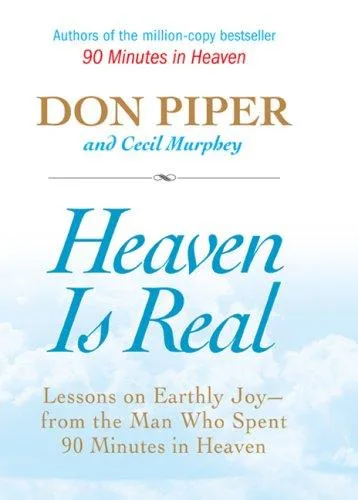
Heaven is real
 77
77

Heaven is real
Don Piper's account of his alleged 1989 journey to heaven is presented with a disarming sincerity that forms its primary strength. The narrative of his visit to the celestial realm, complete with encounters and divine light, is detailed and emotionally resonant for believers. However, the work falters when it attempts to present this deeply personal, subjective experience as objective fact without robust external verification beyond Piper's own testimony and that of his wife. The description of heaven, while vivid, adheres closely to conventional Christian iconography, which, while comforting to some, might limit its appeal to those seeking a more novel or expansive view of the afterlife. The inclusion of Cecil Murphey, a seasoned NDE author, as a co-writer lends credibility to the storytelling, yet the core claims remain within the realm of faith. Piper's testimony serves as a powerful affirmation for those already inclined to believe, rather than a persuasive argument for skeptics.
📝 Description
77
Don Piper claimed to visit heaven in 1989, detailing the experience in "Heaven Is Real."
Don Piper's "Heaven Is Real" recounts his alleged near-death experience from 1989. A Baptist minister, Piper describes a period where he believed he passed into heaven, encountered biblical figures, and witnessed divine light before returning to life. The book presents this as a factual account of the afterlife, detailing the spiritual phenomena and physical sensations he reported during his absence from his body. The narrative focuses on his return to consciousness and the subsequent transformation of his faith and ministry.
This book appeals to readers interested in personal testimonies of the afterlife and near-death experiences, particularly those within a Christian framework. It addresses concepts such as heaven, angelic encounters, and the divine presence. Individuals who draw comfort or conviction from stories of miraculous survival and spiritual encounters are likely to find Piper's narrative engaging. It also offers a point of comparison for those studying near-death experiences across different belief systems.
Published in 2008, "Heaven Is Real" entered a popular discourse on near-death experiences that gained traction following earlier works. Piper's account, framed within an evangelical Christian perspective, offers a specific theological interpretation of the afterlife. It distinguishes itself from more secular or New Age interpretations of NDEs by grounding the experience in biblical narratives and ministerial authority. The book reflects a public interest in narratives that explore the boundary between the physical and spiritual worlds.
💡 Why Read This Book?
• Gain an intimate perspective on a specific purported near-death experience, understanding Don Piper's detailed account of his 1989 celestial journey and the emotional impact it had upon his return to earthly life. • Explore the concept of divine presence and peace as described by Piper, which is presented as a tangible encounter with Jesus Christ and angelic beings during his alleged visit to heaven. • Understand the theological interpretations of afterlife experiences within a contemporary Christian framework, examining how Piper's narrative reinforces traditional beliefs about heaven and divine intervention.
⭐ Reader Reviews
Honest opinions from readers who have explored this book.
❓ Frequently Asked Questions
What year did Don Piper claim his near-death experience occurred?
Don Piper states that his purported near-death experience, which forms the basis of "Heaven Is Real," occurred in November 1989. He was involved in a serious car accident that led to his temporary death.
Who are the authors of "Heaven Is Real"?
The book "Heaven Is Real" is authored by Don Piper, with Cecil Murphey credited as co-author. Don Piper shares his personal near-death experience, while Murphey, an experienced writer on NDEs, helps structure and present the narrative.
What is the main religious perspective presented in "Heaven Is Real"?
The book is firmly rooted in an evangelical Christian perspective. Don Piper, a Baptist minister, interprets his near-death experience through the lens of Christian scripture and theology, describing encounters with Jesus and biblical imagery.
Does "Heaven Is Real" discuss specific theological concepts?
Yes, the book discusses concepts such as the presence of God, the nature of heaven as a literal place, angelic beings, and the return of Christ. Piper's experience is framed as a confirmation of these core Christian tenets.
What is the significance of Don Piper's return to life in the narrative?
Piper's return to life after being declared dead is presented as a miraculous event. This aspect of the narrative emphasizes divine intervention and purpose, suggesting he was given a second chance to share his testimony and serve God.
What kind of reception did "Heaven Is Real" receive upon its publication in 2008?
Upon its publication in 2008, "Heaven Is Real" gained significant popularity, becoming a bestseller. It resonated with a large audience interested in NDE accounts and Christian testimonies, sparking both belief and discussion.
🔮 Key Themes & Symbolism
Authenticity of the Afterlife
The core of "Heaven Is Real" revolves around the author's conviction that his 1989 near-death experience provides undeniable proof of a literal heaven. Piper describes celestial landscapes, divine beings, and the presence of Jesus Christ with a level of detail intended to convey the reality and tangibility of this spiritual realm. His narrative challenges skepticism by presenting his journey as an objective event, distinct from dreams or hallucinations, thereby serving as a proof of the Christian belief in an eternal paradise.
Divine Encounters and Revelation
Piper recounts specific encounters during his purported trip to heaven, most notably with Jesus Christ and his deceased mother. These interactions are depicted as moments of profound love, peace, and revelation, where divine truths are imparted. The book frames these encounters not just as personal experiences but as affirmations of scriptural promises, suggesting that heaven is a place of reunion and spiritual understanding accessible through faith and divine grace.
Miraculous Return and Purpose
A critical element of the book is Don Piper's unexpected return to life after being declared dead for 90 minutes following a severe car accident. This survival is presented as a divine miracle, granting him a second chance to live and share his extraordinary testimony. The narrative emphasizes that his purpose in returning was to bear witness to the reality of heaven and encourage faith in others, underscoring a belief in divine timing and mission.
Christian Hope and Comfort
Ultimately, "Heaven Is Real" functions as a source of hope and comfort for readers, particularly those within the Christian tradition. By offering a vivid, first-hand account of heaven, Piper aims to alleviate the fear of death and provide assurance of eternal life. The book reinforces the Christian message of salvation through Christ and the promise of a perfect, joyful existence beyond earthly suffering, making it a spiritually uplifting read for believers.
💬 Memorable Quotes
Direct passages from the work, attributed to the author.
“I had been to heaven. I had seen things that I could not explain. I had been in the presence of God. I had seen Jesus.”
— This statement expresses the central claim of the book: a direct, verifiable (in Piper's view) experience of the afterlife. It emphasizes the transformative nature of the event and its role in reinforcing his faith and subsequent testimony.
“My purpose was to tell others that heaven is real, that God is real, and that Jesus is real.”
— This statement articulates the author's perceived divine mission stemming from his experience. It underscores the evangelical drive behind sharing his testimony, aiming to inspire faith and conviction in his audience.
💡 Key Ideas
Editorial paraphrase of the work's core concepts — not direct quotes.
The love I felt in heaven was beyond anything I had ever known. It was a love that filled every part of my being.
This paraphrased concept highlights the overwhelming emotional and spiritual experience Piper claims to have had. It speaks to a divine, unconditional love that transcends human comprehension and is a core element of his description of the celestial realm.
I saw my mother. She looked younger and more beautiful than I had ever seen her.
This quote illustrates the personal and relational aspect of Piper's alleged heavenly journey. The reunion with a loved one, depicted in an idealized form, adds an emotional layer to the spiritual narrative, making the afterlife feel more accessible and comforting.
I was dead, but I was alive. I was in heaven, but I was back on earth. It was a paradox I could not explain.
This paraphrased concept addresses the disorienting yet miraculous nature of his near-death experience and subsequent return. It captures the profound mystery and the apparent defiance of natural laws inherent in his testimony.
🌙 Esoteric Significance
Tradition
While not fitting neatly into a specific esoteric lineage like Hermeticism or Kabbalah, "Heaven Is Real" engages with themes common in various spiritual traditions, particularly those focused on visionary experiences and the nature of the afterlife. It shares common ground with Gnostic traditions in its emphasis on a higher, spiritual reality distinct from the material world, and with Christian mysticism in its focus on direct encounters with the divine. However, Piper's account remains firmly within orthodox Christian theology, presenting heaven as a divinely ordained place rather than a constructed inner state or a area of cosmic consciousness often explored in other esoteric schools.
Symbolism
The primary symbolism in "Heaven Is Real" is the overwhelming, divine light, which represents God's presence, purity, and love. This motif is prevalent in many mystical traditions, signifying enlightenment and ultimate reality. Another key symbol is the reunion with deceased loved ones, particularly Piper's mother; this symbolizes continuity of connection beyond death and the comforting aspect of the afterlife, suggesting that earthly relationships have a spiritual echo. The description of the celestial city and heavenly music also draws on biblical apocalyptic imagery, symbolizing perfection, peace, and divine harmony.
Modern Relevance
In contemporary spiritual and wellness circles, "Heaven Is Real" continues to be referenced by those exploring near-death experiences and alternative perspectives on mortality. While not directly adopted by specific esoteric schools, its narrative speaks to individuals seeking experiential validation of spiritual beliefs. Thinkers and practitioners focused on consciousness studies, the intersection of science and spirituality, and those seeking comfort in the face of death often draw upon accounts like Piper's to supplement their understanding of non-physical realities and the potential for existence beyond the physical body.
👥 Who Should Read This Book
• Individuals deeply interested in Christian testimonies of the afterlife and near-death experiences, seeking a detailed, personal account of a purported heavenly visit. • Believers seeking reassurance and comfort regarding death and the nature of heaven, who find strength in narratives that affirm core Christian doctrines about salvation and eternal life. • Students of comparative spirituality and NDE phenomena, who wish to analyze a prominent example of an evangelical Christian interpretation of such experiences.
📜 Historical Context
Published in 2008, Don Piper's "Heaven Is Real" emerged within a field of popular interest in near-death experiences (NDEs), a phenomenon that had gained significant traction following earlier accounts like Betty Eadie's "Embraced by the Light" in the early 1990s. Piper's work, co-authored with Cecil Murphey, a prolific writer on NDEs, contributed to this ongoing discourse by offering a distinctly evangelical Christian interpretation. Unlike more New Age or broadly spiritual explorations of the afterlife, Piper's narrative focused on biblical descriptions and theological affirmations. The book's success tapped into a public appetite for personal testimonies of spiritual encounters, providing a counterpoint to more secular or scientific explanations of NDEs. Its reception highlighted the enduring appeal of narratives that bridge the material and immaterial worlds, reinforcing a belief in divine realities for a substantial audience.
📔 Journal Prompts
The light described in Piper's celestial journey: what qualities does it embody beyond mere illumination?
Piper's reunion with his mother: how does this specific encounter inform the concept of eternal relationships?
The paradox of being declared dead yet experiencing heaven: reflect on the nature of consciousness beyond physical cessation.
The role of divine love as experienced by Piper: how might this influence earthly interactions?
Piper's return to life: consider the implications of a divinely appointed purpose following a profound spiritual event.
🗂️ Glossary
Near-Death Experience (NDE)
A profound personal experience associated with death or dying, often involving altered consciousness, perceptions of a spiritual realm, and encounters with divine beings or deceased relatives.
Celestial Realm
In many religious and spiritual contexts, this refers to a heavenly or divine domain, often described as the abode of God, angels, and the souls of the righteous after death.
Divine Light
A symbolic representation of God's presence, love, wisdom, or ultimate reality, frequently reported in mystical and near-death experiences as an intensely brilliant and benevolent illumination.
Evangelical Christianity
A Protestant Christian movement emphasizing the experience of conversion or being 'born again,' the authority of the Bible, and the necessity of spreading the gospel (evangelism).
Baptist Minister
An ordained leader within Baptist churches, responsible for preaching, pastoral care, and administering sacraments, reflecting a specific Protestant denomination.
Testimony
A personal account of religious experience or belief, often shared to affirm faith or persuade others, as undertaken by Don Piper in this book.
Miracle
An extraordinary event attributed to divine intervention, transcending natural laws, such as Don Piper's alleged survival after being declared dead.
🔮 Readers Also Liked
Browse all →









More Free Occult Philosophy Books
View all →