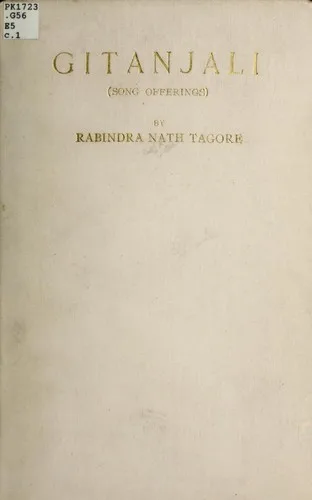
Gitanjali (song offerings)
 75
75

Gitanjali (song offerings)
Tagore's "Gitanjali" is less a collection of discrete poems and more a sustained outpouring of spiritual yearning, a sustained meditation on the divine presence in all things. The strength of this translation lies in its faithful rendering of Tagore's simple yet profound language, particularly in the way it captures the devotional fervor that Yeats himself recognized. One limitation, however, is that the sheer volume of similar devotional expressions can, at times, lead to a certain thematic homogeneity, making individual poems less distinct than they might be in a longer, more varied work. The passage describing the "singer" who "sings his song to the world" (poem 35) encapsulates the collection's core: the artist as a conduit for divine expression, a theme resonating through many of the verses. Ultimately, Gitanjali offers a sustained, beautiful hymn to the divine, best appreciated in its cumulative emotional impact.
📝 Description
75
Rabindranath Tagore's Gitanjali, meaning "song offerings," is a collection of 103 short poems first published in Bengali in 1910.
This volume contains the 1912 English translation of Rabindranath Tagore's "Gitanjali," a collection of 103 lyrical poems. William Butler Yeats selected and prefaced this version, which was instrumental in bringing Tagore international recognition, leading to his Nobel Prize in Literature the following year. The poems express Tagore's spiritual and devotional verses, translated here by Marie Luise Gothein and Yeats.
These verses are suited for readers interested in devotional poetry and the connections between Eastern spirituality and Western literary traditions. Those seeking introspection and a deeper sense of the divine through lyrical language will find resonance here. The work also holds value for scholars of comparative literature and world religions due to its historical and cultural placement.
Published in English in 1912, Gitanjali appeared during a period of heightened interest in Eastern philosophies among Western intellectuals, coinciding with movements like Theosophy. Tagore's "song offerings" offered a personal, devotional path that resonated with those looking for spiritual introspection beyond established Western religious structures. The collection's emphasis on the divine present in everyday life and nature aligns with contemplative traditions that find the sacred in the simple and the natural world.
💡 Why Read This Book?
• Gain an intimate understanding of Tagore's devotional philosophy, exploring the concept of the "Divine Lover" as presented in his 1910 Bengali original, offering a unique perspective on spiritual connection. • Experience the lyrical power of a collection that earned Rabindranath Tagore the Nobel Prize in Literature in 1913, appreciating how its spiritual themes captured global attention. • Engage with the profound symbolism of nature as a manifestation of the divine, a core tenet evident throughout the 103 "song offerings" that form the collection.
⭐ Reader Reviews
Honest opinions from readers who have explored this book.
❓ Frequently Asked Questions
When was Rabindranath Tagore awarded the Nobel Prize in Literature?
Rabindranath Tagore was awarded the Nobel Prize in Literature in 1913, largely due to the international reception of his translated poetry, including Gitanjali.
Who translated Gitanjali into English for the 1912 edition?
The English translation of Gitanjali published in 1912, which brought Tagore international fame, was selected and prefaced by William Butler Yeats, with significant contribution from the translator Marie Luise Gothein.
What does the title 'Gitanjali' mean?
The title 'Gitanjali' translates from Bengali to 'song offerings,' reflecting the devotional and lyrical nature of the poems within the collection.
What is the primary theme of the poems in Gitanjali?
The primary theme of Gitanjali is spiritual devotion and the soul's longing for union with the divine, often expressed through metaphors of love and nature.
In what year was the original Bengali version of Gitanjali published?
The original Bengali version of Gitanjali, containing 103 poems, was first published in 1910.
What role did William Butler Yeats play in the English publication of Gitanjali?
William Butler Yeats selected the poems for the English translation, wrote a significant preface for the 1912 edition, and championed the work, which was instrumental in Tagore's global recognition.
🔮 Key Themes & Symbolism
Divine Presence in Nature
Tagore consistently uses natural elements—the sky, rivers, flowers, the sun, the moon—as metaphors for the divine. The "song offerings" perceive God not as a distant deity but as an immanent force woven into the fabric of existence. This approach aligns with pantheistic or panentheistic views, seeing the sacred manifest in the mundane beauty of the world. The poems suggest that true worship involves appreciating and surrendering to this pervasive divine presence, finding spiritual connection in the rustling leaves or the morning light.
Surrender and Devotion
A central tenet of Gitanjali is the concept of complete surrender to the divine will. The speaker repeatedly expresses a desire to offer their life, their songs, and their very being to God. This isn't a passive resignation but an active, loving submission. The poems explore the paradox of finding freedom through relinquishing ego and personal desires, embracing a state of pure devotion that transcends earthly concerns and fosters a deep, intimate relationship with the divine.
The Divine Lover
The relationship between the speaker and God in Gitanjali is often depicted in terms of romantic love. God is portrayed as a beloved, a divine partner with whom the soul yearns for union. This personification of the divine as a lover imbues the spiritual quest with intense emotion and intimacy. The poems express longing, joy, and sometimes the pain of separation, mirroring human romantic experiences but elevating them to a spiritual plane, seeking ultimate communion with the divine beloved.
The Humble Offering
Tagore emphasizes the value of simple, humble offerings over grand rituals or sacrifices. The "song offerings" themselves are presented as modest gifts from the heart. The divine is shown to be more pleased with sincere devotion and acts of kindness than with elaborate ceremonies. This theme democratizes spirituality, suggesting that anyone, regardless of status or intellectual attainment, can connect with the divine through genuine love and service to humanity, finding sacredness in the ordinary.
💬 Memorable Quotes
Direct passages from the work, attributed to the author.
“My song has no end. It is only sung when it is sung.”
— This paradoxical statement highlights the ephemeral yet continuous nature of creative and spiritual impulse. The song exists, but its true realization and impact occur in the moment of its offering or reception.
“Let me not be judged by the number of my deeds, but by the love in them.”
— This plea emphasizes the primacy of intention and inner feeling over outward accomplishment in the spiritual realm. It suggests that divine judgment focuses on the purity of the heart and the love that motivates actions.
“The world has kissed my soul with its pain.”
— This evocative phrase captures the idea that suffering and hardship are not merely negative experiences but can be sources of profound spiritual growth and understanding, leading to a deeper connection with the world and the divine.
💡 Key Ideas
Editorial paraphrase of the work's core concepts — not direct quotes.
Thou hast made me endless, such is thy pleasure.
This line articulates a core spiritual concept: the soul's infinite potential and its origin in the divine will. It suggests that our boundless nature is not accidental but a deliberate act of creation, a reflection of God's own infinite being.
I have sung to the ages and the ages have sung to me.
This quote speaks to the eternal nature of spiritual expression and connection. It implies a timeless dialogue between the human spirit and the cosmos, suggesting that the act of singing or creating is a participation in an ongoing, universal symphony.
🌙 Esoteric Significance
Tradition
Gitanjali, while rooted in Bengali Vaishnavism and Bengali devotional poetry, speaks to broader pan-Indian spiritual traditions that emphasize Bhakti yoga (devotion). Its focus on the soul's yearning for divine union and the use of love metaphors aligns with mystical traditions across various religions, including Sufism and Christian mysticism. It departs from rigidly defined esoteric systems by presenting a more fluid, intuitive spiritual experience, accessible through emotional and aesthetic engagement rather than strict adherence to dogma or ritual.
Symbolism
Key symbols include **light** (representing divine presence, illumination, and truth), **the river** (symbolizing the flow of life, the journey of the soul, and its connection to the divine source), and **flowers** (representing ephemeral beauty, devotion, and the offerings of the heart). The recurring motif of the **singer** or **bard** symbolizes the poet as a conduit for divine expression, a channel through which the universal song of creation is made manifest and heard.
Modern Relevance
Tagore's Gitanjali continues to influence contemporary spiritual seekers and artists. Its emphasis on finding the divine in nature and everyday life speaks to modern ecological spirituality and mindfulness practices. Thinkers and practitioners in interfaith dialogue often cite Gitanjali as an example of universal spiritual expression transcending cultural boundaries. Its lyrical quality also inspires contemporary poets and musicians exploring themes of devotion, love, and existential longing, bridging traditional devotionalism with modern sensibilities.
👥 Who Should Read This Book
• Devotional poets and writers seeking to deepen their understanding of spiritual expression through lyrical means, drawing inspiration from Tagore's 103 "song offerings." • Students of comparative religion and mysticism interested in the Bhakti tradition and its cross-cultural appeal, especially following its 1912 English publication. • Individuals seeking solace and spiritual connection who are drawn to poetry that explores the relationship between the soul and the divine, as articulated by a Nobel laureate.
📜 Historical Context
The English translation of Rabindranath Tagore's Gitanjali, published in 1912 and prefaced by W.B. Yeats, arrived during a period of intense cross-cultural intellectual ferment. Western thinkers were increasingly exploring Eastern philosophies, partly influenced by the rise of Theosophy and figures like Madame Blavatsky. Tagore’s work offered a deeply personal and lyrical expression of Hindu devotionalism, distinct from the more systematic philosophies often presented. Yeats's enthusiastic endorsement, which highlighted the "spiritual" and "mystical" qualities of the poems, was crucial. It positioned Tagore's work as a vital spiritual counterpoint to the materialist concerns of the era, contributing to his Nobel Prize in Literature in 1913. The collection's success demonstrated a Western appetite for spiritual literature from non-Western sources, influencing subsequent literary and spiritual trends.
📔 Journal Prompts
The "Divine Lover's" silent presence.
The offering of one's song.
Nature as a mirror of the divine.
The soul's longing for union.
Finding sacredness in humble moments.
🗂️ Glossary
Bhakti
A Sanskrit term meaning 'devotion' or 'love' for a deity. It is a major spiritual path in Hinduism, emphasizing intense personal devotion and surrender to God.
Vaishnavism
A major tradition within Hinduism that worships Vishnu and his avatars (such as Rama and Krishna) as the supreme God. Gitanjali draws heavily from this devotional lineage.
Pervasive Divine Presence
The concept that God or the divine is not confined to a specific place or form but is present throughout all of creation and within all beings.
Soul's Yearning
The deep, intrinsic desire of the individual soul for connection, communion, or union with the divine or ultimate reality.
Ephemeral Beauty
The quality of transient or fleeting loveliness, often found in nature, which can serve as a symbol of divine presence or a reminder of the impermanence of worldly things.
Ego Relinquishment
The spiritual practice of setting aside or transcending the sense of self, personal desires, and self-importance to achieve greater spiritual awareness or union.
Lyrical Expression
Poetry characterized by subjective emotions and thoughts, often musical in quality, focusing on personal feelings and experiences rather than narrative.
🔮 Readers Also Liked
Browse all →









More by Rabindranath Tagore, Marie Luise Gothein, William Butler Yeats
All books →
More Free Spiritual Development Books
View all →