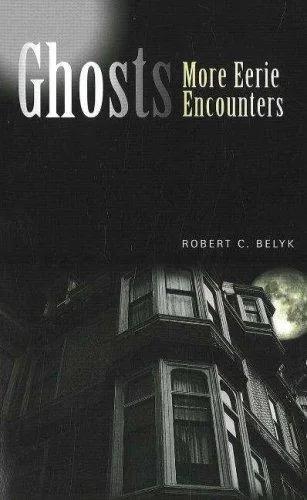
Ghosts
 81
81

Ghosts
Robert C. Belyk’s "Ghosts" approaches its subject with a commendable desire for order, attempting to classify and explain spectral phenomena that often defy easy categorization. The work's strength lies in its systematic breakdown of different hauntings, particularly its distinction between residual and intelligent manifestations. However, the 2002 publication date means some of the scientific theories explored, especially concerning quantum physics, feel somewhat dated in light of subsequent advancements. Belyk’s exploration of the historical context, referencing early parapsychological investigations, offers a valuable anchor. A particularly compelling section discusses the subjective nature of perception in reported sightings, highlighting how observer bias can influence interpretations of events. While "Ghosts" provides a structured overview, it occasionally struggles to advance beyond existing paradigms, offering more of a thorough compilation than a revolutionary perspective.
📝 Description
81
Robert C. Belyk's 2002 book "Ghosts" examines spectral phenomena beyond sensationalism.
Published in 2002, Robert C. Belyk's "Ghosts" offers a structured analysis of spectral phenomena, moving beyond sensationalism to consider underlying principles and potential explanations for reported hauntings and apparitions. The book guides readers through various theories and historical accounts with a methodical approach to understanding a subject often relegated to folklore. It is intended for serious students of the paranormal, researchers, and skeptics who seek a balanced perspective on ghost sightings and related experiences. The work appeals to those interested in the intersection of psychology, physics, and the unexplained, particularly individuals who value evidence-based inquiry into metaphysical subjects.
Belyk dissects various categorizations of hauntings, including residual hauntings, which are seen as imprints of past events, and intelligent hauntings, which suggest interactions with discernible consciousness. Theoretical frameworks are discussed, incorporating potential psychological explanations, electromagnetic field theories, and quantum mechanical interpretations. This approach aims to provide a comprehensive understanding of the ghost phenomenon, engaging with historical discourse on the subject.
Belyk's work follows a tradition of thinkers attempting to rationalize or categorize spectral encounters. This lineage includes figures like Cesare Lombroso, who conducted scientific analyses of mediums and spiritualism in the late 19th century. The book engages with this historical discourse, positioning itself within an era of renewed interest in the paranormal fueled by media attention and online communities.
💡 Why Read This Book?
• Gain a structured understanding of spectral phenomena, learning to differentiate between concepts like residual hauntings and intelligent hauntings as detailed in the book's categorizations. • Explore theoretical explanations for hauntings, including potential psychological factors and early electromagnetic field theories discussed within Belyk's analysis. • Appreciate the historical trajectory of paranormal investigation by understanding how Belyk's work from 2002 relates to earlier scientific attempts to study phenomena, such as those undertaken by figures like Cesare Lombroso.
⭐ Reader Reviews
Honest opinions from readers who have explored this book.
❓ Frequently Asked Questions
What is the publication year of Robert C. Belyk's 'Ghosts'?
Robert C. Belyk's book "Ghosts" was first published in 2002, placing it within a period of increased public interest in paranormal research.
Does 'Ghosts' by Robert C. Belyk offer scientific explanations for hauntings?
Yes, the book explores various theoretical explanations for hauntings, including psychological factors and early scientific concepts like electromagnetic fields, aiming for a balanced perspective.
What are the main types of hauntings discussed in 'Ghosts'?
The book categorizes hauntings into key types, notably differentiating between residual hauntings, which are seen as imprints of past events, and intelligent hauntings, which suggest conscious interaction.
Is Robert C. Belyk's 'Ghosts' suitable for skeptics?
The book is designed for a broad audience, including skeptics, by presenting a methodical examination of spectral phenomena and exploring various explanatory models.
How does 'Ghosts' connect to historical paranormal research?
Belyk's work contextualizes modern ghost studies by referencing earlier figures and methods in parapsychology, offering a historical perspective on the subject.
What theoretical frameworks does Belyk use in 'Ghosts'?
Belyk employs a range of theoretical frameworks, including psychological interpretations, theories related to electromagnetic fields, and even early quantum mechanical ideas to explain ghostly phenomena.
🔮 Key Themes & Symbolism
Categorization of Hauntings
The work meticulously categorizes reported spectral events into distinct types, primarily differentiating between residual hauntings, often described as psychic imprints or replays of past occurrences, and intelligent hauntings, which imply conscious interaction or awareness from a disembodied entity. This structured approach allows for a more analytical discussion of phenomena, moving beyond generalized descriptions of ghostly activity. Belyk examines the characteristics and evidence associated with each category, providing a framework for researchers and enthusiasts to better understand and document their own experiences or observations.
Theoretical Explanations
Belyk studies a spectrum of potential explanations for hauntings, moving beyond purely supernatural interpretations. The book explores psychological frameworks, considering how perception, suggestion, and memory can contribute to reported experiences. It also examines early scientific hypotheses, such as the influence of electromagnetic fields (EMF) on human consciousness and the environment, and touches upon nascent quantum mechanical interpretations that were emerging in parapsychological discussions around the turn of the millennium. This multi-disciplinary approach aims to provide a comprehensive understanding of the complex factors potentially involved.
Historical Context and Research
Published in 2002, "Ghosts" situates itself within the ongoing history of paranormal investigation. Belyk references earlier efforts to study ghosts and related phenomena, acknowledging the work of figures who attempted to apply scientific methods to spiritualism and psychic research in previous centuries. This includes examining the evolution of thought on spectral encounters, from folklore and anecdotal accounts to more structured research attempts. By providing this historical backdrop, the book highlights the enduring human fascination with the afterlife and the persistent quest to understand these elusive manifestations.
Observer Perception
A significant aspect of Belyk's analysis centers on the role of the observer in reported paranormal experiences. The book discusses how individual perception, belief systems, and even physiological states can influence the interpretation of ambiguous stimuli. It addresses the subjectivity inherent in witnessing alleged hauntings and the potential for misinterpretation or hallucination. By emphasizing the psychological component, Belyk encourages a critical evaluation of evidence and promotes a nuanced understanding of how human consciousness interacts with unexplained phenomena.
💬 Memorable Quotes
Direct passages from the work, attributed to the author.
“Spectral phenomena are often categorized as residual or intelligent.”
— This statement highlights a core organizational principle within the book, distinguishing between hauntings that are mere energetic replays of past events and those that involve apparent conscious interaction with an entity.
“Early research into psychic phenomena attempted to apply scientific methods.”
— This concept underscores the book's engagement with the historical context of paranormal studies, referencing efforts by figures in the late 19th and early 20th centuries to investigate spiritualism and apparitions systematically.
💡 Key Ideas
Editorial paraphrase of the work's core concepts — not direct quotes.
The observer's state of mind can significantly impact their perception of an event.
This paraphrase points to the book's exploration of psychological factors, emphasizing how personal beliefs, expectations, and even physiological conditions can shape an individual's interpretation of ambiguous sensory input.
Electromagnetic fields are considered a potential influence on reported hauntings.
This paraphrased idea indicates the book's exploration of physical theories, suggesting that environmental factors like EMF might play a role in generating or influencing experiences of spectral activity.
Distinguishing between different types of hauntings aids in analysis.
This quote emphasizes the analytical benefit of Belyk's classification system, suggesting that by separating phenomena like residual imprints from interactive entities, researchers can conduct more precise investigations.
🌙 Esoteric Significance
Tradition
While not explicitly tied to a single esoteric lineage like Kabbalah or Theosophy, "Ghosts" draws from the broader tradition of metaphysical inquiry into non-physical realities. It engages with concepts found across various spiritual and occult traditions that posit the existence of spirits, energies, or consciousness beyond the physical body. The book attempts to bridge these ancient concepts with modern scientific speculation, creating a work that is accessible to those exploring the edges of established physics and psychology from a spiritual or metaphysical perspective.
Symbolism
The primary symbol explored is the 'ghost' itself, which functions as a multi-layered motif. It represents not only the deceased but also residual energetic imprints, psychological projections, and perhaps even quantum phenomena. The concept of 'haunting' serves as a symbol for unresolved issues, past traumas, or lingering energies that manifest in the present. Belyk’s analysis of residual vs. intelligent hauntings can be seen as symbolizing the difference between passive elements of the past and active, potentially conscious, remnants of existence.
Modern Relevance
Contemporary paranormal investigation, particularly within fields like psychical research and certain branches of parapsychology, continues to grapple with the classifications and theoretical frameworks Belyk outlined in 2002. Thinkers exploring consciousness studies, quantum mysticism, and even those investigating alleged mediumship often reference similar distinctions between different types of paranormal experiences. The book's emphasis on observer effect and potential EMF correlations remains relevant in ongoing discussions about the nature of consciousness and its interaction with subtle energies.
👥 Who Should Read This Book
• Students of parapsychology seeking a foundational text that outlines common theories and classifications of spectral phenomena. • Skeptics interested in understanding the arguments and research methods employed by those who investigate hauntings, offering a structured overview of the subject. • Individuals exploring the intersection of consciousness, physics, and the unexplained, looking for a book that attempts to bridge metaphysical concepts with scientific speculation.
📜 Historical Context
Robert C. Belyk's "Ghosts," published in 2002, arrived during a resurgence of popular interest in the paranormal, amplified by media and the nascent internet. The work engages with a long tradition of spectral inquiry, stretching back to the 19th century. Contemporaries like Hans Bender in Germany were rigorously exploring psychical research with academic backing, while in the UK, figures such as Harry Price had already documented extensive investigations into haunted locations. Belyk’s approach, seeking to classify and theoretically explain phenomena, can be seen as a continuation of efforts to bring a more systematic, albeit speculative, lens to a subject often relegated to folklore. Unlike purely anecdotal accounts, the book attempts to frame ghostly encounters within potential scientific and psychological models, reflecting the ongoing tension between empirical skepticism and the persistent human curiosity about life after death.
📔 Journal Prompts
The distinction between residual and intelligent hauntings: which type resonates more with your personal understanding of spectral phenomena?
Consider the role of observer perception: how might your own state of mind influence your interpretation of an ambiguous event?
Reflect on historical approaches to ghost studies, such as those from the late 19th century; what methods seem most credible and why?
Analyze the concept of electromagnetic field theories in relation to hauntings; what are the potential implications if proven?
Explore the idea of psychic imprints: what kind of energies or events might leave a lasting trace on a location?
🗂️ Glossary
Residual Haunting
A type of haunting characterized by the repetitive, non-interactive manifestation of past events or actions, often described as an energetic imprint or playback.
Intelligent Haunting
A form of haunting where a perceived entity appears to interact with observers, exhibiting awareness, communication, or intentional behavior beyond mere repetition.
Electromagnetic Field (EMF)
A field of force associated with electric charge in motion, which some theories suggest may influence human consciousness or be related to paranormal phenomena.
Psychic Imprint
The theoretical concept of an energetic residue or impression left behind by strong emotions, events, or individuals, which may manifest as a residual haunting.
Observer Effect
In a broader sense, the idea that the act of observation or the state of the observer can influence or be influenced by the phenomenon being observed.
Paranormal
Phenomena that are beyond the scope of conventional scientific understanding or explanation, often relating to psychic abilities, ghosts, or other supernatural occurrences.
Apparition
A ghost or ghostlike image of a person, often appearing suddenly and mysteriously.
🔮 Readers Also Liked
Browse all →









More by Robert C. Belyk
All books →
More Free Occult Philosophy Books
View all →