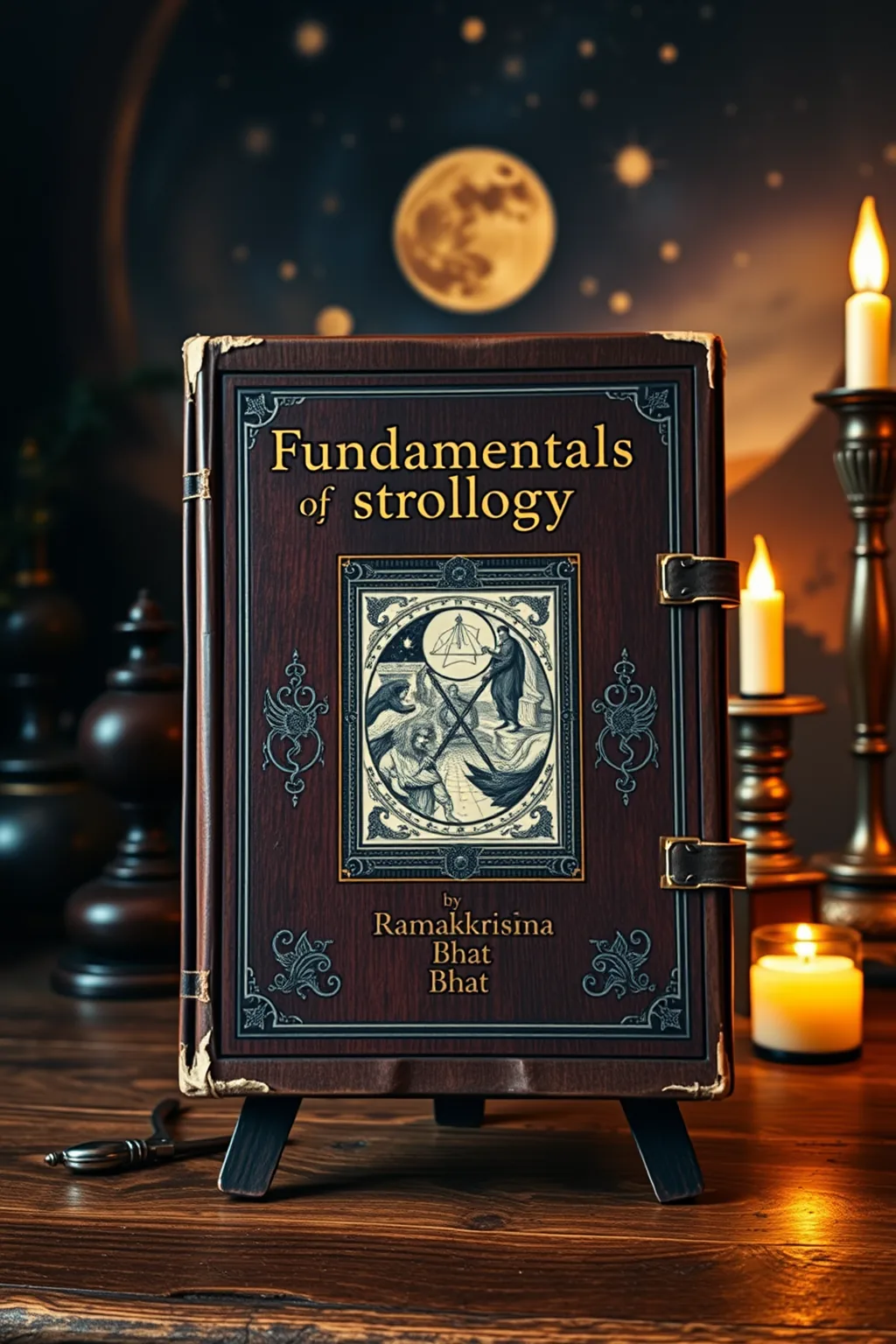
Fundamentals of Astrology
 78
78

Fundamentals of Astrology
M. Ramakrishna Bhat's "Fundamentals of Astrology" is a dense, scholarly treatise that resists the common temptation to oversimplify the intricate science of Jyotisha. Unlike many contemporary guides, Bhat grounds his exposition in the classical texts, offering a rigorous examination of concepts like the Nakshatras and planetary dignities. The section detailing the calculations for Vargas, for instance, is particularly thorough, demanding close attention but rewarding the diligent reader with clarity. However, the book's academic tone, while a strength for serious students, may prove daunting for absolute beginners seeking a more accessible entry point. Its lack of illustrative case studies, beyond the theoretical, also limits its practical application for those new to chart interpretation. Nevertheless, for its precise scholarship and adherence to foundational principles, Bhat's work serves as a valuable reference for the dedicated practitioner or historian of astrology.
📝 Description
78
M. Ramakrishna Bhat's "Fundamentals of Astrology" (2013) systematically explains Vedic astrology, or Jyotisha.
This volume moves beyond simple horoscopes to detail the principles of Vedic astrology, known as Jyotisha. M. Ramakrishna Bhat presents the subject not as a tool for prediction, but as a system for understanding cosmic forces and their effects on Earth. The book is for students serious about the Jyotisha tradition. It assumes some knowledge of astronomy and requires engagement with complex calculations and philosophical ideas. Scholars of comparative religion and ancient sciences, along with those seeking a non-sensationalist approach to astrology, will find this text valuable.
Bhat's work connects to a tradition thousands of years old, with roots in the Vedas. It references key texts like the Brihat Parashara Hora Shastra and acknowledges figures such as Varahamihira and his "Brihat Samhita." This book is part of a continuing effort to study and revive these ancient sciences.
Published in 2013, "Fundamentals of Astrology" draws from Vedic astrology, or Jyotisha, a system with origins in ancient India. This tradition is deeply connected to the Vedas and has evolved through texts like the Brihat Parashara Hora Shastra. Bhat's work situates itself within this lineage, which also includes astronomers and astrologers like Varahamihira. The book contributes to the modern study of these ancient sciences, treating them as frameworks for understanding celestial influences.
💡 Why Read This Book?
• Gain a precise understanding of the Jyotisha system's mathematical and philosophical underpinnings, moving beyond superficial interpretations, as detailed in the sections on planetary periods (dasas). • Appreciate the historical depth of Vedic astrology by engaging with concepts and figures referenced from classical Indian astronomical literature, such as Varahamihira. • Master the intricate calculations and significations of divisional charts (Vargas), a core element often glossed over in introductory texts, providing a unique analytical lens.
⭐ Reader Reviews
Honest opinions from readers who have explored this book.
❓ Frequently Asked Questions
What is the primary astrological system covered in "Fundamentals of Astrology"?
The book primarily focuses on Vedic astrology, known as Jyotisha, a system with ancient Indian origins that utilizes a sidereal zodiac and a unique set of planetary periods (dasas).
Who is M. Ramakrishna Bhat, and what is his background?
M. Ramakrishna Bhat was a notable scholar and author in the field of Indology and Vedic studies. His works, including this one, are characterized by their scholarly rigor and deep engagement with traditional Indian texts.
Does the book explain how to cast a horoscope?
Yes, "Fundamentals of Astrology" covers the foundational calculations necessary for horoscope casting within the Jyotisha framework, including planetary positions and house placements.
What is the significance of the Nakshatras mentioned in the book?
The Nakshatras, or lunar mansions, are a crucial element of Vedic astrology discussed in the book. They offer a finer division of the ecliptic than the zodiacal signs, providing nuanced interpretations of celestial influences.
Is this book suitable for someone new to astrology?
While comprehensive, the book's academic and detailed nature makes it more suitable for students with some existing knowledge or a strong inclination towards rigorous study, rather than absolute beginners.
When was "Fundamentals of Astrology" first published?
The first edition of "Fundamentals of Astrology" by M. Ramakrishna Bhat was published in 2013.
🔮 Key Themes & Symbolism
Jyotisha Systematics
This work meticulously dissects the Jyotisha system, presenting astrology as a structured science. It moves beyond simplistic interpretations to detail the precise calculations and interrelationships between planets (grahas), zodiacal signs (rashis), and houses (bhavas). The book emphasizes the systematic nature of astrological inquiry, highlighting how these components interact to form a coherent cosmic map, reflecting a deep understanding of celestial mechanics and their terrestrial correlations.
Planetary Periods and Yogas
A significant focus is placed on the complex systems of planetary periods (dasas) and planetary combinations (yogas). Bhat explains how these elements are calculated and interpreted, offering a framework for understanding the unfolding of time and destiny. The book treats these as sophisticated tools for delineating life events and personality traits, underscoring the predictive and analytical power inherent in the Jyotisha tradition when applied with scholarly precision.
Vedic Astrological Foundations
The text anchors itself firmly in the Vedic tradition, drawing upon classical texts and philosophical concepts that have shaped Jyotisha for centuries. It explores the esoteric significance of the Nakshatras (lunar mansions) and the use of divisional charts (Vargas), presenting them not as mere additions but as integral components of a holistic astrological understanding, rooted in ancient Indian cosmology and spiritual thought.
Astrology as Science and Art
Bhat frames astrology as a discipline demanding both scientific acumen and artistic intuition. The book's detailed explanations of calculations and principles showcase its scientific aspect, while the interpretation of complex astrological patterns hints at the art form. This duality is explored through the lens of ancient Indian masters who viewed astrology as a profound knowledge system requiring immense talent and wisdom to master.
💬 Memorable Quotes
Direct passages from the work, attributed to the author.
“Astrology is both Science and Art.”
— This aphorism expresses the dual nature of Jyotisha as presented in the work. It suggests that mastery requires not only logical deduction and mathematical precision but also intuitive insight and aesthetic sensibility in interpreting celestial configurations.
“No sin will creep into a place that is sanctified by the presence of a true astrologer.”
— This sentiment, linked to Varahamihira, highlights the ethical and spiritual dimension of astrological practice. It suggests that a genuine astrologer acts as a purifying influence, bringing order and wisdom, thereby warding off negative influences.
“The work explores the intricate system of dasas (planetary periods).”
— This highlights a key technical element discussed in the book. The dasa system is central to Jyotisha for timing events, and its detailed explanation signifies the book's commitment to providing a thorough grounding in the mechanics of Vedic astrology.
💡 Key Ideas
Editorial paraphrase of the work's core concepts — not direct quotes.
Nobody other than a sage can master the ocean-like science of astrology.
This quote, attributed to Visnugupta, emphasizes the vastness and depth of astrological knowledge. It implies that true mastery is exceptionally rare and requires a profound level of wisdom and spiritual attainment, far beyond superficial study.
The great Varahamihira declares, 'No person who studies and divines the course of destiny will ever be found in hell but will reside permanently in the world of Brahman.'
This passage underscores the salvific potential of astrological study within its traditional context. It posits that dedicated engagement with astrology, particularly for the purpose of understanding destiny, leads to spiritual liberation and union with the divine.
🌙 Esoteric Significance
Tradition
This work firmly belongs to the Vedic astrological tradition (Jyotisha), which is considered a Vedanga, or limb of the Vedas. It aligns with a lineage that views astrology not merely as prediction but as a sacred science offering insights into karma, destiny, and the cosmic order. Bhat's scholarly approach respects the philosophical underpinnings of Jyotisha, which are often intertwined with Hindu cosmology and spiritual goals.
Symbolism
Key symbols include the Grahas (planets), each carrying specific energies and significations (e.g., Jupiter for wisdom, Mars for action). The Rashis (zodiacal signs) and Bhavas (houses) form the symbolic map of the cosmos and human experience. The Nakshatras, or lunar mansions, represent a more subtle layer of symbolism, dividing the ecliptic into 27 segments, each with unique characteristics and deities, offering profound layers of interpretation.
Modern Relevance
Contemporary practitioners of Jyotisha, particularly those seeking to deepen their understanding beyond introductory levels, draw heavily on works like Bhat's for their systematic approach. Scholars of comparative religion and ancient sciences also utilize such texts to understand the historical and philosophical context of astrological systems. The book's detailed exposition of classical techniques remains relevant for modern students aiming for authentic Vedic astrological practice.
👥 Who Should Read This Book
• Students of Jyotisha seeking a rigorous, text-based foundation: This book provides detailed explanations of core concepts, calculations, and classical interpretations essential for a serious study of Vedic astrology. • Researchers in the history of science and comparative religion: Individuals interested in understanding ancient Indian knowledge systems will find valuable insights into the structure and philosophy of Jyotisha. • Advanced practitioners of Western astrology looking to cross-reference or integrate Jyotisha principles: Those familiar with Western techniques can use this text to explore a different, yet related, astrological paradigm with its unique methodologies.
📜 Historical Context
M. Ramakrishna Bhat's "Fundamentals of Astrology" was published in 2013, entering a landscape where Vedic astrology (Jyotisha) continues to be studied and practiced globally. The book's approach is deeply rooted in classical Indian astronomical and astrological traditions, tracing back to texts like the Brihat Parashara Hora Shastra and the works of Varahamihira (c. 6th century CE). In the 20th century, figures like K.S. Krishnamurti, with his Krishnamurti Paddhati (KP) system, introduced significant methodological innovations that diverged from some classical interpretations, creating a spectrum of approaches within Jyotisha. Bhat's work, by contrast, emphasizes adherence to the foundational principles and calculations laid out in ancient Sanskrit texts, situating it within a more orthodox lineage. Its publication contributes to the ongoing academic and popular engagement with Jyotisha as a complex, ancient system of knowledge, distinct from Western astrology but sharing a common human interest in celestial influences.
📔 Journal Prompts
The concept of planetary periods (dasas) and their relation to personal unfolding.
Varahamihira's assertion regarding the virtue of an astrologer's presence.
The mathematical precision versus intuitive interpretation in astrological analysis.
The symbolic meaning of a specific Nakshatra in your own birth chart.
How the concept of karma is reflected in the Jyotisha system described.
🗂️ Glossary
Jyotisha
The traditional Indian system of astrology, also known as Vedic astrology. It is considered one of the Vedangas, or auxiliary disciplines related to the Vedas.
Graha
Literally 'seizer' or 'planet' in Jyotisha. Refers to the Sun, Moon, Mars, Mercury, Jupiter, Venus, Saturn, Rahu, and Ketu, each having distinct significations.
Rashi
A zodiacal sign in Vedic astrology. There are 12 Rashis, similar to the Western zodiac but calculated using the sidereal (fixed) zodiac.
Bhava
A house in the astrological chart. There are 12 Bhavas, representing different areas of life, calculated based on the ascendant and other factors.
Dasa
A planetary period system in Jyotisha used for timing events. The Vimshottari Dasa is the most common system, indicating the sequence and duration of planetary influences throughout a lifetime.
Nakshatra
A lunar mansion; one of the 27 divisions of the ecliptic used in Vedic astrology. Each Nakshatra has unique characteristics, deities, and symbolic meanings.
Varga
A divisional chart or sub-chart in Jyotisha. These charts are derived from the main birth chart (Rashi chart) to provide more detailed analysis of specific life areas.