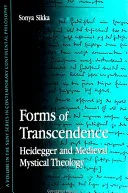
Forms of Transcendence
 82
82

Forms of Transcendence
Sonia Sikka’s Forms of Transcendence offers a genuinely insightful, if at times demanding, comparative study. The book’s signal achievement lies in its sustained effort to bridge the seemingly vast chasm between Martin Heidegger's existential phenomenology and the mystical theology of figures like St. Bonaventure and Meister Eckhart. Sikka navigates the dense prose of both traditions with commendable skill, uncovering surprising resonances. For instance, her analysis of Eckhart’s concept of the 'Godhead' through a Heideggerian lens reveals a shared concern with a primordial ground of being that precedes conceptualization. However, the book’s primary strength—its deep textual engagement—also contributes to its main limitation: accessibility. The intricate philosophical arguments, particularly those concerning Heidegger’s critique of 'ontotheology,' may prove challenging for readers not already well-versed in both philosophical and theological traditions. A more explicit discussion of the implications for contemporary spiritual practice would have broadened its appeal. Nevertheless, Forms of Transcendence provides a vital, scholarly re-examination of how medieval mystical thought can inform, and be informed by, critical modern philosophy.
📝 Description
82
### What It Is Forms of Transcendence, first published in 1997, stages a rigorous intellectual encounter between the 20th-century German philosopher Martin Heidegger and four seminal figures of medieval Christian mysticism: St. Bonaventure, Meister Eckhart, Johannes Tauler, and Jan van Ruusbroec. Sonia Sikka meticulously examines their respective texts, illuminating unexpected points of convergence and divergence.
### Who It's For This book is aimed at scholars and advanced students of philosophy, theology, and religious studies. It will appeal to those interested in the history of metaphysics, mystical traditions, and continental philosophy, particularly those familiar with Heidegger's phenomenology and critique of Western metaphysics. Readers seeking to understand the philosophical underpinnings of medieval mysticism through a modern philosophical lens will find it particularly valuable.
### Historical Context Emerging in the late 20th century, this work engages with post-Heideggerian philosophical discourse and ongoing scholarly interest in medieval thought. The 1990s saw a renewed focus on the philosophical implications of mystical experience, often framed by existentialist and phenomenological critiques. Sikka’s dialogue with Heidegger, a central figure whose critique of "ontotheology" profoundly shaped 20th-century philosophy, positions the book within a significant intellectual lineage that sought to re-evaluate traditional metaphysical frameworks.
### Key Concepts The book explores the complex relationship between theological language and philosophical inquiry, particularly as it pertains to concepts of being, presence, and transcendence. It scrutinizes the possibility of reinterpreting traditional metaphysical and theological ideas in light of Heidegger's thought, even amidst his profound critique of Western metaphysics, suggesting that his work offers avenues for a positive, rather than purely critical, engagement with these historical traditions.
💡 Why Read This Book?
• Gain a nuanced understanding of how Heidegger's philosophy, particularly his critique of "ontotheology," can be applied to re-interpret medieval mystical texts, offering a fresh perspective on the thought of St. Bonaventure and Meister Eckhart. • Discover how close readings of texts from 1997 and the medieval period can reveal possibilities for revising traditional metaphysical and theological ideas, moving beyond purely critical engagement. • Explore the philosophical underpinnings of mystical thought through the specific lens of continental philosophy, enhancing your grasp of figures like Johannes Tauler and Jan van Ruusbroec within their historical and intellectual milieu.
⭐ Reader Reviews
Honest opinions from readers who have explored this book.
❓ Frequently Asked Questions
What is the central philosophical dialogue in Forms of Transcendence?
The book centers on a dialogue between Martin Heidegger's existential phenomenology and the mystical theology of four medieval authors: St. Bonaventure, Meister Eckhart, Johannes Tauler, and Jan van Ruusbroec, exploring their views on being and transcendence.
When was Forms of Transcendence first published?
Forms of Transcendence was first published on May 1, 1997.
Which medieval thinkers are discussed in relation to Heidegger?
The book specifically engages with St. Bonaventure, Meister Eckhart, Johannes Tauler, and Jan van Ruusbroec, examining their theological and mystical concepts through a Heideggerian philosophical framework.
What is "ontotheology" as discussed in the book?
Ontotheology refers to the philosophical tradition that conflates ontology (the study of being) with theology (the study of God). Heidegger critiqued this tradition, and Sikka explores how this critique relates to medieval mystical thought.
What is the primary aim of Sonia Sikka's analysis?
Sikka aims to demonstrate how a close reading of medieval and Heideggerian texts can lead to a revised understanding and appropriation of traditional metaphysical and theological ideas, suggesting a positive contribution from Heidegger's thought.
What kind of reader would benefit most from Forms of Transcendence?
Scholars and advanced students of philosophy, theology, and religious studies, particularly those interested in medieval mysticism, phenomenology, and the history of Western metaphysics, will find this book most beneficial.
🔮 Key Themes & Symbolism
Heideggerian Critique and Medieval Theology
This theme examines how Heidegger's philosophical critique of "ontotheology," his concept of "being-in-the-world," and his analysis of authenticity can be applied to medieval mystical writings. Sikka explores whether Heidegger's thought, often seen as purely critical of Western metaphysical traditions, can instead offer constructive pathways for understanding figures like Meister Eckhart and St. Bonaventure. The focus is on re-appropriating elements of traditional thought through a modern philosophical lens, moving beyond a simple rejection of historical metaphysics.
Mystical Experience and Philosophical Language
The work investigates the linguistic and conceptual challenges in articulating mystical experience, particularly within the traditions of figures like Johannes Tauler and Jan van Ruusbroec. It contrasts their theological language with Heidegger's phenomenological approach to existence and understanding. The core inquiry is how philosophical concepts can illuminate, or perhaps obscure, the nature of transcendence as described by medieval mystics, and vice versa.
Revisiting Western Metaphysics
Forms of Transcendence argues for the possibility of a "revised appropriation" of traditional metaphysical and theological ideas. Rather than discarding them wholesale due to Heidegger's critique, Sikka suggests that his philosophy can provide tools to re-evaluate and potentially revitalize these historical concepts. This theme challenges the notion that Heidegger's engagement with the history of philosophy is exclusively negative, proposing a more nuanced, constructive relationship.
The Nature of Transcendence
Central to the book is an exploration of transcendence itself, as understood by both medieval mystics and Heidegger. It probes what it means to move beyond ordinary experience or being, examining concepts of the divine, the Godhead, and ultimate reality. The dialogue seeks to understand different modalities of transcendence and whether Heidegger's existential framework offers new ways to interpret the medieval pursuit of divine union or ecstatic experience.
💬 Memorable Quotes
Direct passages from the work, attributed to the author.
“Heidegger's critique of 'ontotheology'...”
— This refers to Heidegger's argument that Western philosophy, from Plato onwards, has obscured the fundamental question of Being by focusing on God as the highest being, thus conflating ontology with theology.
“...many aspects of his thought make a positive, and not exclusively critical, contribution.”
— This suggests that despite Heidegger's sharp critique of traditional metaphysics and theology, his own philosophical concepts might offer valuable frameworks for understanding and reinterpreting these very traditions.
“A close reading of medieval and Heideggerian texts...”
— This highlights the book's methodology: a detailed, scholarly analysis of primary sources from both medieval Christian mysticism and 20th-century continental philosophy to find points of connection.
“Forms of Transcendence sets up a dialogue between Heidegger and four medieval authors.”
— This captures the book's core project: creating an intellectual conversation between the modern philosopher Martin Heidegger and medieval figures like St. Bonaventure and Meister Eckhart.
“Possibilities for a revised appropriation of some traditional metaphysical and theological ideas.”
— This phrase indicates the book's aim to show how older philosophical and religious concepts can be understood anew and integrated into contemporary thought, influenced by modern philosophical insights.
🌙 Esoteric Significance
Tradition
While the book engages directly with Christian mysticism, its exploration of transcendence, being, and the critique of traditional metaphysical language aligns with broader Hermetic and Gnostic inquiries into the nature of ultimate reality and the limitations of human conceptualization. It fits within traditions that seek to understand the ineffable, re-framing mystical experience through a philosophical lens that questions established hierarchies of knowledge.
Symbolism
The work implicitly engages with symbols of divine immanence and transcendence found in the writings of figures like St. Bonaventure (e.g., the 'Itinerarium mentis in Deum' as a path) and Meister Eckhart (e.g., the 'Godhead' as a symbol for that which is beyond God). These can be seen as symbolic representations of the ineffable ground of being that both medieval mystics and Heidegger grappled with in distinct ways.
Modern Relevance
Contemporary thinkers in phenomenology, existentialism, and process philosophy, as well as scholars of comparative religion and mysticism, continue to find value in Sikka's work. It informs discussions on the relationship between subjective experience and objective reality, and how ancient contemplative traditions can inform modern philosophical discourse on consciousness and ultimate concern.
👥 Who Should Read This Book
• Scholars and graduate students of philosophy and theology seeking to understand the intersections between 20th-century continental philosophy and medieval mystical traditions, particularly those interested in Heidegger's influence. • Advanced students of religious studies and comparative mysticism who wish to explore the philosophical underpinnings of figures like Meister Eckhart and St. Bonaventure through a modern critical lens. • Philosophers of religion interested in reassessing traditional metaphysical and theological concepts using contemporary philosophical tools, moving beyond purely critical or purely historical analyses.
📜 Historical Context
Published in 1997, Sonia Sikka’s Forms of Transcendence arrived during a period of sustained scholarly interest in both medieval thought and the legacy of Martin Heidegger. The late 20th century witnessed a philosophical landscape increasingly shaped by Heidegger's critique of Western metaphysics, particularly his challenge to "ontotheology." Simultaneously, there was a resurgent academic fascination with the philosophical depth of medieval mysticism, moving beyond purely devotional interpretations. Sikka’s work engaged directly with this intellectual climate by proposing a constructive dialogue between these seemingly disparate fields. Unlike scholarship that might focus solely on the historical development of Christian doctrine or purely on Heideggerian exegesis, Sikka sought to synthesize them. Her approach offered an alternative to purely historical accounts or solely critical engagements with tradition, positioning the book as a significant contribution to comparative philosophy and theology in the post-Heideggerian era.
📔 Journal Prompts
Heidegger's critique of 'ontotheology' and its potential reinterpretation of St. Bonaventure's 'Itinerarium mentis in Deum'.
The concept of the 'Godhead' in Meister Eckhart's writings as illuminated by Heideggerian thought.
Jan van Ruusbroec's description of the soul's union with God, examined through the lens of existential phenomenology.
Johannes Tauler's practical spiritual guidance and its resonance with concepts of authentic existence.
The possibility of a positive, rather than exclusively critical, contribution from Heidegger's philosophy to understanding medieval transcendence.
🗂️ Glossary
Ontotheology
A philosophical position that conflates ontology (the study of being) with theology (the study of God), typically positing God as the highest being or ultimate ground of reality within a metaphysical system.
Phenomenology
A philosophical approach that focuses on the structure of consciousness and subjective experience, aiming to describe phenomena as they appear to the observer without presupposing external reality.
Existentialism
A philosophical movement emphasizing individual existence, freedom, and choice, often exploring themes of anxiety, authenticity, and the meaning of life in a seemingly meaningless universe.
Being-in-the-world (In-der-Welt-sein)
A key Heideggerian concept describing human existence (Dasein) not as a subject separate from an object world, but as fundamentally integrated and engaged within a meaningful context.
Transcendence
The state or quality of surpassing the ordinary, the physical, or the material; in a religious or mystical context, it refers to the aspect of God or ultimate reality that is beyond the material universe and human comprehension.
Dasein
Heidegger's term for human existence, literally 'being-there,' emphasizing the concrete, temporal, and situated nature of human life.
Mysticism
The pursuit of achieving communion with, identity with, or conscious awareness of an ultimate reality, divinity, or spiritual truth, often through direct experience or intuition.