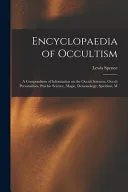
Encyclopaedia of Occultism; a Compendium of Information on the Occult Sciences, Occult Personalities, Psychic Science, Magic, Demonology, Spiritism, M
 73
73

Encyclopaedia of Occultism; a Compendium of Information on the Occult Sciences, Occult Personalities, Psychic Science, Magic, Demonology, Spiritism, M
Spence's *Encyclopaedia of Occultism* is a formidable, if dense, undertaking. Its strength lies in its sheer breadth; it attempts to map the entire terrain of occult thought, from ancient demonology to early 20th-century psychic research. The section on ceremonial magic, for instance, provides a clear, if dry, overview of various rituals and their historical antecedents. However, the work occasionally suffers from its encyclopedic nature, presenting information with a certain detachment that can feel less like an exploration and more like a catalog. The definition of 'Astrology' is thorough but lacks the vital interpretive nuance one might seek from a practicing astrologer. Despite this, the sheer volume of cross-referenced information makes it an indispensable reference for anyone serious about the history of Western esotericism.
📝 Description
73
Lewis Spence's Encyclopaedia of Occultism was first compiled in 1920.
This extensive compendium serves as a reference for terms, figures, and practices across the occult sciences. Spence aims to gather information on subjects ranging from demonology to psychic phenomena, consolidating disparate fields into a structured whole. The work is intended for readers who prefer detailed historical context and an academic approach to occult subjects, rather than a simplified account.
Spence's project emerged during a period of significant fascination with spiritualism and occultism in the late 19th and early 20th centuries. While contemporaries like Helena Blavatsky and Arthur Conan Doyle also engaged with these themes, Spence's contribution is distinctly encyclopedic. This edition maintains a substantial resource for the study of occultism from that historical moment.
Spence's encyclopaedia belongs to a tradition of late Victorian and Edwardian attempts to systematize and define the burgeoning field of occult studies. As interest in spiritualism and psychical research grew, scholars and enthusiasts sought to catalogue phenomena and beliefs that were often seen as peripheral to mainstream thought. This work reflects that effort to create a comprehensive record, drawing connections between diverse practices and figures under the umbrella of occultism.
💡 Why Read This Book?
• Gain a comprehensive understanding of terms and figures within occult sciences, as detailed in the book's extensive entries on subjects like demonology and spiritism. • Grasp the historical development of esoteric thought, including its connections to late 19th and early 20th-century intellectual currents, referenced by Spence. • Acquire precise definitions for complex occult concepts, enabling a more rigorous study than typically found in popular guides.
⭐ Reader Reviews
Honest opinions from readers who have explored this book.
❓ Frequently Asked Questions
What is the primary focus of Lewis Spence's Encyclopaedia of Occultism?
The primary focus is to provide a comprehensive compendium of information on occult sciences, occult personalities, psychic science, magic, demonology, and spiritism, cataloging terms, figures, and practices.
Is this book suitable for beginners in occult studies?
It is suitable for beginners who prefer a structured, encyclopedic approach with historical context, rather than a narrative or practical guide.
When was Lewis Spence's Encyclopaedia of Occultism originally compiled?
While this specific edition was published on 2021-09-09, the original compilation reflects scholarship from the era of Lewis Spence (1874-1955), a period of significant interest in occultism.
What historical period does the book primarily cover?
The book covers a broad historical range, with a particular emphasis on the late 19th and early 20th centuries, a time when spiritualism and occultism were widely discussed.
Can I find information on specific occult figures in this book?
Yes, the encyclopedic format includes entries on 'Occult Personalities', offering biographical and contextual information on notable individuals within occult traditions.
Is this work considered culturally important?
Yes, scholars have selected it as culturally important, preserving knowledge from the history of civilization and the study of esoteric traditions.
🔮 Key Themes & Symbolism
Demonology and Spiritism
The compendium dedicates significant attention to the study of demons and the practice of spiritism. It outlines hierarchies of infernal beings and details historical methods for communication with spirits, drawing from grimoires and theological texts. Spence contextualizes these beliefs within broader religious and philosophical movements, noting their prevalence in Western occult traditions and their impact on popular imagination during his active research period.
Ceremonial Magic
Spence meticulously details the history and practice of ceremonial magic, differentiating it from folk magic. The work covers ritualistic systems, the use of talismans, invocations, and the symbolic language employed by magicians across different eras. It references key texts and figures associated with the development of Western magical traditions, providing a structured overview of its theoretical underpinnings.
Psychic Science and Phenomena
The book addresses the burgeoning field of psychic science in the late 19th and early 20th centuries, examining phenomena such as telepathy, clairvoyance, and mediumship. Spence presents various theories and investigations into these areas, reflecting the scientific and spiritual discourse of his time. This section explores the intersection of occult belief with early parapsychological inquiry.
Occult Personalities and Societies
Entries are provided for significant individuals and groups within the occult landscape. This includes historical figures, founders of esoteric orders, and notable practitioners. The work aims to document their contributions and influence on the development and dissemination of occult knowledge, offering biographical sketches and contextual analysis of their roles.
💬 Memorable Quotes
Direct passages from the work, attributed to the author.
“The occult sciences are those which deal with the hidden forces of nature and the universe.”
— This statement defines the core subject matter of the book: investigating phenomena and energies beyond conventional scientific understanding, focusing on the unseen aspects of existence.
“Demonology is the study of demons or beliefs about demons.”
— This highlights a specific area of occult study covered, emphasizing the systematic investigation and cataloging of supernatural entities traditionally considered malevolent.
“Spiritism claims that the spirits of the dead can communicate with the living.”
— This concisely explains the fundamental tenet of Spiritism, a key topic within the compendium, focusing on inter-dimensional communication and its philosophical implications.
“Magic is the art of manipulating the natural world through supernatural means.”
— This offers a functional definition of magic as presented in the book, distinguishing it as a practice that seeks to influence reality via non-material forces.
“Psychic science investigates mental powers beyond the scope of ordinary consciousness.”
— This frames psychic science as an empirical pursuit of extraordinary mental abilities, aligning it with the broader exploration of hidden potentials discussed in the text.
🌙 Esoteric Significance
Tradition
This work fits broadly within the Western Esoteric Tradition, particularly its late 19th/early 20th-century manifestation. It draws upon Hermeticism, Kabbalah, and Gnosticism implicitly by cataloging their associated symbols and practices. However, Spence's approach is more descriptive and historical than initiatory, acting as a repository for diverse esoteric streams rather than a singular lineage text.
Symbolism
The compendium frequently references symbols central to Western esotericism. For example, the Pentagram is explained in its magical and symbolic contexts, representing the four elements and the spirit. The Ouroboros, the serpent eating its tail, is discussed as an ancient symbol of cyclicality, infinity, and the primordial unity, appearing across various mythologies and alchemical texts.
Modern Relevance
Contemporary scholars of Western Esotericism and comparative religion continue to reference Spence's work for its historical scope and detailed definitions. Occult practitioners interested in the historical underpinnings of modern magical systems, such as those influenced by the Hermetic Order of the Golden Dawn, find value in its comprehensive cataloging of foundational concepts and figures.
👥 Who Should Read This Book
• Aspiring scholars of Western Esotericism seeking a foundational reference text for occult terminology and historical context. • Researchers in comparative religion interested in the historical prevalence and definitions of concepts like demonology and spiritism. • Individuals curious about the intellectual and cultural range of the late 19th and early 20th centuries, particularly concerning occult and psychic phenomena.
📜 Historical Context
Lewis Spence's *Encyclopaedia of Occultism* emerged in an era vibrant with esoteric inquiry, particularly the late 19th and early 20th centuries. This period saw a surge of interest in spiritualism, Theosophy, and various occult revival movements, fueled by societal changes and a reaction against strict materialism. Contemporaries like Aleister Crowley were actively shaping magical traditions, while figures such as Sir Arthur Conan Doyle championed spiritualism. Spence’s work, however, distinguished itself by offering a more systematic, encyclopedic compilation rather than a practitioner's manual or philosophical treatise. It aimed to catalog and explain the diverse phenomena and beliefs that captivated the public and intellectuals alike. While not facing direct censorship, the occult often existed on the fringes of mainstream academia, making such comprehensive works valuable for scholars seeking to understand the breadth of these beliefs and their historical context.
📔 Journal Prompts
The concept of 'Psychic Science' as presented by Spence: what early 20th-century assumptions does it reveal?
Demonology entries: How do Spence's descriptions of demonic hierarchies compare to those in earlier grimoires?
Occult Personalities: Which figure's inclusion prompts further research into their specific occult society?
The definition of 'Magic': What distinction does Spence draw between ceremonial magic and other forms?
Spiritism: What historical or philosophical underpinnings does Spence attribute to its popularity?
🗂️ Glossary
Occult Sciences
Disciplines concerned with hidden, secret, or supernatural knowledge and practices, often including astrology, alchemy, magic, and divination.
Occult Personalities
Individuals who played significant roles in the development, practice, or dissemination of occult traditions and beliefs.
Psychic Science
The study of purported mental abilities such as telepathy, clairvoyance, and mediumship, often investigated during the late 19th and early 20th centuries.
Magic
The art or practice of invoking supernatural powers or the aid of supernatural beings to bring about effects that are beyond the ordinary power of human agency.
Demonology
The systematic study of demons or beliefs about demons, including their nature, rank, and powers, often drawing from religious and mythological texts.
Spiritism
A belief system centered on the idea that spirits of the deceased can communicate with the living, typically through mediums.
Compendium
A collection of concise information on a particular subject, presented in a systematic and thorough manner.