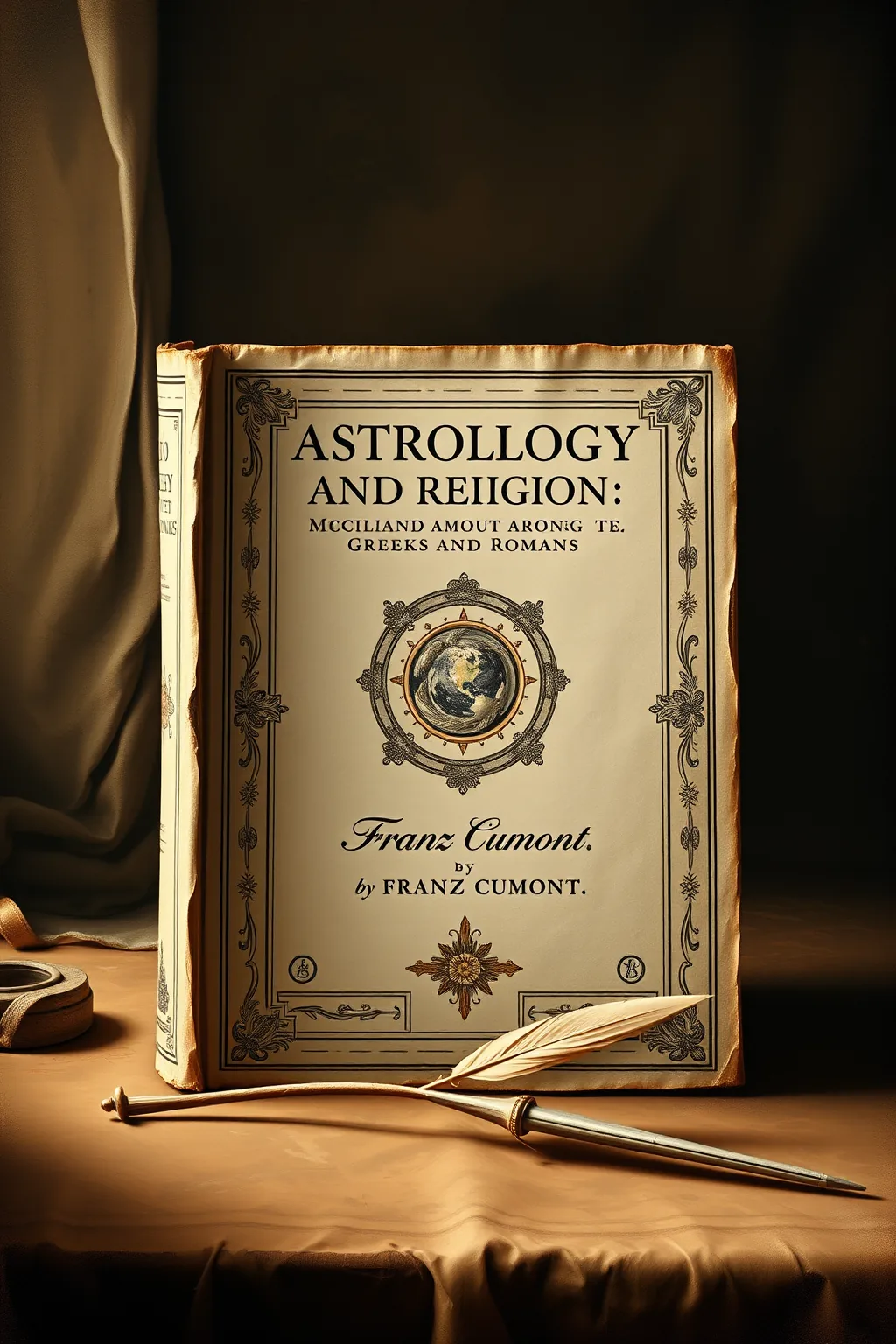
Astrology and Religion Among the Greeks and Romans
 71
71

Astrology and Religion Among the Greeks and Romans


Isolde Whitaker, Sacred Texts Editor: Franz Cumont's 'Astrology and Religion Among the Greeks and Romans' remains an indispensable cornerstone for understanding the profound symbiosis between celestial observation and ancient spirituality. Cumont masterfully synthesizes vast swathes of historical and textual evidence, illuminating how star-worship evolved into complex religious doctrines. His meticulous scholarship reveals the esoteric underpinnings of astronomical knowledge, demonstrating its pivotal role in shaping the worldview of classical civilizations. This work is a vital resource for scholars of ancient religions, historians of science, and occult practitioners alike, offering unparalleled insight into the divine mechanics that governed the minds of Greeks and Romans. It is a testament to the enduring power of cosmic contemplation.
📝 Description
71
Franz Cumont's 1912 study examines how ancient Greeks and Romans saw the stars as divine.
Franz Cumont's 1912 book, 'Astrology and Religion Among the Greeks and Romans,' details the historical connection between astronomical observation and religious belief in antiquity. The work traces the development of early astronomy, particularly its origins in the ancient Near East, and its subsequent influence on Greek and Roman thought. Cumont shows how celestial phenomena were not just subjects of scientific curiosity but were woven into the spiritual and philosophical systems of these cultures.
The book explains how the systematic observation of planets and stars led to predictive systems, which in turn informed deeply held religious convictions. It illustrates how these civilizations perceived the cosmos as a dynamic entity, a source of divine guidance and cosmic order. Cumont's research provides a clear account of how this worldview shaped the understanding of the universe and humanity's place within it.
This study fits within the esoteric tradition by examining how ancient peoples interpreted celestial movements not just as physical events but as messages from the divine. It looks at how these interpretations formed the basis of religious practices and philosophical systems, revealing a worldview where the cosmos was seen as intrinsically linked to human destiny and spiritual understanding. Cumont's work illuminates a historical period where the lines between astronomy, religion, and occult practice were blurred.
💡 Why Read This Book?
Uncover the ancient roots of celestial divination and its integration into religious practice. Explore how astronomical foresight shaped philosophical thought and spiritual beliefs in the Greco-Roman world. Ideal for seekers of esoteric knowledge, scholars of ancient history and religion, and practitioners interested in the historical underpinnings of astrological systems. Discover the profound connection between humanity and the cosmos as perceived by our ancestors.
⭐ Reader Reviews
Honest opinions from readers who have explored this book.
❓ Frequently Asked Questions
What is the primary focus of Cumont's study?
The book's primary focus is the intricate relationship between astronomical observation, astrological beliefs, and the religious systems of ancient Greece and Rome, exploring how star-worship evolved into sophisticated spiritual doctrines.
Where did the astronomical knowledge discussed originate?
Cumont traces the development of astronomical knowledge back to its roots in the ancient Near East, highlighting its transmission and evolution into predictive sciences.
What kind of phenomena did ancient astronomers predict?
Ancient astronomers developed the capacity to predict phenomena such as planetary positions, lunar phases, and celestial events like eclipses, which formed the basis of their religious systems.
Who was Franz Cumont?
Franz Cumont was a highly influential historian and philologist, renowned for his extensive research into ancient Near Eastern religions, Mithraism, and the interplay of astrology and religion in the classical world.
Is this book suitable for beginners in astrology?
While scholarly, the book provides foundational historical context, making it valuable for beginners seeking to understand the origins and ancient perception of astrology, though it is not a practical astrological guide.
🔮 Key Themes & Symbolism
The Celestial Divine
This theme looks at the profound reverence ancient Greeks and Romans held for the cosmos, viewing celestial bodies not merely as astronomical objects but as divine entities influencing earthly destinies. It explores the anthropomorphism of stars and planets and their roles in pantheons, revealing a worldview where the divine was intrinsically linked to the movements and patterns observed in the night sky. This section illuminates the philosophical underpinnings of star-worship, presenting it as a fundamental aspect of ancient religious expression and a quest for cosmic order.
The Dawn of Prediction
Here, the focus shifts to the groundbreaking development of astronomical knowledge, tracing its lineage from the ancient Near East. Cumont meticulously details how observational data was transformed into predictive science, enabling the forecasting of planetary positions, lunar cycles, and eclipses. This theme highlights the intellectual leap that allowed ancient cultures to perceive patterns and causality in celestial events, laying the groundwork for astrological systems and demonstrating an early human drive to understand and potentially influence the future through cosmic interpretation.
Cosmic Order and Human Fate
This crucial theme examines how the perceived order of the heavens was translated into a framework for understanding human life and destiny. It investigates the integration of astrological principles into religious practices, philosophical inquiries, and even political decisions. The book explores how the celestial clockwork was believed to dictate individual lives and societal trajectories, revealing the deep-seated belief in a cosmic governance that connected the fate of mortals to the grand movements of the stars, offering a glimpse into a world where the heavens held undeniable sway.
💬 Memorable Quotes
Direct passages from the work, attributed to the author.
“Divination by the stars was a science of the gods.”
— This highlights the sacred and highly specialized nature of astrology in antiquity, positioning it as a divine art understood through esoteric knowledge and direct communion with celestial powers.
“Astronomy was the mother of religion.”
— This poignant statement suggests that the earliest attempts to comprehend the cosmos through observation and pattern recognition directly birthed religious systems and spiritual beliefs.
“The heavens declared the will of the divine.”
— This emphasizes the belief that celestial phenomena were not random occurrences but deliberate communications from higher powers, guiding humanity and revealing divine intent.
“To know the stars was to know the secrets of existence.”
— This points to the profound philosophical and existential significance attributed to astrological knowledge, suggesting it offered ultimate truths about the universe and humanity's place within it.
💡 Key Ideas
Editorial paraphrase of the work's core concepts — not direct quotes.
The stars were not merely lights in the sky, but intelligences.
This quote expresses the ancient belief that celestial bodies possessed conscious will and agency, serving as divine messengers or even deities themselves, actively involved in the unfolding of events.
🌙 Esoteric Significance
Tradition
This work is deeply rooted in the Hermetic and Neoplatonic traditions, exploring the ancient world's intricate cosmology that viewed the universe as a divinely ordered and interconnected system. It illuminates the esoteric understanding of the stars as living intelligences and cosmic forces that directly influenced human affairs and spiritual development, forming a key pillar of ancient mystical thought.
Symbolism
The book unravels the strong symbolism embedded in ancient astrology, where planetary movements, constellations, and celestial events were interpreted as potent metaphors for divine will, cosmic cycles, and human destiny. It reveals how these symbols were not mere decorative elements but integral components of a spiritual language used to understand the hidden order of the universe and humanity's place within it.
Modern Relevance
Cumont's study remains highly relevant for modern esoteric practitioners and spiritual seekers, offering a profound historical context for contemporary astrological practices and metaphysical inquiries. It highlights the enduring human fascination with celestial influence and the quest for meaning in cosmic patterns, demonstrating how ancient wisdom continues to inform our understanding of the universe and our connection to it.
👥 Who Should Read This Book
This key work is essential for scholars of ancient history, comparative religion, and the history of science, providing a rigorous academic foundation for understanding classical belief systems. Esoteric practitioners and astrologers will find invaluable historical depth and insight into the origins of their craft. Seekers of spiritual knowledge and those fascinated by the ancient world's perception of the cosmos will discover a wide range of thought. Beginners can gain a foundational understanding of astrological history, while advanced students will appreciate Cumont's detailed scholarship and his comprehensive synthesis of complex ideas.
📜 Historical Context
Written at the turn of the 20th century, Franz Cumont's 'Astrology and Religion Among the Greeks and Romans' emerged from a period of intense scholarly interest in the ancient Near East and the Hellenistic world. This era saw a surge in archaeological discoveries and textual analysis that brought to light previously obscure religious and philosophical traditions. Cumont, a leading figure in this movement, dedicated his career to deciphering the complex interactions between diverse cultures and their belief systems. His work on astrology and religion reflects the prevailing academic drive to understand the syncretic nature of ancient thought, where Mesopotamian, Egyptian, Greek, and Roman ideas often merged. The book's comprehensive approach, drawing on a vast array of ancient sources, was groundbreaking and established a foundational understanding of how celestial observation transitioned from empirical science to a central to spiritual and esoteric practice.
📔 Journal Prompts
How did the ancient Greeks and Romans perceive the 'will' of the stars, and what rituals or practices did this belief inspire?
Trace the journey of astronomical knowledge from the Near East to the Greco-Roman world as described by Cumont. What were the key innovations?
In what ways did the belief in celestial influence shape the daily lives and decisions of individuals in antiquity?
Compare and contrast the ancient understanding of planetary 'intelligence' with modern scientific views of astronomy.
Reflect on the enduring human need to find meaning in celestial patterns. How does this drive manifest in contemporary society?
🗂️ Glossary
Hellenistic Period
The historical period following the conquests of Alexander the Great, characterized by the spread of Greek culture and the fusion of Greek, Egyptian, and Near Eastern traditions, a key era for astrological development.
Cosmology
The branch of philosophy and theology that contemplates the origin, structure, and destiny of the universe, often incorporating religious and mythical elements.
Divination
The practice of seeking knowledge of the future or the unknown by supernatural means, particularly through the interpretation of omens or signs, such as celestial movements.
Syncretism
The merging of different religious and philosophical beliefs and practices, common in the Hellenistic world as cultures interacted and exchanged ideas.
Anthropomorphism
The attribution of human form, characteristics, or behaviors to non-human entities, such as planets and stars in ancient religious thought.
This book appears in 1 collection
🔮 Readers Also Liked
Browse all →









From the “Astrology” Collection
View all →









More Free Astrology & Cosmology Books
View all →