Don't Believe Everything You Think
 83
83

Don't Believe Everything You Think
Nguyen’s *Don't Believe Everything You Think* offers a welcome antidote to the often uncritical acceptance of ideas prevalent in esoteric circles. The author's strength lies in his clear, methodical deconstruction of how our minds construct reality, particularly evident in his discussion of 'belief anchors.' He avoids jargon, making complex psychological concepts accessible. A notable passage details how the desire for belonging can solidify fringe beliefs, a point Nguyen illustrates with stark clarity. However, the book’s focus on cognitive mechanisms occasionally overshadows the emotional and spiritual dimensions that often drive esoteric pursuits. While the analytical approach is valuable, it sometimes feels like dissecting a butterfly without acknowledging its flight. The work is an indispensable tool for critical thinking, though practitioners seeking purely devotional or ecstatic experiences might find its approach overly rational.
Verdict: A sharp, analytical guide for scrutinizing one's own mental architecture.
📝 Description
83
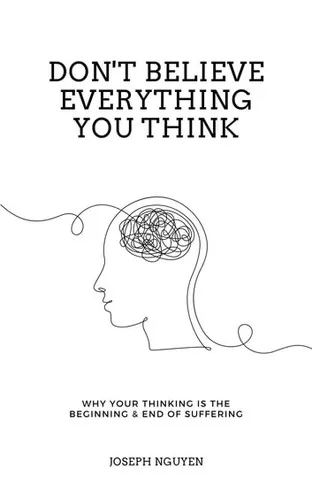
Joseph Nguyen's 2024 book *Don't Believe Everything You Think* dissects how cognitive biases shape our perception of reality.
This book offers a structured approach to examining ingrained thought patterns, moving beyond simple self-help advice. Nguyen encourages readers to question the basis of their beliefs, especially those concerning esoteric subjects and personal truths. The work is intended for individuals engaged in spiritual or philosophical inquiry who encounter mental blocks or repetitive reasoning. It is particularly useful for those who have read basic texts on mysticism or psychology and want a more analytical way to understand themselves. Readers who value intellectual depth and are willing to re-examine their own assumptions will find much to consider.
Nguyen introduces concepts designed to break down unquestioned assumptions. He explains confirmation bias, the appeal of reducing cognitive dissonance, and how mental shortcuts affect decisions. The book also discusses 'belief anchors,' which are core ideas that resist examination, often formed early in life or through cultural influence. The text systematically provides methods for identifying and challenging these deeply held beliefs.
Published in 2024, Nguyen's work addresses the modern challenge of information overload and digital echo chambers, which complicate spiritual and philosophical discernment. It connects to a long history of thinkers like William James, who in *The Varieties of Religious Experience* (1902) explored the intersection of subjective spiritual insight and empirical evidence. *Don't Believe Everything You Think* provides contemporary tools for navigating belief systems, echoing earlier efforts to reconcile personal spiritual experience with rational analysis.
💡 Why Read This Book?
• Gain practical methods to identify and dismantle 'belief anchors,' foundational ideas that often resist critical examination, enabling a more objective assessment of spiritual or philosophical doctrines. • Learn to recognize the influence of confirmation bias and cognitive dissonance reduction, crucial for navigating conflicting information in esoteric literature and personal practice. • Develop intellectual agility through Nguyen's structured approach, empowering you to question assumptions and refine your understanding, inspired by his 2024 publication’s focus on critical self-awareness.
⭐ Reader Reviews
Honest opinions from readers who have explored this book.
❓ Frequently Asked Questions
What is the primary goal of Joseph Nguyen's 'Don't Believe Everything You Think'?
The primary goal is to equip readers with tools to critically examine their own thought processes and ingrained beliefs, particularly those related to esoteric subjects, fostering greater intellectual honesty and self-awareness.
How does the book address the concept of 'belief anchors'?
Nguyen defines 'belief anchors' as fundamental, often unquestioned ideas that shape our worldview. The book provides methods for identifying these anchors, tracing their origins, and evaluating their validity.
Is this book suitable for beginners in esoteric studies?
While accessible, the book's analytical rigor makes it best suited for those who have some foundational knowledge and are prepared to critically engage with their existing beliefs, rather than absolute beginners.
What is the publication year of 'Don't Believe Everything You Think'?
The book was first published in 2024, placing it firmly within contemporary discussions on cognitive science and critical thinking.
Does the book offer spiritual or practical advice?
It offers practical advice on cognitive hygiene and critical thinking, which can indirectly support spiritual development by clearing mental obstacles, rather than providing direct spiritual guidance.
What makes this book different from typical self-help guides?
Unlike many self-help books, Nguyen's work emphasizes rigorous analysis and deconstruction of thought patterns, avoiding platitudes and focusing on actionable cognitive strategies.
🔮 Key Themes & Symbolism
Cognitive Anchors and Belief Systems
This theme focuses on 'belief anchors,' the foundational, often unexamined ideas that underpin our worldview. Nguyen explores how these anchors are formed—through upbringing, cultural conditioning, or early spiritual experiences—and how they resist critical scrutiny. The work posits that understanding these anchors is crucial for anyone engaged in esoteric paths, as many spiritual beliefs can become rigidly fixed, preventing further growth or objective evaluation. The book provides methods for identifying and analyzing these anchors, encouraging a more fluid and less dogmatic approach to personal truth.
The Psychology of Esoteric Acceptance
Nguyen examines the psychological mechanisms that contribute to the acceptance of esoteric concepts. This includes the role of confirmation bias, where individuals seek out information that validates existing beliefs, and the desire for belonging that can solidify adherence to specific doctrines. The work analyzes how cognitive dissonance is managed, often leading to the reinforcement of unconventional ideas. This exploration is vital for understanding why certain spiritual or metaphysical frameworks gain traction and how individuals might become entrenched within them, sometimes to their detriment.
Critical Discernment in a Digital Age
The book addresses the challenges of critical thinking in an era saturated with information, particularly online. Nguyen highlights how echo chambers and the rapid dissemination of unverified claims can distort perception. He argues for the necessity of developing robust analytical skills to navigate this landscape, especially within communities focused on spirituality or the occult, where unsubstantiated theories can spread quickly. This theme underscores the practical application of critical thinking for maintaining intellectual integrity.
Self-Awareness Beyond Dogma
A central aim is to foster a deeper level of self-awareness that transcends rigid dogma. Nguyen encourages readers to observe their own mental processes without judgment, recognizing patterns of thought that may be limiting. The objective is not to discard beliefs, but to understand their origins and the processes that sustain them, allowing for conscious choice and evolution. This promotes a more authentic engagement with personal truths and spiritual journeys, moving away from blind faith towards informed conviction.
💬 Memorable Quotes
Direct passages from the work, attributed to the author.
“The desire to fit in can be a powerful force in solidifying beliefs that lack empirical support.”
— This interpretation highlights how social needs can override critical thinking, particularly in groups where shared beliefs, even unconventional ones, foster a sense of community and belonging.
“Identifying the origin of a belief is the first step to assessing its validity.”
— This concept emphasizes the importance of genealogical analysis for ideas; understanding where a belief comes from—personal experience, cultural input, authority—is key to evaluating its current relevance and truthfulness.
“Heuristic shortcuts, while efficient, can lead us astray in complex conceptual landscapes.”
— This interpretation explains how mental shortcuts, useful for everyday decisions, become problematic when applied to nuanced philosophical or spiritual questions, potentially leading to oversimplified or incorrect conclusions.
💡 Key Ideas
Editorial paraphrase of the work's core concepts — not direct quotes.
We often build elaborate mental structures to avoid confronting contradictory evidence.
This paraphrased concept points to cognitive dissonance, illustrating how the mind actively works to maintain internal consistency, sometimes by rationalizing away or ignoring information that challenges established views.
A belief held without examination is merely an inherited assumption.
This quote challenges the reader to actively engage with their own convictions, suggesting that passively accepting ideas, especially those related to profound truths or esoteric knowledge, lacks genuine understanding or personal authority.
🌙 Esoteric Significance
Tradition
While not strictly belonging to a single esoteric lineage, Nguyen's work engages with the perennial philosophical quest for truth, a common thread across Hermetic, Gnostic, and even certain Buddhist traditions. It offers a secularized lens for examining the psychological underpinnings of belief that often form the bedrock of esoteric systems. The book acts as a critical tool *for* esoteric practitioners, rather than a text *within* a specific esoteric tradition, providing a meta-level analysis of how spiritual ideas are processed and integrated.
Symbolism
The book's primary 'symbol' is the 'belief anchor,' representing fixed points in the mind that resist change, akin to the immovable stones of ancient temples symbolizing permanence. Another motif is the 'mental map,' illustrating how our cognitive frameworks structure reality, much like cartographic symbols represent physical landscapes. These concepts function symbolically to depict the often rigid and unseen structures that govern perception and understanding within any belief system.
Modern Relevance
Contemporary thinkers in cognitive psychology and critical thinking studies, such as those influenced by Daniel Kahneman's work on heuristics, find resonance in Nguyen's analysis. His methods are applicable to modern mindfulness practices that encourage observing thoughts without attachment, and to digital literacy initiatives aiming to combat misinformation. Practitioners of secular spirituality and skepticism movements also draw on similar frameworks for evaluating extraordinary claims in an increasingly complex informational environment.
👥 Who Should Read This Book
• Individuals engaged in comparative mythology or religious studies seeking to understand the psychological drivers behind belief systems. • Practitioners of esoteric disciplines (e.g., Hermeticism, Kabbalah) who wish to critically examine the foundations of their own practices and beliefs. • Skeptics and critical thinkers looking for structured methods to analyze arguments and identify cognitive biases in philosophical and spiritual discourse.
📜 Historical Context
Published in 2024, *Don't Believe Everything You Think* emerges in an era characterized by the proliferation of online information and the rise of 'wellness' culture, often blending genuine inquiry with pseudoscientific claims. Joseph Nguyen's work offers a counterpoint to the uncritical embrace of spiritual or self-help ideologies that gained momentum throughout the late 20th and early 21st centuries. While figures like Carl Jung explored archetypes and the collective unconscious, and later authors like Eckhart Tolle emphasized presence, Nguyen focuses on the *mechanisms* of belief formation and adherence. His approach provides a cognitive framework that contrasts with more intuitive or faith-based methodologies prevalent in contemporary esoteric thought. The book arrives at a time when philosophical skepticism, championed by thinkers like Bertrand Russell in the mid-20th century, finds renewed relevance in dissecting unsubstantiated claims circulating globally.
📔 Journal Prompts
Analyze one of your core 'belief anchors' identified using Nguyen's methodology.
Reflect on a time confirmation bias influenced your interpretation of esoteric texts.
How do the psychological mechanisms described by Nguyen manifest in online spiritual communities?
Evaluate a commonly held esoteric concept through the lens of cognitive dissonance.
Consider the role of 'belief anchors' in your personal journey toward self-awareness.
🗂️ Glossary
Belief Anchor
A fundamental, often unquestioned idea or assumption that forms the basis of an individual's worldview or belief system. These anchors significantly influence how new information is processed and integrated.
Cognitive Dissonance
The mental discomfort experienced by a person who holds two or more contradictory beliefs, ideas, or values, or is confronted by new information that conflicts with existing beliefs.
Confirmation Bias
The tendency to search for, interpret, favor, and recall information in a way that confirms or supports one's preexisting beliefs or hypotheses.
Heuristic Shortcut
A mental shortcut or rule of thumb that allows for quick problem-solving and decision-making, often used in situations with limited information or time, but can lead to errors.
Mental Map
An internal representation of external reality or a conceptual space, guiding perception, understanding, and behavior. It is shaped by beliefs, experiences, and cognitive frameworks.
Echo Chamber
A metaphorical description of a situation where information, ideas, or beliefs are amplified or reinforced by communication and repetition within a defined system, often leading to a lack of dissenting views.
Cognitive Hygiene
The practice of maintaining mental clarity and sharpness by consciously managing thought processes, challenging assumptions, and filtering information critically.
🔮 Readers Also Liked
Browse all →









More by Joseph Nguyen
All books →
More Free Spiritual Development Books
View all →