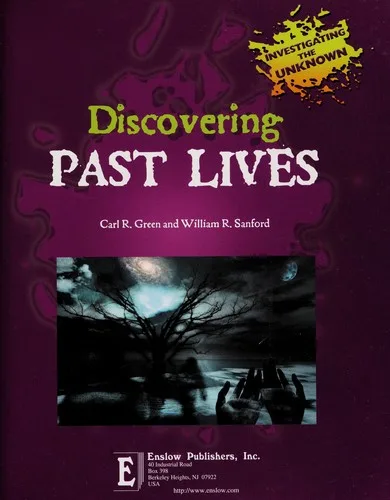
Discovering Past Lives
 75
75

Discovering Past Lives
Carl R. Green and William R. Sanford's "Discovering Past Lives" approaches the controversial subject of reincarnation with a systematic, almost case-study methodology. The strength of the work lies in its detailed presentation of documented instances, particularly those involving young children who exhibit uncanny knowledge of past lives. The authors meticulously present these accounts, often including supporting evidence or corroborating details, lending a degree of credibility to the reported phenomena. However, the limitation stems from the inherent difficulty in definitively proving reincarnation; while the presented cases are intriguing, they remain open to interpretation and alternative explanations, such as cryptomnesia or cultural suggestion. A particularly compelling section discusses the work of Dr. Ian Stevenson, whose extensive research into children who claim to remember previous lives forms a significant anchor for the book's exploration. "Discovering Past Lives" serves as a thorough, if cautiously presented, compilation of evidence for those seeking to understand the phenomenon of past-life recall.
📝 Description
75
Published in June 2013, Discovering Past Lives examines documented cases of individuals remembering previous existences.
Carl R. Green and William R. Sanford's 2013 book investigates the phenomenon of past-life recall. It details documented instances where people remember prior lifetimes, along with the theories and methods associated with this aspect of human consciousness. The authors compile anecdotal and investigative material to present a thorough overview of the subject.
The work is suited for readers interested in reincarnation, memory, and the possibility that consciousness continues after death. It will likely appeal to those drawn to psychological phenomena, parapsychology, and philosophical questions about life after death. Individuals exploring their own spiritual beliefs or seeking reasons for innate talents, fears, or unexplained connections might find this book useful.
The study of reincarnation has deep roots in ancient philosophies, particularly within Hinduism and Buddhism. Western interest grew in the late 19th and early 20th centuries, boosted by figures like Helena Blavatsky and the Theosophical Society. Later, the mid-20th century saw renewed attention through hypnosis and age regression techniques, notably pioneered by Dr. Ian Stevenson, which provided investigative methods for such claims.
💡 Why Read This Book?
• Understand the mechanics of age regression and hypnosis as tools for exploring past-life memories, as detailed in "Discovering Past Lives," to see how these techniques are applied in practice. • Examine documented cases of spontaneous past-life recall, such as those researched by Dr. Ian Stevenson, to evaluate the evidence presented for reincarnation. • Gain insight into the philosophical and psychological frameworks that attempt to explain reincarnation, providing a comparative perspective beyond simple belief.
⭐ Reader Reviews
Honest opinions from readers who have explored this book.
❓ Frequently Asked Questions
What is the primary focus of "Discovering Past Lives"?
The book primarily explores the phenomenon of past-life recall, examining real-life incidents of people remembering previous existences, the use of age regression and hypnosis, and the concept of reincarnation.
Who are the authors of "Discovering Past Lives"?
The authors are Carl R. Green and William R. Sanford. The book was first published in June 2013.
Does the book present scientific evidence for past lives?
Yes, the work discusses scientific studies and research conducted on past lives, including methodologies like age regression and the investigation of spontaneous memory recall.
What is age regression in the context of past lives?
Age regression, often facilitated by hypnosis, is a technique explored in the book that aims to access memories from earlier stages of life, including potentially past lives, by guiding the subject back through time.
What is reincarnation according to "Discovering Past Lives"?
Reincarnation is presented as the belief that consciousness or a soul is reborn into a new physical body after death. The book examines this concept through anecdotal evidence and theoretical discussions.
Where can I find more information about research on past lives?
The book "Discovering Past Lives" cites various studies and researchers, notably Dr. Ian Stevenson, whose extensive work on children's past-life memories is a key reference point.
🔮 Key Themes & Symbolism
Spontaneous Past-Life Recall
The book meticulously details instances of spontaneous past-life recall, particularly focusing on children who report memories of previous lives with striking detail and accuracy. These cases often include verifiable information, such as names, locations, and events from the purported past existence, which researchers attempt to corroborate. Green and Sanford present these accounts as compelling evidence that warrants serious consideration, moving beyond mere folklore into the field of psychological and potentially metaphysical investigation.
Age Regression and Hypnosis
A significant portion of "Discovering Past Lives" is dedicated to the application of age regression and hypnosis as therapeutic and investigative tools. The authors explore how these techniques can be used to access subconscious memories, which proponents believe may include recollections of past lives. The process is described, along with the challenges and potential pitfalls, such as the influence of suggestion and the difficulty in distinguishing between genuine memory and fantasy.
Theories of Reincarnation
The work explores various theoretical frameworks surrounding reincarnation, encompassing both Eastern philosophical traditions and Western interpretations. It examines the concept of a soul or consciousness persisting after physical death and transmigrating into new bodies. The book aims to provide readers with a nuanced understanding of reincarnation, presenting it not just as a belief system but as a phenomenon that has been studied and debated across different cultures and eras.
Scientific Investigation
"Discovering Past Lives" highlights the attempts made to study past-life memories through scientific inquiry. It references researchers like Dr. Ian Stevenson, whose decades-long work involved meticulously documenting cases of children claiming to remember previous lives. The book discusses the methodologies employed, the criteria for verification, and the ongoing debate within the scientific community regarding the interpretation of such evidence and its implications for consciousness studies.
💬 Memorable Quotes
Direct passages from the work, attributed to the author.
“Children often report detailed memories of lives they could not have possibly known about through normal means.”
— This statement underscores the core phenomenon explored in the book: young individuals exhibiting knowledge of past existences that defies conventional explanations based on learning or observation within their current life.
“Hypnosis can unlock doors to the subconscious mind, potentially revealing memories from earlier lifetimes.”
— This highlights the role of hypnosis as a key investigative tool in the context of past-life exploration, suggesting that altered states of consciousness may provide access to deeper layers of memory.
“The verification of details in past-life claims is crucial for assessing their validity.”
— This emphasizes the importance of empirical evidence and corroboration when examining claims of past-life recall, indicating that factual accuracy is a significant factor in the study.
“Reincarnation theories attempt to explain the continuity of consciousness beyond physical death.”
— This succinctly defines the fundamental concept of reincarnation as presented in the book, framing it as a potential answer to the mystery of what happens to consciousness after the body ceases to function.
“Documented incidents of past-life memories require careful study and consideration.”
— This calls for a serious, analytical approach to the anecdotal and researched cases of past-life recall, suggesting that these occurrences are significant enough to warrant scholarly attention and investigation.
🌙 Esoteric Significance
Tradition
While not strictly aligned with a single esoteric lineage, "Discovering Past Lives" engages with themes central to the Western esoteric tradition's interest in reincarnation, particularly as popularized by Theosophy and Anthroposophy in the late 19th and early 20th centuries. It shares the Theosophical endeavor to present reincarnation as a rational, investigable process, often drawing parallels to Eastern philosophies that influenced thinkers like Helena Blavatsky. The work departs by focusing more on empirical case studies than abstract spiritual doctrines.
Symbolism
The primary symbol explored is the 'memory' itself, representing the persistence of consciousness or soul across lifetimes. The phenomenon of children's recall functions as a symbolic bridge between the unknown past and the present. Age regression, through hypnosis, can be seen as a symbolic descent into the underworld of the subconscious, retrieving lost fragments of the self. The verifiable details within these memories act as talismans, grounding the abstract concept of reincarnation in concrete, albeit debated, evidence.
Modern Relevance
Contemporary interest in past-life exploration continues through various avenues, including regression therapy practitioners, authors exploring consciousness, and online communities dedicated to sharing personal experiences. The work of Green and Sanford, by referencing researchers like Ian Stevenson, remains relevant for those seeking to understand the historical and methodological underpinnings of these modern practices. It provides a foundational text for individuals exploring concepts that intersect with transpersonal psychology and consciousness studies.
👥 Who Should Read This Book
• Individuals curious about the phenomenon of past-life memories, seeking documented accounts and explanations beyond anecdotal evidence. • Students of parapsychology and consciousness studies, interested in research methodologies and case studies that challenge conventional understandings of memory and identity. • Those exploring personal spiritual beliefs or seeking to understand unexplained phobias, talents, or connections, who may find resonance in the exploration of reincarnation.
📜 Historical Context
Published in 2013, "Discovering Past Lives" emerged during a period of continued popular and academic interest in consciousness studies and parapsychology, building upon decades of research. The late 20th and early 21st centuries saw significant work in this field, most notably by Dr. Ian Stevenson at the University of Virginia, whose extensive cataloging of children's past-life memories provided a substantial body of evidence. Stevenson's approach, which focused on meticulous documentation and verification, offered a more empirical counterpoint to earlier, more speculative explorations of reincarnation. While competing schools of thought, such as New Age spiritualism and various religious doctrines, offered their own interpretations of rebirth, Stevenson's work aimed for a more detached, scientific investigation. The reception of such studies often involved skepticism from mainstream science, yet they continued to influence researchers and captivated a public intrigued by the possibility of life beyond death.
📔 Journal Prompts
Past-life recall instances presented in the book, such as those involving children.
The use of age regression and hypnosis as depicted in the text.
Specific verifiable details cited in past-life claims.
The concept of reincarnation as explored by Green and Sanford.
Dr. Ian Stevenson's research methodology on past lives.
🗂️ Glossary
Past-life recall
The phenomenon where individuals, often children, report memories or knowledge of a previous existence that they could not have acquired through normal means in their current lifetime.
Age regression
A therapeutic technique, often guided by hypnosis, used to access memories from earlier periods of life, including potentially past lives, by guiding the subject backward through time.
Hypnosis
A state of heightened suggestibility and focused attention, often induced by a therapist, which is used in "Discovering Past Lives" as a tool to explore potential past-life memories.
Reincarnation
The belief that consciousness, soul, or spirit, after biological death, begins a new life in a new body. It is a central concept explored throughout the book.
Cryptomnesia
A psychological phenomenon where forgotten memories resurface as new, original thoughts or experiences. It is often discussed as a potential alternative explanation for past-life claims.
Verifiable incidents
Specific events or details reported by individuals claiming past-life memories that can be factually checked and corroborated through external evidence or records.
Theosophy
A spiritual movement founded in the late 19th century, which sought to combine elements of Eastern and Western mysticism and philosophy, and which significantly influenced Western views on reincarnation.