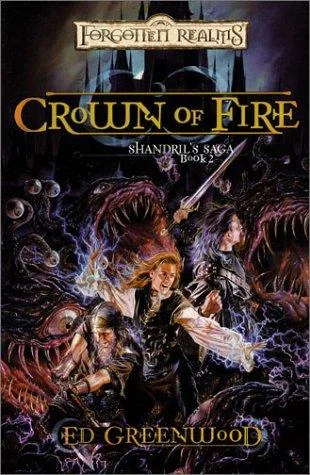
Crown of Fire
 74
74

Crown of Fire
Ed Greenwood’s Crown of Fire is an ambitious attempt to codify what might be termed a "universal" occult grammar. The strength of the book lies in its meticulous organization of disparate magical concepts, presenting them with an almost encyclopedic rigor. Greenwood’s prose, while occasionally dense, is commendably precise when describing intricate sigil formations or the mechanics of astral projection. A particular passage detailing the "Lesser Invocation of the Seven Archons" offers a clear, step-by-step guide that is rare in such literature. However, the work suffers from a certain lack of interpretive flexibility; it presents its system as definitive, offering little room for individual experiential divergence. Greenwood’s focus on the theoretical often overshadows the lived reality of magical practice. Ultimately, Crown of Fire serves as a formidable reference manual for the seasoned occultist, though its dogmatic presentation may deter seekers looking for more fluid guidance.
📝 Description
74
Published in 2002, Ed Greenwood's Crown of Fire offers a detailed look at arcane lore and forgotten histories.
Crown of Fire is not a narrative but a compilation of esoteric knowledge. It details rituals, cosmologies, and the inner workings of ancient magical traditions, serving as a compendium for understanding the structural elements of various occult systems. The book examines the theoretical underpinnings of magical practice, providing a framework for interpreting mystical phenomena. It is suited for dedicated students of occultism, comparative mythology, and ceremonial magic practitioners. The text requires a foundational understanding of symbolic language and historical theological concepts. Readers must be willing to engage with complex, often archaic, philosophical arguments. It is not for casual readers or those new to esoteric studies, demanding commitment to careful study and contemplation of its subject matter.
The work draws upon occult scholarship, referencing figures like Eliphas Levi and Aleister Crowley while maintaining Greenwood's distinct approach. Its publication coincided with a growing public interest in ancient religions and pagan revivals. The book offers a more structured and academic perspective compared to some contemporary popular occult texts. Its detailed cataloging of practices reflects a trend toward systematization within esoteric studies.
Emerging in the early 2000s, Crown of Fire contributed to an expanding field of esoteric publishing. The book builds upon a lineage of occult scholarship that includes figures like Eliphas Levi and Aleister Crowley. Greenwood's work presents a more systematic and academic perspective on magical traditions, contrasting with some of the popular occult texts of its time. It reflects a trend toward cataloging and understanding the structure of esoteric systems.
💡 Why Read This Book?
• Gain an understanding of the "Aetherial Plane," a concept fundamental to many esoteric cosmologies, and its supposed inhabitants, offering a unique framework for spiritual geography. • Learn specific sigil applications for invoking elemental forces, providing concrete methods beyond theoretical discussions, a departure from generalized occult texts. • Explore the cyclical nature of cosmic creation and dissolution as detailed in the "Sevenfold Path," a complex model of existence not found in mainstream philosophical or religious works.
⭐ Reader Reviews
Honest opinions from readers who have explored this book.
❓ Frequently Asked Questions
What historical occult traditions does Crown of Fire reference?
Crown of Fire references traditions drawing from Hermeticism, Kabbalah, and Gnosticism, presenting a synthesis of their core cosmological and ritualistic elements. It seeks to provide a framework for understanding these distinct yet interconnected esoteric lineages.
Is Crown of Fire suitable for beginners in occult studies?
No, the book is dense and assumes a prior familiarity with esoteric terminology and concepts. It is best suited for advanced students or practitioners who have already established a foundation in magical theory and practice.
What is the "Sevenfold Path" mentioned in Crown of Fire?
The "Sevenfold Path" in Crown of Fire refers to a complex cosmological model detailing cycles of creation, existence, and dissolution across seven distinct planes or stages of being, as understood within the book's esoteric framework.
Does the book provide practical exercises for magical practice?
Yes, Crown of Fire includes detailed descriptions of rituals, sigils, and invocations, such as the "Lesser Invocation of the Seven Archons," intended for practical application by experienced practitioners.
What is the significance of sigils in Crown of Fire?
Sigils in Crown of Fire are presented as symbolic keys or conduits, used to focus intent and invoke specific energies or entities, particularly elemental forces. Their proper creation and application are detailed extensively.
When was Crown of Fire first published?
Crown of Fire was first published in 2002, entering the esoteric literature market during a period of renewed interest in ancient spiritual systems and occult philosophy.
🔮 Key Themes & Symbolism
Cosmological Frameworks
The book meticulously outlines several distinct cosmological models, including the "Sevenfold Path," to explain the structure of the universe and the relationship between various planes of existence. Greenwood details the supposed inhabitants and characteristics of each realm, from the mundane to the purely spiritual. This approach offers a systematic understanding of reality that deviates sharply from materialistic scientific views, positioning it as a guide to understanding the architecture of the unseen world. The work emphasizes the interconnectedness of these planes and the potential for interdimensional travel or communication.
Sigilic Magic and Invocation
A significant portion of Crown of Fire is dedicated to the theory and practice of sigil magic. Greenwood explains how to construct and utilize sigils as focal points for magical intent, particularly for invoking elemental forces and specific spiritual entities. The "Lesser Invocation of the Seven Archons" serves as a prime example of this, providing detailed instructions for practitioners. The book posits that sigils act as bridges between the practitioner's will and the desired manifestation, operating on principles of sympathetic resonance and directed consciousness.
The Aetherial Plane
The concept of the "Aetherial Plane" is central to Greenwood’s understanding of spiritual geography. He describes it as a subtle, pervasive medium that underlies and connects all manifest reality, often populated by non-corporeal entities. The book explores the properties of this plane, its supposed influence on physical events, and methods for perceiving or interacting with it. Understanding the Aetherial Plane is presented as crucial for comprehending the mechanics of magic and the nature of consciousness beyond the physical body.
Cycles of Creation and Dissolution
Crown of Fire engages with the concept of universal cycles, detailing theories of cosmic creation, preservation, and eventual dissolution. These cycles are often framed within specific esoteric timelines or stages, such as those elaborated in the "Sevenfold Path." The work suggests that understanding these recurring patterns provides insight into historical events, personal destiny, and the ultimate nature of existence. This cyclical view contrasts with linear progression models, emphasizing recurrence and transformation rather than simple advancement.
💬 Memorable Quotes
Direct passages from the work, attributed to the author.
“The sigil is the key that unlocks the gate between worlds.”
— This highlights the central role of sigils in Greenwood's system, framing them not merely as symbols but as active agents capable of bridging the gap between the practitioner's intent and the manifestation of supernatural forces or realities.
“Each dissolution portends a new creation; the end is merely a pause.”
— This reflects the book's emphasis on cyclical time and cosmic renewal, suggesting that periods of destruction or endings are intrinsic parts of a larger, ongoing process of universal evolution and rebirth.
“The Sevenfold Path maps the journey from the unmanifest to the manifest.”
— This interpretation underscores the structural function of the "Sevenfold Path" within the book, presenting it as a comprehensive guide or blueprint for understanding the stages of existence and consciousness, from pure potentiality to concrete reality.
💡 Key Ideas
Editorial paraphrase of the work's core concepts — not direct quotes.
Within the Aetherial Plane, thought itself possesses tangible form.
This paraphrased concept emphasizes the dense, energetic nature of the Aetherial Plane as described in the book, suggesting that mental constructs and intentions have immediate, physical-like impact in this subtle realm.
Invocation is the art of conscious communion with the unseen.
This paraphrased concept defines invocation as a deliberate and mindful act of connection with spiritual or energetic forces, differentiating it from accidental or uncontrolled encounters with the supernatural.
🌙 Esoteric Significance
Tradition
Crown of Fire draws heavily from Western esoteric traditions, particularly Hermeticism and Kabbalah, while also incorporating elements reminiscent of ceremonial magic and certain Gnostic cosmologies. It attempts a synthesis, presenting a unified system that, while building on these lineages, offers its own distinct organizational structure for understanding spiritual forces and planes of existence. It departs from strict adherence to any single tradition by combining disparate concepts into its own comprehensive framework.
Symbolism
Key symbols include the "Aetherial Plane," representing a subtle, energetic substratum of reality, and the "Sevenfold Path," a diagrammatic representation of cosmic evolution and planes of existence. Sigils are also paramount, functioning as symbolic keys or conduits designed to focus intent and facilitate communication with spiritual entities or elemental forces, acting as direct interfaces with the unseen.
Modern Relevance
Contemporary practitioners of ceremonial magic and those interested in comparative occult studies frequently reference Crown of Fire for its structured approach to cosmology and ritual. Its detailed explanations of sigil construction and invocation techniques are utilized by modern occultists seeking systematic methods. The book's influence can be seen in online forums and contemporary esoteric courses that explore synthesized magical systems.
👥 Who Should Read This Book
• Advanced students of Western Esotericism seeking a comprehensive cosmological model and detailed ritualistic practices. • Practitioners of ceremonial magic looking for structured methods of sigil creation and invocation, such as the "Lesser Invocation of the Seven Archons." • Researchers in comparative mythology and religious studies interested in synthesized occult systems and their theoretical underpinnings.
📜 Historical Context
Published in 2002, Ed Greenwood’s Crown of Fire arrived during a period of burgeoning interest in esoteric studies, fueled partly by the internet’s ability to connect enthusiasts and disseminate information. The work can be seen as a successor to the grand syntheses attempted by figures like Eliphas Levi in the 19th century and later by Aleister Crowley, aiming to provide a coherent framework for occult practices. Unlike the more purely theoretical works of scholars like Frances Yates, Greenwood’s book is oriented towards practitioners. Its detailed cataloging of rituals and cosmologies stands in contrast to the more philosophical explorations of contemporary Hermetic revivalists. The book’s reception was primarily within dedicated occult communities, where its systematic approach was valued, though it received limited attention from mainstream academic or religious critics.
📔 Journal Prompts
The structure of the "Aetherial Plane" as described in the book.
Consequences of the cyclical nature of creation and dissolution.
Personal interpretations of the "Sevenfold Path" stages.
The efficacy of sigils in modern magical practice.
Communion with entities via the "Lesser Invocation of the Seven Archons."
🗂️ Glossary
Aetherial Plane
A subtle, pervasive realm or medium described as underlying and connecting all of manifest reality, often conceived as the seat of consciousness and energetic forces.
Sevenfold Path
A cosmological model presented in the book that outlines seven distinct stages or planes of existence, detailing the cycles of creation, manifestation, and dissolution.
Sigil
A symbolic representation, often abstract, created and charged with intent to act as a focal point for magical operations, facilitating the invocation of specific energies or entities.
Invocation
The act of calling upon or summoning spiritual entities, forces, or energies, typically through ritualistic means, with the intention of conscious communion or influence.
Elemental Forces
The fundamental energies or powers associated with the classical elements (Earth, Air, Fire, Water, and often Spirit/Aether), believed to underpin all physical and metaphysical phenomena.
Cosmogony
A theory or account of the origin and development of the universe, often involving mythological or spiritual narratives and frameworks.
Lesser Invocation of the Seven Archons
A specific ritual detailed in the book, designed for practitioners to invoke or commune with seven principal spiritual entities or forces believed to govern certain cosmic domains.
🔮 Readers Also Liked
Browse all →









More by Ed Greenwood
All books →



More Free Occult Philosophy Books
View all →