Bhagavad-Gita As It Is
 74
74

Bhagavad-Gita As It Is
A. C. Bhaktivedanta Swami Prabhupada's Bhagavad-Gita As It Is presents a robust, often uncompromising, interpretation of Krishna's teachings to Arjuna. The strength of this edition lies in its unwavering focus on the devotional aspect, framing the entire discourse as an instruction on achieving Krishna consciousness through service. Prabhupada's extensive commentary leaves no verse unexamined, providing a thorough, if sometimes repetitive, narrative arc. The limitation, for readers not already aligned with Vaishnava theology, is the singular perspective; alternative interpretations, which are abundant across centuries of scholarship, are largely set aside in favor of this specific tradition's exegesis. A particularly potent section involves the discussion of the different types of devotees and their varying levels of engagement, highlighting the supremacy of pure devotional love. This edition serves as a definitive statement of faith for its adherents, offering little room for broader philosophical exploration.
📝 Description
74
A. C. Bhaktivedanta Swami Prabhupada's 2013 translation of the Bhagavad-Gita presents Krishna consciousness through detailed commentary.
This edition of the Bhagavad-Gita, translated and explained by A. C. Bhaktivedanta Swami Prabhupada, focuses on the dialogue between Arjuna and Krishna on a battlefield. Prabhupada's interpretation, rooted in the Gaudiya Vaishnavism tradition, aims to guide readers toward an understanding of Krishna consciousness. The text meticulously analyzes each Sanskrit verse, providing Prabhupada's elaborations.
The book is intended for those interested in a devotional reading of the Bhagavad-Gita, particularly within the philosophical framework of the Hare Krishna movement. It also serves students of Indian philosophy, comparative religion, and Eastern spiritual traditions from a theistic viewpoint. Readers who value extensive commentary and a focus on the personal nature of the divine will appreciate its detailed explanations. It offers textual support for practitioners of Bhakti yoga.
Published in its current form in 2013, this translation reflects Prabhupada's lifelong work in sharing Vaishnava philosophy. He founded the International Society for Krishna Consciousness (ISKCON) in 1966. The Bhagavad-Gita itself, an ancient text, has influenced numerous thinkers. Prabhupada's commentary emerged during a time of increased Western interest in Eastern spirituality.
This translation situates the Bhagavad-Gita within the Gaudiya Vaishnavism lineage, a devotional Hindu tradition emphasizing the worship of Krishna. Prabhupada's commentary focuses on the personal, theistic aspects of the divine, interpreting the verses as a guide to spiritual realization through devotion. It presents a specific devotional lens, distinct from philosophical or ascetic interpretations, aiming to connect the reader directly with Krishna.
💡 Why Read This Book?
• Gain a specific understanding of bhakti yoga as the primary path to spiritual liberation, as articulated by A. C. Bhaktivedanta Swami Prabhupada within the Gaudiya Vaishnavism tradition. • Explore the concept of dharma, particularly Arjuna's crisis of duty on the battlefield of Kurukshetra, and its resolution through Krishna's counsel. • Examine the nature of the soul (atma) and its relationship to the Supreme Being (Krishna), as presented in this devotional commentary, offering a distinct theological viewpoint.
⭐ Reader Reviews
Honest opinions from readers who have explored this book.
❓ Frequently Asked Questions
What is the primary purpose of the Bhagavad-Gita As It Is?
The primary purpose, as stated by A. C. Bhaktivedanta Swami Prabhupada, is to present the Bhagavad-Gita as it is, emphasizing the direct instructions of Lord Krishna regarding devotion (bhakti) and the attainment of Krishna consciousness.
Who was A. C. Bhaktivedanta Swami Prabhupada?
He was the founder-acharya of the International Society for Krishna Consciousness (ISKCON), a spiritual teacher who dedicated his life to spreading the teachings of the Bhagavad-Gita and other Vedic scriptures in the West starting in the 1960s.
What does 'As It Is' signify in the title?
It signifies an intention to present the Bhagavad-Gita's message without the interpretations or philosophical deviations that Prabhupada believed had obscured its original meaning over time, focusing on a specific Vaishnava perspective.
What is the significance of the Kurukshetra battlefield setting?
The battlefield setting symbolizes the struggle of the conditioned soul in the material world. Arjuna's dilemma represents the human condition, facing difficult choices and existential questions, with Krishna's guidance offering a path forward.
Are there other translations of the Bhagavad-Gita?
Yes, there are hundreds of translations and commentaries on the Bhagavad-Gita, each offering different scholarly and philosophical perspectives. This edition is notable for its specific devotional commentary from the Gaudiya Vaishnavism lineage.
What is Krishna consciousness?
Krishna consciousness refers to a state of spiritual awareness where one understands their eternal relationship with Krishna as the Supreme Lord, engaging in activities that are pleasing to Him, leading to spiritual liberation.
🔮 Key Themes & Symbolism
Bhakti Yoga Supremacy
This edition strongly emphasizes bhakti yoga, or devotional service, as the paramount spiritual practice. It interprets Krishna's instructions to Arjuna as a directive to engage in loving service to the Supreme Lord. The commentary details various forms of devotional service, from hearing and chanting to remembering and worshiping, presenting them as the most effective means for spiritual advancement and liberation from the cycle of birth and death (samsara).
The Nature of the Soul (Atma)
A central tenet explored is the eternal nature of the soul (atma) and its distinction from the temporary material body. The text explains that the soul is an infinitesimal part and parcel of Krishna, inherently spiritual and unchanging. Misidentification with the body and mind leads to suffering. Understanding this spiritual identity is presented as the first step toward achieving true peace and self-realization.
Dharma and Duty
The concept of dharma, often translated as duty or righteous action, is an important theme, particularly in Arjuna's crisis. The commentary elucidates how true dharma is aligned with one's eternal spiritual nature and Krishna's will. Arjuna's struggle to fight his relatives is reframed as a duty to uphold righteousness, guided by Krishna's divine instruction, moving beyond personal sentiment to divine purpose.
The Gunas and Material Nature
The text studies the three modes of material nature—sattva (goodness), rajas (passion), and tamas (ignorance)—and their pervasive influence on consciousness, action, and perception. It explains how these modes bind living entities to the material world and obscure their true spiritual nature. The path of bhakti is presented as a means to transcend the influence of the gunas.
💬 Memorable Quotes
Direct passages from the work, attributed to the author.
“The living entity, the soul, is by nature Krishna conscious, but due to contact with material nature, his consciousness has become diluted.”
— This highlights the core Vaishnava belief that our innate spiritual awareness is obscured by material existence. It suggests that spiritual practices aim to cleanse this consciousness, revealing our natural connection to the Divine.
“One who is constantly engaged in the service of the Lord is not bound by the reactions of karma.”
— This interpretation points to the transformative power of devotional service. It suggests that engaging in activities for Krishna's pleasure purifies karma, freeing one from the cycle of action and reaction.
💡 Key Ideas
Editorial paraphrase of the work's core concepts — not direct quotes.
A learned man should not be troubled by the new, nor by the old.
This quote, often attributed to Krishna's teachings, emphasizes detachment from transient worldly concerns. It encourages focusing on eternal truths rather than being swayed by the ever-changing nature of material circumstances.
There is no truth more essential than that the soul is eternal.
This paraphrase underscores the foundational concept of the soul's immortality. It positions the understanding of the atma as a fundamental prerequisite for comprehending spiritual reality and achieving liberation.
The Supreme Personality of Godhead is the proprietor of all planets and the supreme controller.
This paraphrase asserts the absolute sovereignty of Krishna. It establishes the theological framework for the text, positioning Krishna as the ultimate reality and the source of all existence and control.
🌙 Esoteric Significance
Tradition
This work is situated firmly within the Gaudiya Vaishnavism tradition, a prominent branch of Hindu devotionalism tracing its lineage back to Chaitanya Mahaprabhu (1486-1534). It departs from non-dualistic interpretations (Advaita Vedanta) and ritualistic paths (Karma Kanda) by asserting the supremacy of loving devotion (bhakti) to the personal God, Krishna. It fits within the broader Vaishnava lineage but offers a specific theological emphasis on the rasa (divine mellows) of devotional service.
Symbolism
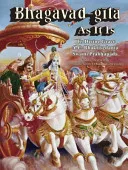
Key symbols include the battlefield of Kurukshetra, representing the human soul's struggle with material existence and duty. Lord Krishna, as the charioteer, symbolizes the Divine guiding the individual soul (Arjuna) through life's dilemmas. The chariot itself often symbolizes the body, with the senses, mind, and intellect as its components, all needing to be controlled by the driver (the soul guided by higher consciousness).
Modern Relevance
Contemporary practitioners of Bhakti yoga, particularly within ISKCON and affiliated groups, draw directly from this text for their spiritual practice and philosophical understanding. Its influence extends to comparative religion studies and those exploring theistic interpretations of consciousness and the divine. Modern spiritual seekers interested in devotional paths and Eastern philosophies often encounter this edition as a primary source for understanding Vaishnava theology.
👥 Who Should Read This Book
• Devotees and students of Gaudiya Vaishnavism seeking an authoritative commentary on Krishna's teachings from their specific lineage. • Comparative religion scholars interested in understanding the diverse interpretations of the Bhagavad-Gita and the influence of ISKCON. • Individuals exploring devotional paths in Eastern spirituality who appreciate a detailed, theistic exegesis of sacred texts.
📜 Historical Context
The Bhagavad-Gita, an ancient Sanskrit scripture, has been a central to Indian philosophy for millennia. A. C. Bhaktivedanta Swami Prabhupada's translation and commentary, Bhagavad-Gita As It Is, first gained widespread publication in the mid-20th century, with significant editions appearing after he founded ISKCON in 1966. Prabhupada's work emerged during a period of intense Western interest in Eastern religions, influenced by movements like Transcendental Meditation and the Theosophical Society. Unlike more academic or syncretic interpretations prevalent at the time, Prabhupada's commentary strictly adheres to the Gaudiya Vaishnavism tradition, emphasizing the personal nature of God as Krishna and the path of devotion. This approach contrasted with, for example, the Advaita Vedanta interpretations championed by figures like Swami Vivekananda earlier in the century, which focused on non-dualism. Prabhupada's direct, devotional exegesis aimed to provide an unadulterated spiritual message for a global audience, becoming a foundational text for ISKCON devotees worldwide.
📔 Journal Prompts
Arjuna's dilemma on the battlefield of Kurukshetra.
The concept of the soul (atma) as distinct from the body.
Krishna's explanation of the three modes of material nature (gunas).
The practice of bhakti yoga as described by Krishna.
Understanding one's own dharma in relation to spiritual duty.
🗂️ Glossary
Bhagavad-Gita
A 700-verse scripture in the Hindu epic Mahabharata, containing a dialogue between Prince Arjuna and Lord Krishna on duty, devotion, and liberation.
Bhakti Yoga
The path of devotion or loving service to the Supreme Lord, considered by many traditions, including Gaudiya Vaishnavism, as a primary means of spiritual realization.
Krishna
In this context, revered as the Supreme Personality of Godhead, the source of all existence, who imparts spiritual knowledge to Arjuna.
Arjuna
The warrior prince to whom Lord Krishna delivers the teachings of the Bhagavad-Gita on the battlefield.
Dharma
One's prescribed duty, righteousness, or intrinsic nature, often interpreted in relation to cosmic order and spiritual goals.
Atma
The eternal self or soul, considered distinct from the physical body and mind in Vedic philosophy.
Gunas
The three modes or qualities of material nature—sattva (goodness), rajas (passion), and tamas (ignorance)—which influence consciousness and action.