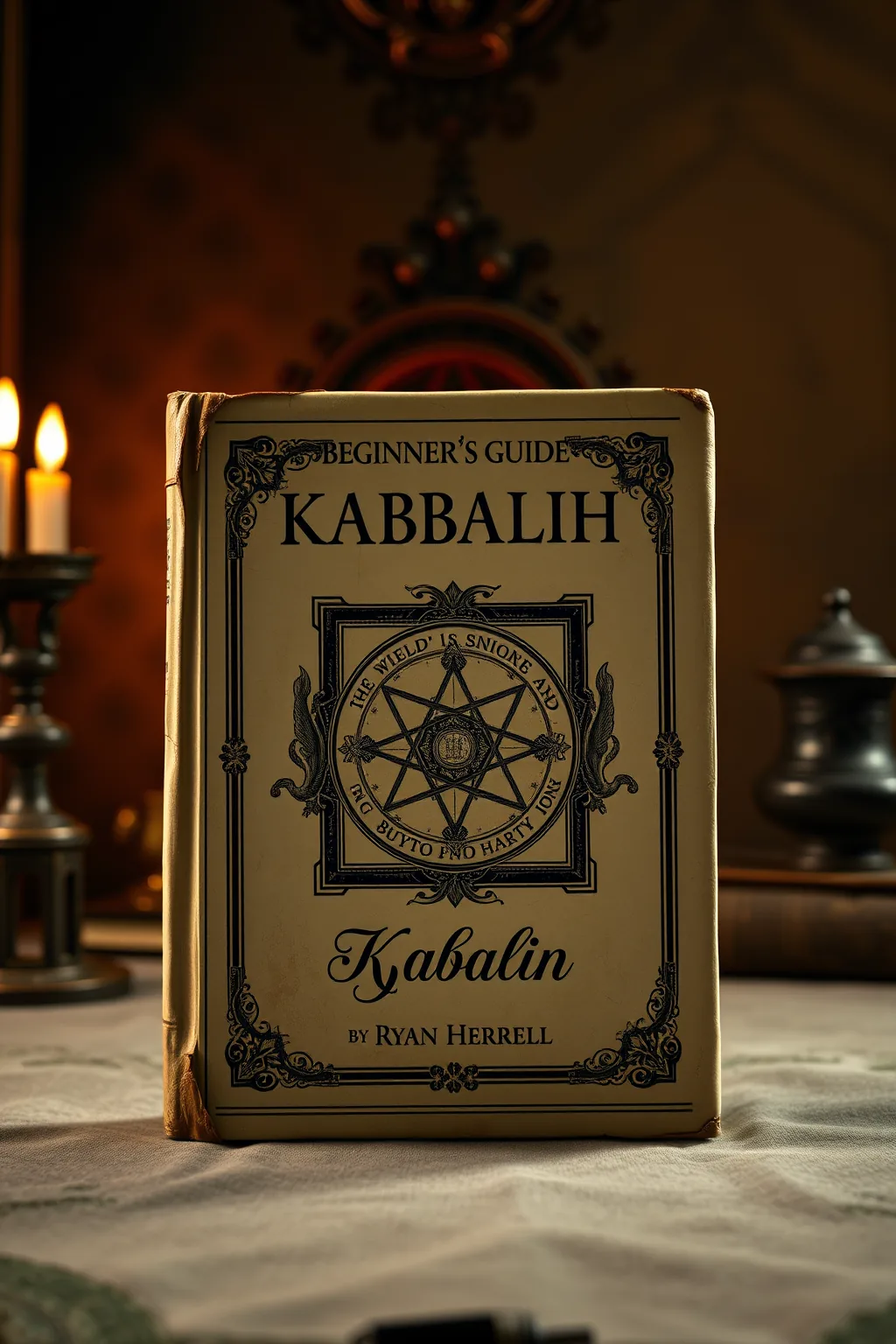
Beginner's Guide to Kabbalah
 61
61

Beginner's Guide to Kabbalah


Cassian Rothmann (Senior Critic, Ancient Wisdom) — Ryan Herrell's 'Beginner's Guide to Kabbalah' is a beacon for those venturing into the luminous depths of Jewish mysticism. Herrell masterfully demystifies complex concepts, rendering the esoteric accessible without sacrificing its profound essence. He skillfully unpacks the Tree of Life's architecture and the Sephiroth's archetypal energies, providing a clear yet evocative introduction to Kabbalistic thought. This guide is an invaluable companion for spiritual explorers, offering not just intellectual understanding but also practical pathways for personal transformation. Herrell's lucid prose and insightful interpretations make this an essential first step for anyone drawn to the ancient wisdom of Kabbalah.
📝 Description
61
Ryan Herrell's 'Beginner's Guide to Kabbalah' was written to demystify Jewish mysticism for new students.
This book introduces the core concepts of Kabbalah, a system of Jewish mysticism. Herrell explains the Tree of Life, a central diagram in Kabbalah, and the ten Sephiroth, which are divine attributes or emanations. The text also covers the mystical pathways connecting these Sephiroth, describing them as routes for spiritual development.
The guide aims to make these esoteric ideas accessible. It addresses fundamental questions about creation, divinity, and the individual's place within the cosmos. Herrell focuses on providing a philosophical structure to help readers grasp the interconnectedness of all things and the divine presence within them. The book encourages a closer look at sacred texts and the potential for heightened spiritual awareness.
Kabbalah is a tradition within Jewish mysticism that developed over centuries. It seeks to understand the divine nature and the relationship between God and the created world through symbolic interpretation of scripture and mystical practices. Key elements include the Tree of Life, a map of divine emanations, and concepts like the Sephiroth. This book places itself within that lineage, aiming to present these complex ideas to a contemporary audience unfamiliar with the tradition.
💡 Why Read This Book?
This book is an essential primer for anyone yearning to understand the esoteric underpinnings of existence. It offers a clear, accessible pathway into the profound symbolism and spiritual practices of Kabbalah, ideal for beginners, spiritual seekers, and those curious about Jewish mysticism. If you seek to explore the Tree of Life, divine emanations, and the architecture of the soul, this guide provides the foundational knowledge and contemplative tools.
⭐ Reader Reviews
Honest opinions from readers who have explored this book.
❓ Frequently Asked Questions
What is Kabbalah?
Kabbalah is a mystical tradition within Judaism that explores the divine nature, the creation of the universe, and the human soul's connection to God through esoteric interpretation of scripture and symbolic representation.
What is the Tree of Life?
The Tree of Life is a central diagram in Kabbalah, representing the ten Sephiroth (divine emanations) and the pathways connecting them, illustrating the structure of the cosmos and the journey of the soul.
Is this book suitable for absolute beginners?
Yes, this guide is specifically designed for individuals with no prior knowledge of Kabbalah, offering a gentle yet comprehensive introduction to its core concepts and teachings.
What are the Sephiroth?
The Sephiroth are the ten divine attributes or emanations through which God reveals Himself and interacts with creation, forming the structure of the Tree of Life.
Can Kabbalah be practiced secularly?
While rooted in Jewish tradition, Kabbalistic principles and symbolism are studied and applied by individuals of various backgrounds for spiritual growth, self-understanding, and philosophical inquiry.
🔮 Key Themes & Symbolism
The Tree of Life and the Sephiroth
This central theme explores the archetypal map of creation and consciousness represented by the Tree of Life. It studies the ten Sephiroth, understanding them not merely as abstract concepts but as dynamic forces and divine attributes that govern existence and the spiritual journey. Readers will learn how these emanations bridge the Infinite with the finite, offering a framework for understanding divine will, human potential, and the interconnectedness of all manifest reality.
Symbolism and Esoteric Interpretation
This book emphasizes the profound symbolic language inherent in Kabbalistic texts and traditions. It guides the reader in decoding the body of symbols, numbers, and letters that form the bedrock of Kabbalistic thought. Understanding this esoteric lexicon is presented as crucial for accessing deeper spiritual truths and for comprehending the hidden meanings within sacred literature and the very fabric of the cosmos. The focus is on cultivating an intuitive and symbolic mode of perception.
Spiritual Ascent and Gnosis
A core focus is the Kabbalistic path of spiritual evolution, the ascent from the mundane to the divine. The book illuminates the methods and inner work required to purify the soul, align with divine energies, and achieve a state of gnosis—direct, experiential knowledge of God. It presents Kabbalah as a practical system for self-transformation, encouraging readers to integrate its wisdom into their lives to foster spiritual growth and a deeper connection to the divine source.
💬 Memorable Quotes
Direct passages from the work, attributed to the author.
“Every letter is a divine secret.”
— Highlights the Kabbalistic belief in the inherent sacredness and hidden meanings within the Hebrew alphabet, viewing letters as carriers of divine power and cosmic blueprints.
“Wisdom is the bridge between the visible and the unseen.”
— Emphasizes the role of Kabbalistic wisdom in revealing the subtle, invisible dimensions of reality and connecting them to our everyday experience.
“To know oneself is to begin to know the Divine.”
— Points to the introspective nature of Kabbalah, where self-discovery is seen as an integral part of the path to understanding the ultimate reality and God.
“The path of return is illuminated by the Sephiroth.”
— Suggests that the divine emanations, as depicted on the Tree of Life, provide guidance and energy for the soul's journey back to its divine source.
💡 Key Ideas
Editorial paraphrase of the work's core concepts — not direct quotes.
The Tree of Life is the blueprint of the soul.
This quote expresses the Kabbalistic view of the Tree of Life as a profound map not only of the cosmos but also of the inner spiritual structure and potential of every human being.
🌙 Esoteric Significance
Tradition
Kabbalah is the quintessential esoteric tradition within Judaism, offering a profound, mystical interpretation of the Torah and the divine nature. It provides a complex cosmology, a system of spiritual development, and a method for understanding the interconnectedness of all creation. Unlike exoteric religious practice, Kabbalah studies hidden meanings, divine emanations, and the soul's journey towards reunion with the Infinite, making it a central to Western esoteric thought.
Symbolism
The esoteric significance of Kabbalah is deeply embedded in its detailed symbolism. The Tree of Life, with its ten Sephiroth and twenty-two pathways, is a universal diagram representing the divine structure of the cosmos and the human soul. Hebrew letters, gematria (numerical interpretation of words), and various mystical diagrams are employed as keys to unlock hidden truths about God, creation, and human destiny, serving as potent vehicles for meditation and spiritual insight.
Modern Relevance
In contemporary times, Kabbalah's esoteric principles offer a powerful framework for personal growth, spiritual exploration, and understanding the interconnectedness of existence. Its emphasis on introspection, divine immanence, and the inherent potential within each individual speaks to seekers of all backgrounds. The symbolic language and cosmological maps provide tools for navigating complex life challenges, fostering a deeper sense of purpose, and cultivating a more profound, integrated spiritual life in a rapidly changing world.
👥 Who Should Read This Book
This guide is an indispensable resource for the curious beginner eager to explore the profound depths of Jewish mysticism. Spiritual seekers looking for a structured path to understanding divine principles and their personal connection to the cosmos will find clarity and inspiration. Students of comparative religion and esotericism will appreciate its accessible yet rigorous introduction to a foundational mystical system. Practitioners seeking to deepen their contemplative practices or integrate Kabbalistic insights into their spiritual journey will also find immense value in its foundational teachings and practical guidance.
📜 Historical Context
The Kabbalah emerged from the fertile intellectual and spiritual range of medieval Judaism, primarily in 12th and 13th century Provence and Spain. It developed as a response to both philosophical currents and a deep-seated desire to understand the mystical dimensions of the Torah. Early Kabbalistic texts like the Sefer Bahir and later seminal works such as the Zohar synthesized biblical interpretation, Neoplatonic philosophy, and Gnostic ideas into a coherent esoteric system. This tradition flourished during periods of both intellectual vibrancy and persecution, offering solace, meaning, and a profound connection to the divine for its adherents. Its influence has extended far beyond Jewish circles, impacting Western esotericism, philosophy, and art throughout the centuries, evolving and adapting while retaining its core mystical tenets.
📔 Journal Prompts
Reflect on a time you felt a deep connection to something greater than yourself. How might the concept of divine emanation relate to this experience?
Consider one of the Sephiroth. What qualities does it represent, and how do you see these qualities manifesting in your own life or the world around you?
How does the idea of hidden knowledge in Kabbalah challenge or affirm your current beliefs about reality?
What does it mean to you to 'decode' a symbol? How might this apply to understanding yourself or others?
If the Tree of Life is a blueprint for the soul, what aspect of your own 'blueprint' are you most interested in exploring or developing?
🗂️ Glossary
Sephiroth
The ten divine emanations or attributes through which God manifests and interacts with the universe, forming the structure of the Kabbalistic Tree of Life.
Tree of Life (Etz Chaim)
A central diagram in Kabbalah, consisting of ten interconnected spheres (Sephiroth) and twenty-two pathways, representing the structure of the cosmos, divine revelation, and the spiritual journey.
Gnosis
Direct, intuitive, or experiential knowledge of spiritual truths, often referring to a profound and immediate understanding of the divine.
Ein Sof
The Kabbalistic concept of the Infinite or the Limitless Divine, the absolute, unknowable essence of God beyond all creation and comprehension.
Tikkun
Literally 'correction' or 'rectification.' In Kabbalah, it refers to the cosmic task of repairing the world and restoring divine harmony, often through spiritual practice and ethical action.
This book appears in 1 collection
🔮 Readers Also Liked
Browse all →








More by Ryan Herrell
All books →
From the “Kabbalah” Collection
View all →








More Free Kabbalah & Jewish Mysticism Books
View all →