Astrology
 73
73

Astrology
MacNeice’s "Astrology" presents a lucid, almost anthropological survey of the subject, treating its historical development with a poet’s sensibility for narrative and symbolic resonance. The book’s strength lies in its clear tracing of astrological ideas from ancient Mesopotamia through the Hellenistic period, anchoring them in specific cultural and intellectual contexts. A particular strength is its detailed discussion of the Ptolemaic system, which formed the bedrock of Western astrology for centuries. However, the work’s brevity, while a virtue for accessibility, means that the deeper philosophical implications or the later evolution of astrological thought are only touched upon. MacNeice avoids the sensational, focusing instead on the intellectual scaffolding. The passage detailing the astrological interpretation of the four elements—fire, air, water, earth—as fundamental qualities is particularly illustrative of his balanced approach. Ultimately, "Astrology" serves as an excellent, albeit brief, primer on the historical construction of celestial meaning.
📝 Description
73
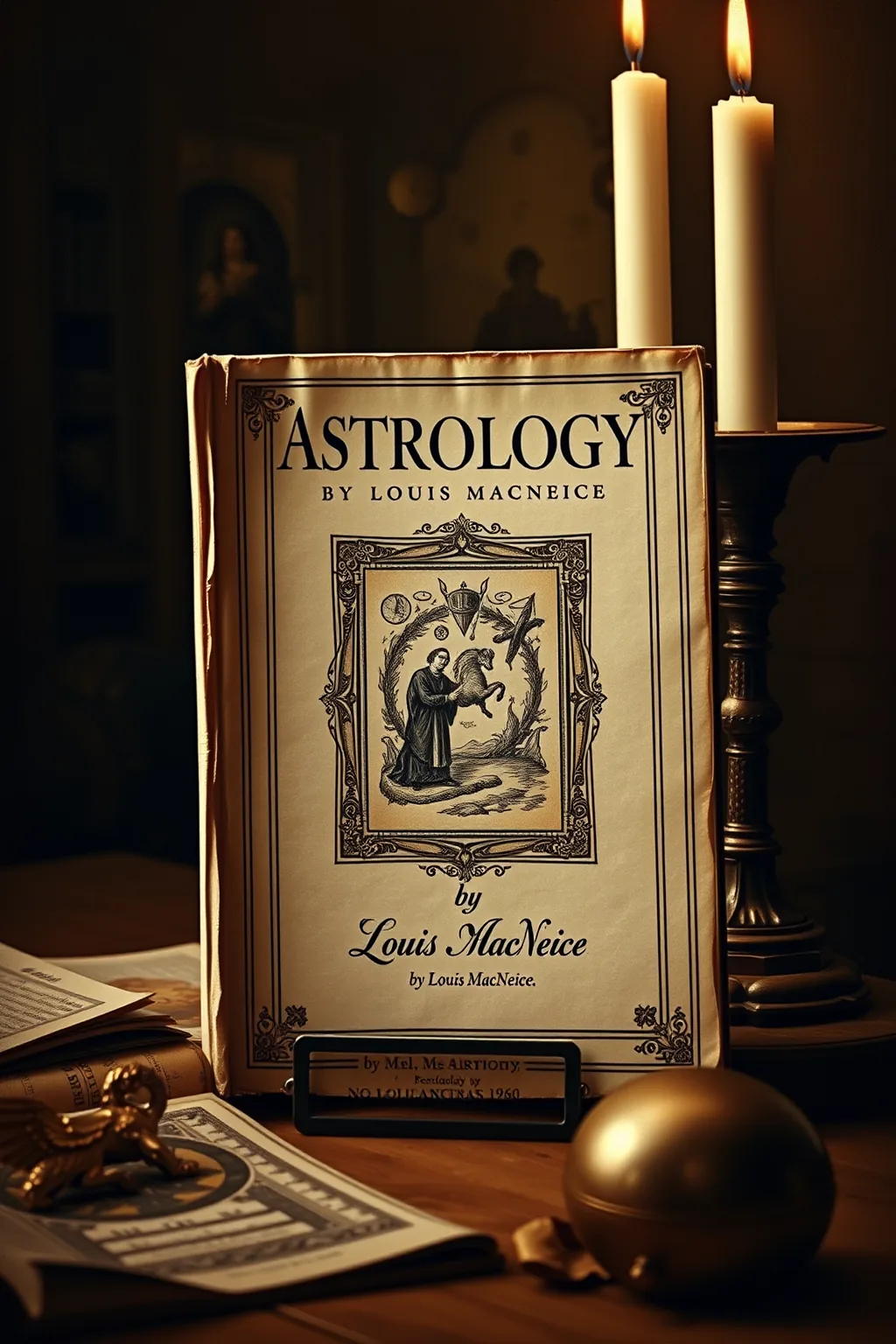
Louis MacNeice's Astrology, published in 1964, examines celestial mapping of human destiny.
Published in 1964, Louis MacNeice's Astrology delves into the history and philosophical foundations of astrological thought. It moves past simple horoscopes to examine the ancient systems that used celestial observation to chart human fate. MacNeice, a poet familiar with classical literature, viewed astrology as a symbolic language and a historical lens for understanding humanity's place in the universe. He approached the subject with a scholar's perspective, placing it within broader humanistic inquiry and ancient belief systems.
The book covers the evolution of zodiacal constellations and the impact of Babylonian and Hellenistic cosmology. It highlights how astrological systems served as early forms of classification and as frameworks for interpreting personality and destiny. MacNeice's work emerged during a mid-20th century period when interest in esoteric traditions was growing, often as a response to scientific rationalism. This approach reveals astrology not as a predictive tool, but as a historical and cultural phenomenon.
This book engages with a mid-20th century resurgence of interest in esoteric traditions, which often served as a counterpoint to increasing scientific rationalism. MacNeice, drawing on his background in classical literature and myth, treats astrology not as a mystical practice but as a significant historical and intellectual system. He connects it to ancient belief systems and broader humanistic inquiry, situating it within the long tradition of humanity's attempts to find meaning and order in the cosmos through celestial observation.
💡 Why Read This Book?
• Gain an understanding of the historical evolution of astrological thought, from its Babylonian origins to its Hellenistic codification, a perspective vital for comprehending Western cosmology. • Explore the symbolic language of the zodiac and planetary influences as developed in antiquity, offering a framework for interpreting ancient texts beyond mere literalism. • Appreciate the intellectual impulse behind astrology as a system of order and meaning-making, as illuminated by MacNeice's scholarly yet accessible narrative.
⭐ Reader Reviews
Honest opinions from readers who have explored this book.
❓ Frequently Asked Questions
When was Louis MacNeice's "Astrology" first published?
Louis MacNeice's "Astrology" was first published in 1964, a period marked by renewed interest in esoteric and historical subjects.
What historical periods does MacNeice cover regarding astrology?
The book primarily examines the origins and development of astrology in ancient Mesopotamia and the Hellenistic world, tracing its foundational concepts.
Does MacNeice present astrology as a predictive science?
No, MacNeice approaches astrology as a historical and philosophical system of symbolic interpretation and cosmology, rather than a predictive science.
Who was Ptolemy in relation to astrology, as discussed by MacNeice?
MacNeice discusses Ptolemy, the Greco-Roman scholar, as a key figure whose "Tetrabiblos" codified much of Hellenistic astrological theory that influenced Western thought for centuries.
What is the 'Tetrabiblos' mentioned in MacNeice's work?
The 'Tetrabiblos' is an ancient treatise by Ptolemy, considered a foundational text in Western astrology, which MacNeice references as a significant historical document.
What are the four elements as discussed in the context of MacNeice's astrology?
MacNeice touches upon the classical elements of fire, air, water, and earth, which were integral to early astrological systems for categorizing celestial influences and terrestrial phenomena.
🔮 Key Themes & Symbolism
Celestial Mapping
MacNeice details how early civilizations, particularly the Babylonians, developed sophisticated systems for observing and charting celestial movements. This wasn't mere astronomical record-keeping but a profound attempt to find order and meaning in the cosmos, believing that these patterns held keys to understanding earthly events and human destiny. The book illustrates how these early celestial maps formed the bedrock for later astrological traditions.
Hellenistic Synthesis
The work highlights the crucial period of the Hellenistic era, where Greek philosophical thought merged with Babylonian astronomical practices. MacNeice explains how figures like Ptolemy synthesized these traditions, developing a more systematic and complex astrological framework that would dominate Western thought for over a millennium. This synthesis aimed to provide a coherent model for interpreting planetary influences on individuals and societies.
Symbolic Language of the Stars
Beyond literal prediction, MacNeice explores astrology as a rich symbolic language. He examines how zodiacal signs, planetary positions, and their configurations were interpreted as representations of fundamental qualities and archetypes. This symbolic approach allowed ancient thinkers to articulate complex ideas about human nature, fate, and the interconnectedness of the macrocosm and microcosm.
Cosmic Order and Human Destiny
A central theme is the ancient human drive to understand one's place within a perceived cosmic order. MacNeice shows how astrology provided a framework for this, suggesting that human lives and events were not random but intricately linked to celestial cycles. This belief in a divinely ordered or causally connected universe offered solace and a means of interpreting life's challenges.
💬 Memorable Quotes
Direct passages from the work, attributed to the author.
“The stars influence but do not compel.”
— This common astrological tenet, likely referenced by MacNeice, suggests that celestial alignments may predispose individuals or events towards certain outcomes, but free will or other factors can alter the course.
“The development of the zodiac from Babylonian observation.”
— This refers to the historical process where early Mesopotamian sky-watchers began dividing the ecliptic into twelve segments, each associated with constellations, laying the groundwork for the zodiacal system.
“Ptolemy's 'Tetrabiblos' as a core part of Western astrology.”
— This highlights the enduring influence of Ptolemy's work, a systematic treatise from the 2nd century CE that codified much of the astrological theory and practice adopted and adapted throughout subsequent centuries.
“The four elements: fire, air, water, earth, as fundamental qualities.”
— This points to the classical system where the zodiac signs and planets were categorized according to these four fundamental terrestrial qualities, providing a framework for interpreting their nature and interactions.
💡 Key Ideas
Editorial paraphrase of the work's core concepts — not direct quotes.
Astrology is a form of divination that seeks to understand the human condition through celestial patterns.
This paraphrased concept emphasizes MacNeice's approach: viewing astrology not as a hard science, but as an ancient method of inquiry into human experience, grounded in the observation of the heavens.
🌙 Esoteric Significance
Tradition
MacNeice's work engages with the Hermetic and Hellenistic traditions, which are foundational to much of Western esotericism. It examines the practical and philosophical applications of celestial observation that developed in ancient Mesopotamia and was later synthesized and systematized by Greco-Roman thinkers. While not strictly a practitioner's guide, it provides historical context for the symbolic language and cosmology that underpin many esoteric paths.
Symbolism
The book explores key astrological symbols such as the twelve signs of the zodiac, each representing archetypal energies and cycles of the year. It also touches upon the symbolism of the planets, which were understood not just as celestial bodies but as personified forces influencing human affairs. The concept of the four elements (fire, air, water, earth) is presented as a fundamental symbolic classification system used to interpret these celestial influences.
Modern Relevance
Contemporary interest in astrology often draws upon historical frameworks. Thinkers and practitioners exploring psychological astrology, archetypal astrology, or even historical astrology as a field of study find value in MacNeice's clear exposition of the ancient systems and their development. His work provides a crucial historical anchor for understanding how these symbolic languages evolved and continue to be interpreted in modern esoteric and psychological contexts.
👥 Who Should Read This Book
• Students of comparative religion and ancient history seeking to understand early cosmological systems and divination practices. • Literary scholars interested in the cultural and symbolic impact of astrology on Western literature and thought. • Inquirers into esoteric traditions looking for a grounded historical overview of astrology's origins and philosophical underpinnings before diving into more specialized texts.
📜 Historical Context
Published in 1964, Louis MacNeice's "Astrology" emerged during a post-war era where intellectual curiosity began to turn towards older traditions and less orthodox philosophies. The mid-20th century saw a resurgence of interest in esotericism, partly as a reaction against the perceived limitations of purely materialistic or scientific worldviews. MacNeice, already a respected poet and critic known for his engagement with myth and classical literature, brought a scholar's discipline to the subject. He situated astrology within a lineage of human attempts to understand cosmic order, tracing its roots back to Babylonian and Hellenistic civilizations. This was a period when scholars like Frances Yates were exploring the Hermetic tradition and the history of occult philosophy, providing a broader academic context for such studies. While not a mainstream academic pursuit, astrology occupied a space in the cultural imagination, influencing writers and thinkers who sought alternative frameworks for meaning. MacNeice's work contributed to a more nuanced understanding of astrology's historical significance, distinct from contemporary popular interpretations.
📔 Journal Prompts
The Babylonian origins of celestial mapping and their influence.
The Hellenistic synthesis of Babylonian and Greek thought in astrology.
Ptolemy's role in codifying astrological principles.
The symbolic meaning of the four elements in early astrological systems.
How ancient civilizations perceived the connection between celestial events and human destiny.
🗂️ Glossary
Zodiac
The band of the celestial sphere through which the Sun, Moon, and planets appear to move. Anciently divided into twelve equal segments, each associated with constellations and symbolic meanings.
Hellenistic Period
The historical era following the conquests of Alexander the Great (roughly 323 BCE to 31 BCE), characterized by the spread of Greek culture and the fusion of Greek, Egyptian, and Mesopotamian traditions.
Tetrabiblos
A foundational treatise on astrology written by Claudius Ptolemy in the 2nd century CE, considered a key text that systematized much of ancient astrological knowledge.
Babylonian Astrology
The earliest known systematic form of astrology, originating in ancient Mesopotamia, which focused on omens derived from celestial phenomena and laid groundwork for later systems.
Planetary Influences
The concept within astrology that celestial bodies (planets, Sun, Moon) exert specific effects or predispositions on earthly events and individual personalities.
Elements (Fire, Air, Water, Earth)
In classical and astrological thought, four fundamental qualities believed to constitute all matter and to characterize the nature of signs, planets, and phenomena.
Divination
The practice of seeking knowledge of the future or the unknown by supernatural means or by interpreting omens and celestial patterns.
🔮 Readers Also Liked
Browse all →








More by Louis MacNeice
All books →
More Free Astrology & Cosmology Books
View all →