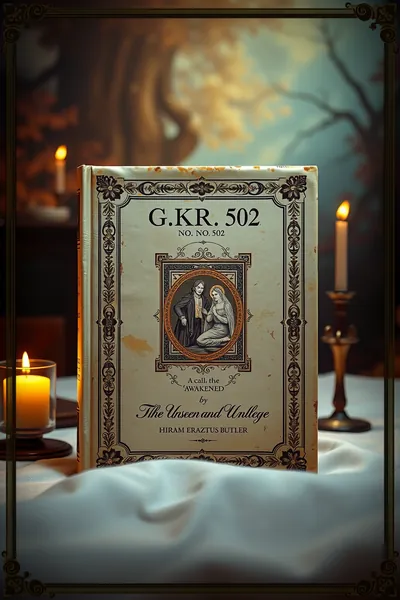
Astral Projection, Ritual Magic and Alchemy
 75
75

Astral Projection, Ritual Magic and Alchemy
Mathers' exploration of astral projection and ritual magic offers a stark, unvarnished look at the mechanics of occult practice as understood by a principal architect of the Golden Dawn. The text’s strength lies in its directness, presenting complex theories with a procedural clarity that belies their arcane nature. For instance, the detailed instructions for constructing talismans and conducting invocations, while dense, provide a clear blueprint for ritualists. However, the work’s primary limitation is its inherent didacticism; it assumes a high degree of prior knowledge and offers little by way of introductory context for the uninitiated. The section on alchemical symbolism, while insightful, often reads as a cipher requiring extensive cross-referencing with other Hermetic texts. Ultimately, this is less an invitation to the uninitiated and more a reference manual for the dedicated student of ceremonial magic.
📝 Description
75
Samuel Liddell MacGregor Mathers' writings on astral projection, ritual magic, and alchemy are collected in this volume.
This book gathers writings by Samuel Liddell MacGregor Mathers, a significant figure in modern Western occultism. It focuses on his work concerning astral projection, the practices of ritual magic, and the principles of alchemy. The collection serves as a direct source for understanding the theories and methods that influenced occult groups in the late 19th and early 20th centuries. It is intended for students of esoteric traditions, especially those interested in the Hermetic Order of the Golden Dawn and its subsequent impact. Practitioners of ceremonial magic, academic researchers of occultism, and those studying the history of occult thought will find value here. A basic familiarity with occult terms and a dedication to in-depth study are recommended for readers.
The texts originate from a dynamic period in Western esotericism. Mathers co-founded the Hermetic Order of the Golden Dawn in 1888, blending elements from Kabbalah, Rosicrucianism, and ceremonial magic. This era saw a renewed interest in older spiritual systems, often interpreted through new philosophical and scientific perspectives. The book details the mechanics of astral projection as a controllable faculty for spiritual exploration. It outlines a systematic approach to ritual magic, highlighting its use for personal growth and the direction of subtle energies. Alchemy is examined not just as a literal process, but as a symbolic framework for spiritual refinement, reflecting internal transformation.
These writings emerge from the late 19th and early 20th centuries, a period of significant activity in Western esotericism. Mathers was a central figure in the establishment of the Hermetic Order of the Golden Dawn in 1888. His work synthesized diverse occult traditions, including Kabbalah and Rosicrucianism, within a framework of ceremonial magic. This intellectual climate was marked by a revival of interest in older spiritual doctrines, often reinterpreted alongside contemporary scientific and philosophical ideas. The texts reflect this synthesis, contributing to the development of modern occult societies.
💡 Why Read This Book?
• Gain direct insight into the foundational principles of astral projection as codified by a key Golden Dawn member, understanding techniques for conscious out-of-body travel that influenced subsequent occult literature. • Learn the systematic approach to ritual magic described by Mathers, focusing on the precise construction of magical instruments and the execution of invocations as detailed in his original works. • Explore the alchemical symbolism presented in the text, understanding its connection to spiritual purification and transformation beyond purely material interpretations, as outlined in his alchemical treatises.
⭐ Reader Reviews
Honest opinions from readers who have explored this book.
❓ Frequently Asked Questions
What is the primary focus of Samuel Liddell MacGregor Mathers' work on astral projection?
Mathers' work focuses on astral projection as a disciplined, controllable faculty for intentional spiritual exploration and experience beyond the physical body, detailing methods for its development and safe practice.
When was Samuel Liddell MacGregor Mathers' original work first published?
The original publication date of Mathers' seminal work, which is compiled in this volume, is 1972.
What role did Samuel Liddell MacGregor Mathers play in the Hermetic Order of the Golden Dawn?
Mathers was a principal founder of the Hermetic Order of the Golden Dawn in 1888, a significant organization that synthesized various esoteric traditions and greatly influenced modern Western occultism.
How does Mathers' approach to alchemy differ from purely material interpretations?
Mathers views alchemy through a Hermetic lens, emphasizing its symbolic function for spiritual transformation and purification of the practitioner, rather than solely focusing on the transmutation of metals.
Is this book suitable for absolute beginners in occult studies?
While informative, the book's dense theoretical content and reliance on esoteric terminology make it more suitable for students with some prior exposure to occult or Hermetic concepts.
What are the main esoteric traditions that influence Mathers' writings?
Mathers' writings draw heavily from Hermeticism, Kabbalah, Rosicrucianism, and ceremonial magic, integrating these streams into a cohesive system of occult practice.
🔮 Key Themes & Symbolism
Astral Projection Mechanics
The text details astral projection not as a random phenomenon but as a cultivatable skill. It outlines specific techniques and mental disciplines required to achieve conscious separation from the physical body, emphasizing control and awareness during the experience. Mathers posits this as a method for direct spiritual perception and exploration of non-physical realms, distinct from dreams or imagination, requiring rigorous practice and mental fortitude.
Systematic Ritual Magic
Mathers presents ritual magic as a structured, scientific art. This section elaborates on the construction of magical implements, the significance of divine names and angelic invocations, and the precise execution of ceremonial sequences. The emphasis is on the systematic application of will and knowledge to effect changes in the subtle planes, aligning with Hermetic principles of correspondence and sympathetic magic.
Alchemical Symbolism and Transformation
The alchemical component transcends mere metallurgy, interpreting the Great Work as a profound process of spiritual purification and evolution for the adept. Mathers explores the symbolic stages of alchemical transformation, relating them to psychological and spiritual development. This approach aligns alchemy with Hermeticism's goal of achieving gnosis and perfecting the human soul.
Golden Dawn Pedagogy
As a foundational text for understanding the Golden Dawn's curriculum, this work implicitly teaches its structured approach to occultism. It reveals the interconnectedness of the various disciplines—astral travel, ritual, and alchemy—as taught within the Order, demonstrating a holistic system for spiritual advancement rooted in ancient wisdom traditions and early 20th-century occult revival.
💬 Memorable Quotes
Direct passages from the work, attributed to the author.
“Ritual is the science of operating the Will through the medium of the Invisible.”
— This interpretation underscores Mathers' perspective on ceremonial magic as a practical, almost scientific, discipline for influencing non-physical realities through focused intent and symbolic actions.
“Knowledge of divine names is essential for invoking celestial intelligences.”
— This captures the essence of a concept within the text, emphasizing the importance of specific divine nomenclature in ceremonial magic for establishing contact and authority with spiritual entities.
💡 Key Ideas
Editorial paraphrase of the work's core concepts — not direct quotes.
The projection of the Astral Body is a faculty to be cultivated by will and discipline.
This paraphrased concept highlights Mathers' view of astral projection as an achievable skill, not an innate gift, requiring dedicated practice and mental control, characteristic of his systematic approach to occultism.
The Alchemical processes mirror the stages of the Great Work within the soul.
This paraphrased concept illustrates Mathers' symbolic interpretation of alchemy, framing its stages of purification and transformation as a metaphor for the spiritual development and perfection of the individual practitioner.
The Astral Body can be trained to perceive planes beyond the physical.
This paraphrased idea reflects the text's assertion that the subtle body, through training, gains the capacity to interact with and apprehend realities not accessible to the ordinary senses.
🌙 Esoteric Significance
Tradition
Mathers' work is deeply rooted in the Western Hermetic tradition, specifically its ceremonial magic and Kabbalistic branches. It represents a key effort to systematize and codify these ancient streams of knowledge, making them accessible (albeit challenging) to a modern audience through organizations like the Hermetic Order of the Golden Dawn. His synthesis integrated diverse esoteric sources into a coherent framework for spiritual development.
Symbolism
Key symbols explored include the Caduceus of Hermes, representing the union of opposites and the flow of spiritual energy (Kundalini-like force), and the Tree of Life from Kabbalah, used as a map of consciousness and the cosmos. Alchemy's symbolism of metals, planets, and laboratory processes is reinterpreted as stages of inner purification and divine union.
Modern Relevance
Contemporary practitioners of Western esoteric traditions, particularly those involved in ceremonial magic, Golden Dawn-derived systems, and Hermeticism, continue to draw upon Mathers' foundational texts. His methodical approach to ritual and his interpretations of alchemical and Kabbalistic symbolism remain influential in modern occult studies and personal spiritual development practices.
👥 Who Should Read This Book
• Students of ceremonial magic seeking to understand the historical and theoretical underpinnings of modern occult orders like the Golden Dawn. • Researchers of Western Esotericism interested in primary source material from a key figure of the late 19th and early 20th-century occult revival. • Aspiring practitioners of astral projection and alchemy who desire a structured, historical perspective on these disciplines from a foundational occultist.
📜 Historical Context
Samuel Liddell MacGregor Mathers' writings emerged during a vibrant period of occult revival in late Victorian England. As a principal architect of the Hermetic Order of the Golden Dawn, founded in 1888, Mathers synthesized elements from Kabbalah, Rosicrucianism, Freemasonry, and ceremonial magic. This era witnessed intense interest in spiritualism and esoteric philosophies, partly as a reaction against prevailing materialism and industrialization. Mathers' work stood alongside that of contemporaries like Helena Blavatsky, founder of the Theosophical Society, though Mathers focused more on structured ceremonial magic. While the Golden Dawn attracted significant figures like Aleister Crowley and W.B. Yeats, its internal disputes and Mathers' authoritarian style led to schisms. The Order's teachings, however, disseminated widely, influencing generations of occult practitioners and scholars.
📔 Journal Prompts
The precise construction of magical instruments, as detailed by Mathers.
The symbolic stages of alchemical transformation and their inner resonance.
Your understanding of astral projection as a cultivated faculty.
The role of divine names in ceremonial invocations.
The interconnectedness of Kabbalah and ceremonial magic in Mathers' system.
🗂️ Glossary
Astral Body
A subtle, non-physical body believed to be capable of perception and locomotion independent of the physical body, often associated with dreams and out-of-body experiences.
Ritual Magic
A systematic practice involving symbolic actions, invocations, and the manipulation of subtle energies, intended to effect change in the practitioner or their environment.
Alchemy
An ancient tradition focused on the transformation of matter, often interpreted esoterically as a symbolic process for spiritual purification and the perfection of the soul.
Kabbalah
A system of Jewish mysticism that explores the divine nature, creation, and the relationship between God and humanity, often using symbolic interpretations of scripture and the Tree of Life.
Hermeticism
A philosophical and religious tradition based on the purported teachings of Hermes Trismegistus, emphasizing gnosis, the unity of all things, and the principle of 'As Above, So Below'.
Invocation
The act of calling upon or inviting a spiritual entity, divine power, or force, typically within a magical or religious ceremony.
Great Work
In alchemy, the process of creating the Philosopher's Stone, often understood metaphorically as the spiritual transformation and enlightenment of the alchemist.