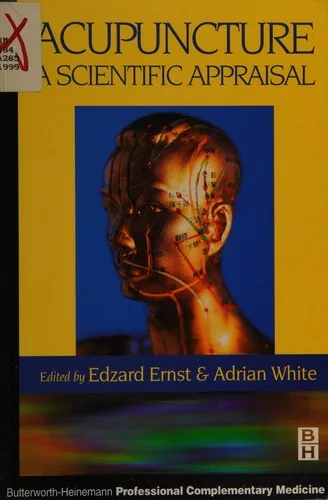
Acupuncture
 79
79

Acupuncture
Adrian White and Edzard Ernst's *Acupuncture* offers a solid, if somewhat dry, examination of its subject. The work commendably avoids hyperbole, presenting the material with academic rigor. Its strength lies in its systematic approach to explaining the complex theoretical framework of Traditional Chinese Medicine, particularly the concept of qi and its meridians. A notable limitation is the book's dense prose, which can make the subject matter less accessible to absolute beginners. For instance, the detailed explanation of the Zang-fu organ systems, while accurate, requires significant concentration. The authors successfully ground the practice in its historical and philosophical origins, providing context that is often missing in more clinically focused texts. Ultimately, this is a valuable reference for those committed to a thorough understanding of acupuncture's foundational principles.
📝 Description
79
Adrian White and Edzard Ernst's 2008 book details acupuncture's theoretical underpinnings and therapeutic applications.
This book examines the ancient Chinese practice of acupuncture, covering its theoretical foundations, diagnostic methods, and practical uses. It aims to give readers a solid grasp of the concepts of qi, meridians, and acupoints that define this healing art. The authors move beyond a simple introduction to present substantial information for dedicated study.
The work is suited for students of traditional medicine, practitioners of alternative therapies, and anyone interested in the body's energetic systems. It is a useful resource for understanding acupuncture's historical and philosophical background, not just its techniques. Healthcare professionals looking to incorporate or better comprehend traditional Chinese medicine will find this text particularly helpful.
Acupuncture's history in China spans millennia, influenced by Taoist philosophy and observations of nature. Early texts, such as the Huangdi Neijing from around the 2nd century BCE, established the core theories of qi, yin and yang, and the meridian system. Acupuncture's arrival in the West, notably after diplomatic relations with China improved in the 1970s, generated considerable interest and discussion, leading to its gradual adoption into global healthcare, though often with different theoretical frameworks.
Rooted in Taoist philosophy, acupuncture operates on the principle of vital energy, or qi, flowing through distinct pathways in the body. Imbalances in this flow are seen as the cause of illness, and therapeutic intervention aims to restore this harmony. The text situates acupuncture within this traditional understanding, linking its practice to ancient Chinese cosmological views and the energetic relationship between humanity and the natural world. Its inclusion of concepts like yin and yang and the five elements places it firmly within a holistic, energetic worldview.
💡 Why Read This Book?
• Gain a foundational understanding of qi and meridian theory, essential for comprehending acupuncture's energetic principles as detailed in the book's exploration of the *Huangdi Neijing*. • Grasp the historical trajectory of acupuncture, tracing its development from ancient Chinese philosophy to its modern global reception, a journey marked by figures like the Yellow Emperor. • Learn about the Zang-fu organ systems and their relationship to health and illness, a core tenet of Traditional Chinese Medicine that White and Ernst explicate with precision.
⭐ Reader Reviews
Honest opinions from readers who have explored this book.
❓ Frequently Asked Questions
When was the first edition of Acupuncture by Adrian White and Edzard Ernst published?
The first edition of *Acupuncture* by Adrian White and Edzard Ernst was published in 1999, marking its introduction to the contemporary discourse on traditional medicine.
What is the central concept of energy discussed in Acupuncture?
The central concept of energy discussed is 'qi' (pronounced 'chee'), the vital life force that is believed to flow through the body's meridian system, influencing health and well-being.
Who is Edzard Ernst and what is his contribution to this book?
Edzard Ernst is a prominent academic in complementary and alternative medicine. His contribution to *Acupuncture* involves bringing a rigorous, evidence-informed perspective to the study of this ancient practice.
What are meridians in the context of acupuncture?
Meridians are described as pathways or channels within the body through which qi flows. Acupuncture involves stimulating specific points along these meridians to regulate qi and restore health.
Does the book discuss the historical origins of acupuncture?
Yes, the book delves into the historical origins of acupuncture, referencing ancient Chinese texts and philosophical underpinnings that shaped its development over millennia.
Is Acupuncture suitable for complete beginners?
While comprehensive, the book offers a structured approach that can benefit beginners willing to engage with its detailed explanations of theory and history, though prior exposure might enhance comprehension.
🔮 Key Themes & Symbolism
The Flow of Qi
This work meticulously details the concept of qi, the fundamental life force in Traditional Chinese Medicine. It explains how qi circulates through the body's intricate meridian network, influencing physiological and psychological well-being. Imbalances or blockages in qi are presented as the root cause of various ailments, positioning the restoration of harmonious flow as the primary goal of acupuncture therapy. The book examines how different types of qi relate to specific bodily functions and organ systems.
Meridian Pathways
Central to the practice are the meridians, invisible channels that connect acupoints across the body. The book maps out these pathways, detailing their relationships to internal organs and their role in distributing qi. Understanding the twelve primary meridians and their associated acupoints is presented as essential for effective diagnosis and treatment. The text explores how these pathways form a complex, interconnected system crucial for maintaining homeostasis.
Yin and Yang Balance
The principle of yin and yang, a central to Taoist philosophy, is thoroughly explored in relation to acupuncture. The book illustrates how health depends on the dynamic equilibrium between these opposing yet complementary forces. Illness is often framed as a manifestation of yin-yang disharmony, and acupuncture treatments are designed to re-establish this balance by addressing excesses or deficiencies in either aspect. The interplay of yin and yang is examined across various bodily functions and pathologies.
Acupoint Stimulation
The book provides an in-depth look at acupoints – specific locations on the meridians where needles are inserted or pressure is applied. It categorizes and describes the function of numerous key acupoints, explaining how their precise location and stimulation can influence the flow of qi and address particular health concerns. The selection and manipulation of these points form the practical application of the theoretical framework presented.
💬 Memorable Quotes
Direct passages from the work, attributed to the author.
“Qi is the fundamental substance and vital energy that animates all life.”
— This statement expresses the core energetic principle of Traditional Chinese Medicine. It posits qi not merely as a metaphor but as a tangible, albeit subtle, force that underlies all physiological processes and consciousness.
“Meridians form an internal network connecting the superficial body to the deep viscera.”
— This highlights the crucial anatomical and functional role of the meridian system. It emphasizes that these pathways are not just external routes but integral conduits linking the body's surface to its internal organ systems.
“Health is a state of dynamic balance between yin and yang.”
— This concisely explains the philosophical basis of health within this tradition. It suggests that well-being is not a static condition but a continuous, fluctuating equilibrium between dualistic forces.
“Acupuncture seeks to regulate the flow of qi to restore harmony.”
— This offers a functional definition of the practice itself. It states the primary objective: to manipulate the body's vital energy through specific interventions to achieve a state of balance and health.
“Acupoints are specific gateways that allow access to the meridian system.”
— This emphasizes the strategic importance of acupoints. They are presented as precise entry points or interfaces through which practitioners can directly influence the energetic pathways within the body.
🌙 Esoteric Significance
Tradition
Acupuncture draws heavily from Taoist philosophy and ancient Chinese cosmology, which form the bedrock of its esoteric lineage. It is not directly aligned with Western Hermeticism or Kabbalah but shares common ground in its focus on vital energies and interconnectedness. The concept of qi and its flow through meridians can be seen as a parallel to concepts of subtle energy bodies found in other esoteric traditions, reflecting a universal interest in non-physical principles governing existence.
Symbolism
Key symbols include the dynamic interplay of Yin and Yang, representing fundamental dualities (e.g., dark/light, passive/active) that must remain in balance for health. The Five Elements (Wood, Fire, Earth, Metal, Water) are another symbolic system used to classify phenomena and understand relationships within the body and between the body and its environment. The meridian system itself can be viewed symbolically as a map of the body's energetic geography.
Modern Relevance
Contemporary thinkers and practitioners in fields like integrative medicine, energy psychology, and somatic therapies often reference acupuncture's foundational principles. Its emphasis on holistic balance and the body's innate healing capacity continues to influence modern wellness movements. Schools of thought focusing on mind-body connection and subtle energy systems frequently incorporate or draw parallels from the concepts of qi and meridians explored in texts like this.
👥 Who Should Read This Book
• Aspiring acupuncturists and students of Traditional Chinese Medicine seeking a comprehensive theoretical foundation. • Healthcare professionals interested in understanding the principles behind complementary therapies and their historical context. • Philosophers of medicine and comparative religion scholars examining diverse approaches to health and the body across cultures.
📜 Historical Context
Published in 1999, *Acupuncture* by White and Ernst entered a landscape where Traditional Chinese Medicine (TCM) was increasingly recognized in the West, yet often viewed with skepticism by the biomedical establishment. The 1970s saw a surge of interest following the visit of US journalists to China, where acupuncture anesthesia was demonstrated. This period marked a significant shift, moving acupuncture from an esoteric curiosity to a subject of scientific inquiry, albeit one often met with the competing school of thought represented by Western reductionist medicine. While the book itself may not have generated specific reception events like bans or prizes, it contributed to the growing body of academic literature aiming to bridge the gap between Eastern and Western medical paradigms. Its publication coincided with a broader global effort to document and validate traditional healing systems, a movement influenced by organizations like the World Health Organization's push for integrating TCM into global health agendas.
📔 Journal Prompts
The concept of qi as vital energy and its flow through meridians.
The relationship between yin and yang and bodily equilibrium.
The symbolic representation of the Five Elements in health.
The historical evolution of acupuncture theory and practice.
The diagnostic methods used to assess qi imbalances.
🗂️ Glossary
Qi (Chi)
The fundamental vital energy or life force that circulates throughout the body, animating all living things and responsible for physiological and psychological functions.
Meridians
A network of pathways or channels through which qi flows within the body, connecting acupoints and linking superficial tissues to internal organs.
Acupoints
Specific points located on the meridians that are targeted for stimulation (e.g., with needles) to regulate the flow of qi and treat various conditions.
Yin and Yang
A fundamental concept in Taoism representing complementary, interdependent, and opposing forces (e.g., dark/light, passive/active) whose dynamic balance is essential for health.
Five Elements
A traditional Chinese philosophical framework (Wood, Fire, Earth, Metal, Water) used to categorize natural phenomena, including bodily functions, emotions, and their interrelationships.
Zang-fu
A system of paired organs in Traditional Chinese Medicine, comprising the Zang (solid, yin organs like the liver and heart) and Fu (hollow, yang organs like the stomach and intestines).
Homeostasis
A state of internal balance and stability within a living organism, maintained through regulatory processes, which Traditional Chinese Medicine aims to achieve through acupuncture.
🔮 Readers Also Liked
Browse all →









More Free Occult Philosophy Books
View all →