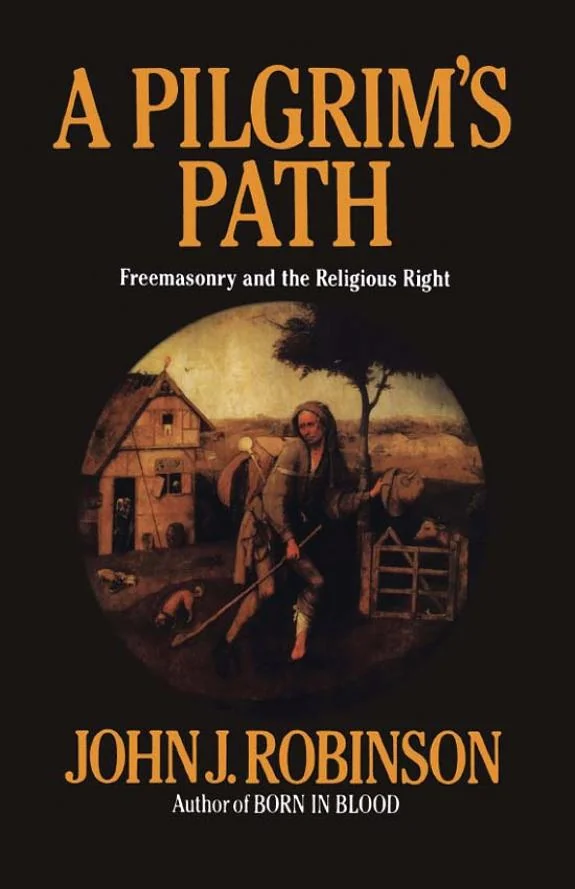
A Pilgrim's Path
 76
76

A Pilgrim's Path
John J. Robinson’s A Pilgrim's Path offers a diligent account of American Masonry, moving beyond mere historical recounting to explore its philosophical currents. Robinson demonstrates a clear understanding of the symbolic language embedded within Masonic practice, particularly in his analysis of the journey from the craft lodges to the higher degrees. A notable strength lies in his ability to connect esoteric concepts to tangible historical developments, showing how ideas influenced tangible institutions. However, the narrative can occasionally become dense, requiring sustained attention from the reader, especially when detailing specific ritualistic interpretations. The passage discussing the symbolic significance of the 'temple' motif, for instance, is meticulously constructed but demands careful consideration. While it avoids speculative leaps, its scholarly rigor might alienate those seeking a more introductory overview. It serves as a robust examination for the dedicated student.
📝 Description
76
John J. Robinson's 1993 book traces Masonic thought from Europe to America.
A Pilgrim's Path examines the historical and philosophical roots of Freemasonry, particularly its development and influence within the United States. The book follows Masonic thought and ritual from their European beginnings to their American forms. Robinson investigates the symbolic language and allegorical stories that are fundamental to Masonic tradition.
This work is suited for individuals seriously interested in fraternal organizations, American history, and esoteric thought. Freemasons seeking a deeper understanding of their fraternity's philosophical basis will find it valuable, as will scholars of Western esotericism. Anyone curious about the connections between religion, philosophy, and secret societies will find it especially relevant.
Robinson's book appeared in 1993, a time when academic and public interest in Freemasonry and its historical impact was growing. The text engages with scholarship that aimed to place Masonic practices within the larger intellectual currents of the Enlightenment and its aftermath. It contributes to discussions about the origin and evolution of Masonic symbolism and degrees.
This book fits within the study of Western esotericism, specifically the historical and philosophical aspects of Freemasonry. It approaches Masonic symbolism and allegorical narratives not just as historical artifacts, but as vehicles for moral and philosophical instruction. The text considers how concepts like the 'Great Architect of the Universe' and personal transformation through symbolic work are interpreted within Masonic traditions, placing these ideas within a broader context of philosophical inquiry and spiritual development characteristic of esoteric studies.
💡 Why Read This Book?
• Gain a concrete understanding of the symbolic evolution of Masonic rituals, from their earliest forms to their American adaptations, as detailed through the progression of degrees discussed in the book. • Grasp the philosophical underpinnings of Masonic allegory, specifically how concepts like the 'Great Architect of the Universe' were interpreted and integrated into American Masonic thought after its introduction. • Appreciate the historical context of Freemasonry's influence in America, understanding its relationship to Enlightenment ideals and its societal impact as presented from the 1993 publication date.
⭐ Reader Reviews
Honest opinions from readers who have explored this book.
❓ Frequently Asked Questions
What historical period does A Pilgrim's Path primarily focus on regarding American Masonry?
The book examines American Masonry from its introduction and establishment through the colonial era and into the 19th century, detailing its philosophical development and societal integration.
What is the central argument about Masonic ritual in Robinson's book?
Robinson argues that Masonic ritual is not merely ceremonial but serves as a profound allegorical system designed for moral and philosophical instruction, guiding the initiate through symbolic stages of development.
Does A Pilgrim's Path discuss specific Masonic symbols?
Yes, the work explores numerous Masonic symbols, including the Square, Compasses, and the concept of the Temple, interpreting their significance within the broader esoteric framework.
Is A Pilgrim's Path suitable for non-Masons?
Absolutely. It is written for anyone interested in esoteric traditions, comparative religion, or the historical impact of fraternal organizations on American society, offering insights without requiring prior Masonic knowledge.
What distinguishes Robinson's approach to Freemasonry in this book?
Robinson's approach emphasizes the philosophical and allegorical dimensions of Masonry, viewing it as a system of moral and spiritual development rooted in ancient wisdom traditions, rather than just a social club.
When was A Pilgrim's Path first published?
The book was first published on October 14, 1993, placing its analysis within the scholarly context of late 20th-century studies on Western esotericism and fraternal orders.
🔮 Key Themes & Symbolism
Allegory and Ritual
The central thesis of A Pilgrim's Path is the interpretation of Masonic rituals as intricate allegorical narratives. Robinson posits that these ceremonies are not mere historical vestiges but active vehicles for transmitting moral philosophy and spiritual lessons. He meticulously breaks down the symbolic language, illustrating how each element, from the tools of operative stonemasons to the dramatic representations within degrees, contributes to an overarching journey of self-discovery and ethical cultivation. The work argues for a deeper, esoteric understanding of these practices, moving beyond literal interpretations to reveal the philosophical architecture.
The American Masonic Experience
Robinson's work specifically focuses on how Freemasonry took root and evolved within the American context following its introduction. He explores the adaptation of European traditions to the burgeoning American nation, considering the influence of Enlightenment ideals and the unique social fabric of the colonies and early republic. The book examines how American Masonry, particularly through figures and institutions of the 18th and 19th centuries, developed its distinct characteristics while retaining core esoteric principles, impacting civic life and philosophical discourse.
Symbolic Architecture
A significant theme is the concept of 'symbolic architecture' within Freemasonry. This refers to the use of building and construction metaphors to represent the construction of character and the development of a spiritual edifice within the individual. Robinson details how symbols such as the Temple of Solomon, the working tools of a stonemason, and geometric principles are employed to instruct initiates in principles of order, harmony, and moral rectitude. This symbolic framework is presented as the esoteric heart of the Craft.
The Pilgrim's Journey
The title itself, A Pilgrim's Path, captures the theme of spiritual progression. Robinson interprets the Masonic degrees as stages in a symbolic pilgrimage towards enlightenment and self-knowledge. The initiate is depicted as a traveler, undertaking a journey of moral and intellectual discovery, guided by ancient wisdom and symbolic instruction. This narrative arc emphasizes personal transformation, the overcoming of ignorance, and the pursuit of truth as the ultimate goals of the Masonic path.
💬 Memorable Quotes
Direct passages from the work, attributed to the author.
“The ritual is the vessel, but the meaning is the content.”
— This emphasizes Robinson's core argument that the power of Masonic practice lies not just in its performance but in the profound philosophical and ethical insights it conveys through its symbolic structure.
“American Masonry reflects the Enlightenment's pursuit of reason and virtue.”
— This highlights the book's exploration of how Masonic principles in the United States were shaped by the intellectual currents of the Enlightenment, focusing on reason, moral improvement, and civic duty.
“The operative tools become allegorical guides.”
— This points to the book's method of reinterpreting the tools of physical construction (like the square and compasses) as symbolic instruments for building character and navigating ethical dilemmas.
“The search for the 'lost word' is the search for ultimate truth.”
— This interpretation captures a key symbolic quest within Masonry, framing it as an allegorical pursuit of fundamental knowledge and spiritual enlightenment, central to the esoteric journey.
💡 Key Ideas
Editorial paraphrase of the work's core concepts — not direct quotes.
Each degree marks a step in self-mastery.
This paraphrased concept reflects the theme of personal growth, suggesting that progression through the Masonic degrees is a structured process of developing inner discipline and understanding.
🌙 Esoteric Significance
Tradition
A Pilgrim's Path situates itself within the broad tradition of Western Esotericism, specifically engaging with Hermetic, Kabbalistic, and Gnostic underpinnings that scholars often associate with the philosophical development of Freemasonry. It interprets Masonic ritual and symbolism not as a standalone system but as a modern manifestation of ancient wisdom lineages that sought to understand the divine through symbolic representation and philosophical inquiry. The work bridges operative craft traditions with speculative philosophy, aligning with the Hermetic principle of 'as above, so below'.
Symbolism
Central to the book's esoteric analysis are symbols such as the Temple of Solomon, representing divine order and the ideal human spiritual structure; the working tools of operative masons (Square, Compasses, Level, Plumb Rule), which are reinterpreted as instruments for moral and ethical development; and the concept of the 'Great Architect of the Universe,' symbolizing the ultimate creative principle that transcends specific religious dogma, allowing for a universalist interpretation.
Modern Relevance
Contemporary practitioners and scholars of Western Esotericism, particularly those focused on the philosophical aspects of Freemasonry, continue to draw upon Robinson's meticulous analysis. His work informs modern discussions on ritualistic efficacy, symbolic interpretation, and the historical evolution of esoteric thought. Thinkers and groups interested in comparative symbolism and the cross-pollination of ideas between ancient traditions and modern fraternal orders find his research valuable for understanding the enduring appeal of Masonic symbolism.
👥 Who Should Read This Book
• Students of Western Esotericism: Those seeking to understand the lineage and development of symbolic systems within traditions like Hermeticism and Rosicrucianism will find valuable connections to Masonic practices. • Historical Researchers of Fraternal Orders: Individuals investigating the societal impact and philosophical underpinnings of organizations like Freemasonry in America, particularly during the 18th and 19th centuries, will benefit from the detailed historical context. • Freemasons Seeking Deeper Understanding: Members of the Craft looking to move beyond surface-level ritual and explore the philosophical allegories and esoteric meanings embedded within their degrees will find a comprehensive guide.
📜 Historical Context
Published in 1993, John J. Robinson's A Pilgrim's Path emerged within a fertile period for scholarship on Western esotericism and fraternal orders. The late 20th century saw a resurgence of interest in analyzing the historical and philosophical dimensions of movements like Freemasonry, moving beyond simple historical accounts or sensationalist claims. Robinson's work engaged with intellectual currents tracing Masonic symbolism back to ancient mystery traditions and Hermetic philosophy, placing it within a lineage distinct from, though sometimes intersecting with, purely religious or philosophical movements of the Enlightenment. It appeared in dialogue with scholars like David Stevenson and Margaret Jacob, who were actively re-evaluating Masonry's role in the 18th century. The book's reception was generally positive among those interested in esoteric studies, appreciated for its systematic approach to Masonic symbolism.
📔 Journal Prompts
Reflect on the symbolic meaning of the 'working tools' as allegorical guides for personal conduct.
Consider the concept of the 'Great Architect of the Universe' and its implications for universal spiritual understanding.
Analyze how the 'Temple' motif functions as a symbol of both cosmic order and inner spiritual construction.
Explore the parallels between the 'Pilgrim's Path' and your own journey of self-discovery.
How does the allegorical nature of Masonic ritual provide a framework for moral instruction?
🗂️ Glossary
Allegory
A story, poem, or picture that can be interpreted to reveal a hidden meaning, typically a moral or political one. In A Pilgrim's Path, Masonic rituals are presented as allegories for spiritual and ethical development.
Esotericism
Belief systems or practices concerned with the esoteric, or 'inner,' meaning of reality and the pursuit of spiritual illumination. Robinson applies this lens to Freemasonry.
Great Architect of the Universe (G.A.O.T.U.)
A term used in Freemasonry to represent a Supreme Being or God, interpreted in a non-denominational way to encompass diverse religious beliefs among members.
Operative Masonry
The historical practice of stonemasonry, involving the physical construction of buildings. Robinson discusses how its traditions and tools were adopted and reinterpreted by speculative Freemasons.
Speculative Masonry
The modern form of Freemasonry, which focuses on philosophical and moral teachings through ritual and symbolism, rather than the physical craft of building.
Degree
A stage or level of initiation within Freemasonry, each typically conveying distinct lessons, symbols, and allegorical narratives related to the pilgrim's journey.
Symbolism
The use of symbols to represent ideas or qualities. Robinson's work extensively decodes the detailed symbolism inherent in Masonic rituals and architecture.