Yogis
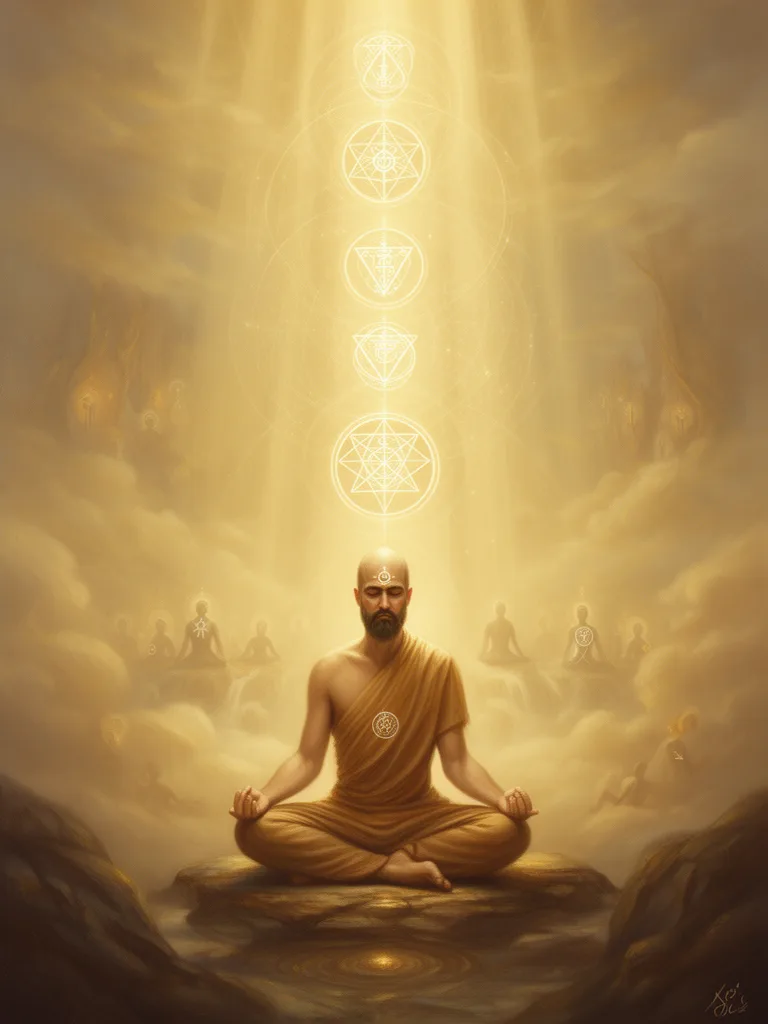
Ascetic practitioners, primarily from Indian traditions, who dedicate themselves to spiritual discipline through physical postures, breath control, meditation, and ethical principles. Their goal is often liberation, enlightenment, or union with the divine, achieved through rigorous self-mastery.
Where the word comes from
The term "Yogi" derives from the Sanskrit word "yoga," meaning "union," "yoke," or "discipline." It originates from the Proto-Indo-European root *yug-, signifying connection or joining. The practice of yoga, and by extension the term "Yogi," has ancient roots in India, with early mentions in Vedic literature and significant development in classical Sanskrit texts like the Yoga Sutras of Patanjali.
In depth
This shows who are really meant. They were the enemies of religious mummeries and ritualism.
How different paths see it
What it means today
Helena Blavatsky, in her characteristic directness, frames the Yogi as an antagonist to "religious mummeries and ritualism." This is not to dismiss the profound spiritual traditions from which the concept of the Yogi emerges, but rather to highlight a core tenet that often gets obscured by the commodification and popularization of yoga in the West. The Yogi, in its most potent sense, is an individual who has undertaken a radical internal discipline, a process described by Mircea Eliade in Yoga: Immortality and Freedom as a systematic attempt to transcend the limitations of the human condition. This is not merely about flexibility or stress reduction, though those may be byproducts. It is about the rigorous cultivation of consciousness, a deliberate effort to achieve a state of being where the ordinary dualities of existence—self and other, sacred and profane, life and death—begin to dissolve.
The path of the Yogi, as codified by Patanjali in the Yoga Sutras, is an eight-limbed path (ashtanga yoga). This framework, far from being solely physical, begins with ethical observances (yama) and self-purification (niyama), laying a foundation of moral integrity. The physical postures (asana) and breath control (pranayama) are not ends in themselves but tools to steady the body and mind, preparing them for the deeper stages of concentration (dharana), meditation (dhyana), and ultimately, absorption (samadhi). It is in these states that the Yogi experiences a profound sense of unity, a concept echoed in the mystical traditions of many cultures, from the Sufi concept of fana (annihilation of the ego in God) to the Christian mystic's experience of divine union. The Yogi's internal work, therefore, bypasses the need for external validation or elaborate ceremonies, offering a direct apprehension of reality.
The danger, as Blavatsky implies, is when the outward forms of spiritual practice become detached from their inner purpose. When asana becomes a performance, or meditation a mere relaxation technique, the transformative potential is lost. The true Yogi, however, remains unswayed, their practice a living testament to an inner freedom that external structures cannot contain or corrupt. They are, in essence, those who have found the divine not in temples or scriptures, but within the architecture of their own awakened consciousness.
RELATED_TERMS: Asceticism, Samadhi, Moksha, Pranayama, Asana, Dhyana, Mysticism, Liberation
Related esoteric terms
Books on this concept







No reflections yet. Be the first.
Share your interpretation, experience, or question.
