Wodan
Wodan, also known as Odin or Wuotan, is a Germanic deity often associated with wisdom, war, poetry, and magic. He is a central figure in Norse mythology, depicted as a one-eyed wanderer who seeks knowledge and presides over Valhalla, the hall of slain warriors.
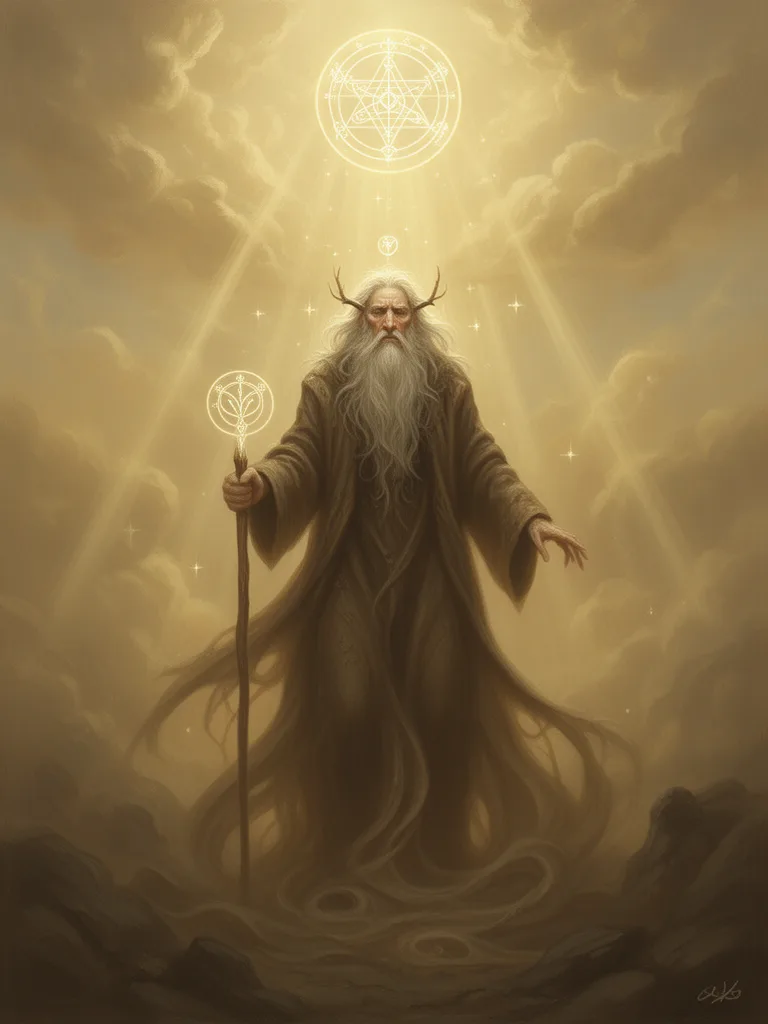
Where the word comes from
The name Wodan derives from Proto-Germanic *wōdanaz, likely meaning "frenzy" or "inspiration." It is cognate with Old English Wōden and Old High German Wuotan. This root connects to concepts of ecstatic or divinely inspired states, reflecting the god's association with powerful, often wild, spiritual forces.
In depth
The Scandinavian Odin, Votan, or Wuotan. World. As a prefix to mountains, trees, and so on, it denotes a univer.s<il belief. Thus the "World-Mountain" of the Hindus was Meru. As said in Isis Unveiled: "All the world-mountains and mundane eggs, the mundane trees, and the mundane snakes and pillars, may be shown to embody scientifically demonstrated truths of natural philosophy. All of these mountains contain, wdth very trifling variations, the allegorically-exi)ressed description of primal cosmogony ; the mundane trees, that of subsequent evolution of si)irit and matter; the mundane snakes and pillars, symbolical memorials of the various attributes of this double evolution in its endless correlation of cosmic forces. Within the mysterious recesses of the mountains — the matrix of the universe — the gods (powers) prepare the atomic germs of organic life, and at the same time the life-drink, which, when tasted, awakens in man-matter the manspirit. The Soma, the .sacrificial drink of the Hindus, is that sacred beverage. For at the creation of the prima materia, while the grossest portions of it w^ere used for the physical embryo-world, its more divine essence pervaded the universe, invisibly permeating and enclosing within its ethereal waves the newly-born infant, developing and stimulating it to activity as it .slowly evolved out of the eternal chaos. From thf poetry of abstract conception, these mundane myths gradually passed into the concrete images of cosmic symbols, as archaeology now finds them." Another and still more usual prefix to all these objects is "Mundane". (See "Mundane Egg", "Mundane Tree", and "Yggdrasil".) Worlds, the Four. The Kabbalists recognise Four Worlds of Existence : viz., Atziluth or archetypal ; Briah or creative, the first reflection of the highest; Yetzirah or formative; and Assiah, the AVorld of Shells or Klippoth. and the material universe. The essence of Deity concenGLOSS AEY 345 trating into the Sephiroth is first manifested in the Atz
How different paths see it
What it means today
The ancient Germanic figure of Wodan, also rendered as Odin or Wuotan, offers a potent archetype for the modern seeker grappling with the fragmented nature of contemporary knowledge. Blavatsky's note, linking him to a universal concept of "World" and citing the "World-Mountain" of Hindu cosmology, points toward a more profound, unifying significance than mere mythological character. This is not simply a warrior god, but a cosmic principle that underpins existence, a divine seeker of wisdom whose very name suggests a connection to ecstatic states and profound inspiration.
Mircea Eliade, in his seminal works on myth and religion, explored the concept of the axis mundi, the world axis or cosmic pillar that connects heaven and earth, a role that the "World-Mountain" prefix implies for Wodan. This axis is not merely geographical but spiritual, a conduit for divine energy and a point of access to the sacred. Wodan, in this light, becomes a personification of this cosmic connection, a deity who traverses the realms to gather wisdom, much like the shaman journeys between worlds. His one eye, famously sacrificed for a drink from the Well of Mimir, symbolizes the profound cost of true insight—a willingness to surrender ordinary perception for a deeper, often unsettling, vision.
The quest for knowledge in Wodan's mythology is not an academic pursuit but a visceral, transformative experience. It is a journey into the wild, into the heart of mystery, mirroring the psychological explorations undertaken by Carl Jung, who saw archetypes like Odin as manifestations of the collective unconscious, guiding individuals toward individuation. The "frenzy" or "inspiration" inherent in his name suggests a state of heightened awareness, a divinely induced madness that breaks down ordinary barriers of thought and allows for the influx of profound truths. This resonates with the contemplative practices found across traditions, where altered states of consciousness are cultivated to achieve spiritual realization.
The notion of Wodan as a "World" prefix, denoting a universal belief, suggests an underlying unity that transcends individual phenomena. This echoes the non-dual philosophies that perceive a single, indivisible reality underlying the multiplicity of the world. In this sense, Wodan is not merely a god in the world, but a principle of the world, embodying its inherent dynamism, its capacity for both creation and destruction, and its ceaseless quest for meaning. He reminds us that true understanding is not found in isolated facts but in the interconnectedness of all things, a wisdom that requires not just intellect but a willingness to embrace the transformative power of the unknown. He beckons us to become our own divinities of wisdom, to seek the wellspring of knowledge at whatever personal cost.
Related esoteric terms
Books on this concept



No reflections yet. Be the first.
Share your interpretation, experience, or question.
