Iduna
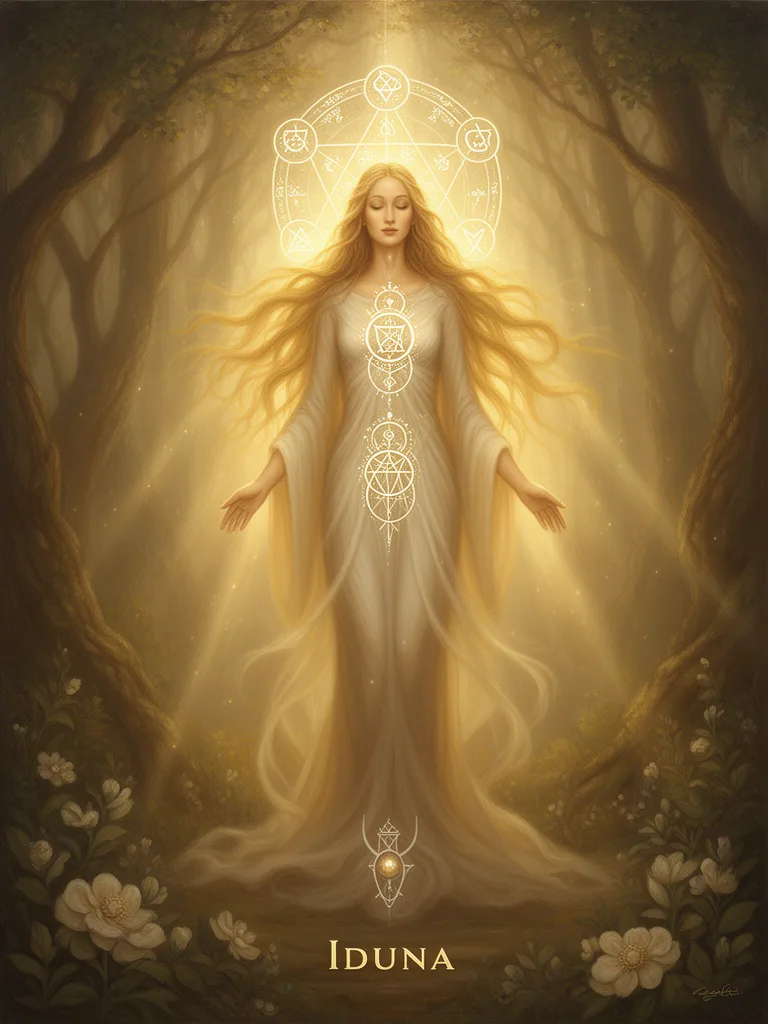
Iduna is the Norse goddess associated with eternal youth and immortality, famously guarding the apples that sustain the gods. Her myth symbolizes the cyclical renewal of life and the preservation of vitality against the ravages of time.
Where the word comes from
The name "Iduna" is of Old Norse origin. Its etymology is debated, with some scholars suggesting it derives from "íd" meaning "again" or "renewal" and "unn" meaning "to give" or "to bestow," thus signifying "the bestower of renewal." It first appeared in Norse sagas and the Poetic Edda.
In depth
The goddess of immortal youth. The daughter of Iwaldi, the Dwarf. She is said in the Edda to have hidden "life" in the Deep of the Ocean, and when the right time came, to have restored it to Earth once more. She was the wife of Bragi, the god of poetry ; a most charming myth. Like Heimdal, "born of nine mothers", Bragi at his birth rises upon the crest of the wave from the bottom of the sea (see "Bragi"). He married Iduna, the immortal goddess, who accompanies him to Asgard where every morning she feeds the gods with the apples of eternal youth and health. (See Asgard and the Gods.)
How different paths see it
What it means today
In the grand, frost-rimed halls of Norse mythology, Iduna stands as a radiant counterpoint to the inevitable decay that gnaws at all existence. Her role, as chronicled in the Eddas, is far more than that of a simple divine grocer. She is the keeper of the apples of youth, a sacred charge that ensures the gods of Asgard remain vibrant, their wisdom and strength undimmed by the passage of aeons. This myth resonates deeply with the perennial human yearning for enduring vitality, a desire that transcends cultural and temporal boundaries.
The apples themselves, as described by Snorri Sturluson, are not just symbols of physical rejuvenation but of the very essence of life's continuity. They are the antidote to the encroaching shadows, the tangible representation of an unbroken chain of being. Iduna's act of hiding and then restoring "life" to Earth, as mentioned in Blavatsky's account, echoes primal creation narratives found across many traditions, from the cyclical cosmologies of ancient India to the alchemical pursuits of the West, where the quest for the elixir of life has long been a central, albeit often allegorical, pursuit.
This myth speaks to the profound human understanding that life is not a finite commodity to be hoarded, but a dynamic force that requires careful tending and periodic renewal. Iduna's custodianship is an active one, a constant vigilance against the forces that would steal away youth and vigor. It suggests that true immortality, or at least a life lived with sustained purpose and vitality, is found not in passive reception but in the diligent preservation and re-infusion of life's essential energies. The myth invites us to consider what our own "apples of youth" might be, the practices, insights, or connections that continuously replenish our spirit and sustain our engagement with the world. It is a reminder that even in the face of inevitable change, the capacity for renewal is a divine gift, to be cherished and guarded.
Related esoteric terms
No reflections yet. Be the first.
Share your interpretation, experience, or question.
