Viraj
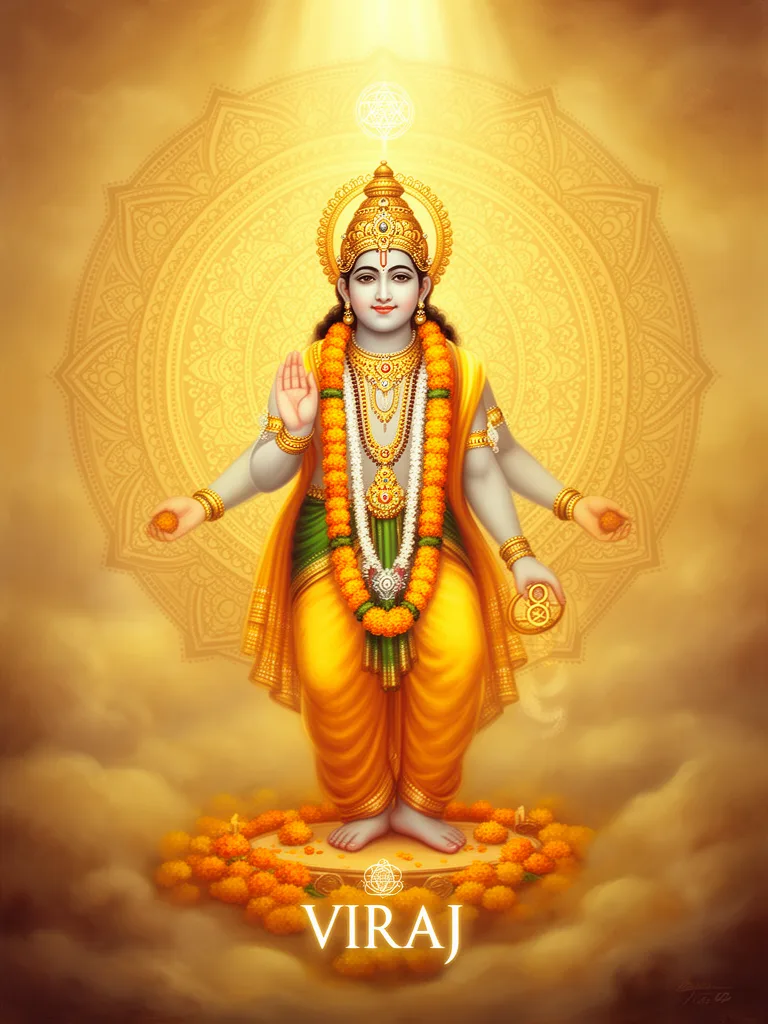
Viraj is a Sanskrit term in Hinduism representing the primordial, cosmic being or the first male creation, often equated with the divine creative principle or the "Logos." It signifies the totality of existence that arises from the primal unity, encompassing both male and female aspects of creation.
Where the word comes from
The term "Viraj" derives from the Sanskrit root vṛj, meaning "to separate," "to distinguish," or "to shine forth." It signifies something that shines forth or is spread out, indicating the cosmic expanse. In Vedic literature, it refers to a cosmic being or principle, appearing as early as the Rigveda.
In depth
The Hindu Logos in the Purdnas; the male Manu, created in the female portion of Brahma's body (Vach) by that god. Says Manu: "Ha\ang divided his body into two parts, the lord (Brahma) became with the one half a male and with the other half a female; and in her he created Viraj". The Rig-Veda makes Viraj GLOSS AKY 339 spring from Purusha, and Purusha sprin^]^ from Viraj. Tlu' latter is the type of all male beings, and Vaeh, Sata-riipa (she of the hundred forms), the type of all female forms. Vishnu (8k.). The second person of the Hindu Trimurti (trinity), composed of Brahma, Vishnu and Siva. P>om the root visit, to pervade". In the Rig-Veda, Vishnu is no high god, but simply a manifestation of the solar energy, described as "striding through the seven regions of the Universe in three steps and enveloping all things with the dust (of his beams".) AVhatever may be the six other occult signiticances of the statement, this is related to the same class of types as the seven and ten Sephiroth, as the seven and three orifices of the perfect Adam Kadmon, as the seven "principles" and the higher triad in man, etc., etc. Later on this mystic tj'pe becomes a great god. the preserver and the renovator, he "of a thousand names — Sahasranama".
How different paths see it
What it means today
The concept of Viraj, as articulated in Hindu traditions and touched upon by Blavatsky, offers a profound lens through which to view the genesis of the cosmos and our place within it. It speaks to a primal creative impulse, a divine efflorescence that gives rise to the differentiated world. Mircea Eliade, in his exploration of myth and reality, would recognize in Viraj the archetype of the cosmic king or the first man, the progenitor from whom all subsequent life streams. This is not merely a theological construct but a psychological reality, a representation of the psyche's own capacity for creation and self-organization.
The notion of Viraj emerging from a divided Brahma, as mentioned in the Purdnas, highlights the inherent duality that characterizes the manifest world. The cosmic unity, in its act of creation, necessarily introduces separation and distinction, the male and female principles that become the very fabric of existence. This echoes the Hermetic axiom, "As above, so below," where the macrocosmic drama of creation is mirrored in the microcosm of human experience. The Rigvedic idea of Viraj springing from Purusha and Purusha from Viraj suggests a cyclical, interdependent process, a cosmic dance of emanation and dissolution, akin to the Taoist concept of Yin and Yang, where each arises from and gives rise to the other.
For the modern seeker, Viraj can serve as a potent symbol of the potential for creative expression inherent within each individual. The cosmic being, the totality of existence, is not an external entity but an internal reality waiting to be recognized. The practice of meditation or contemplation can be seen as a means of reconnecting with this primordial source, allowing the individual consciousness to expand and encompass the vastness of being, much like Vishnu's three steps encompassing the universe. This is not about aspiring to godhood but about realizing the divine spark, the inherent creative power that resides at the core of our own existence, the very essence of consciousness made manifest. It is the recognition that the universe is not merely something we inhabit, but something we are, a continuous unfolding of the cosmic breath.
Related esoteric terms
Books on this concept



No reflections yet. Be the first.
Share your interpretation, experience, or question.
