Ulom
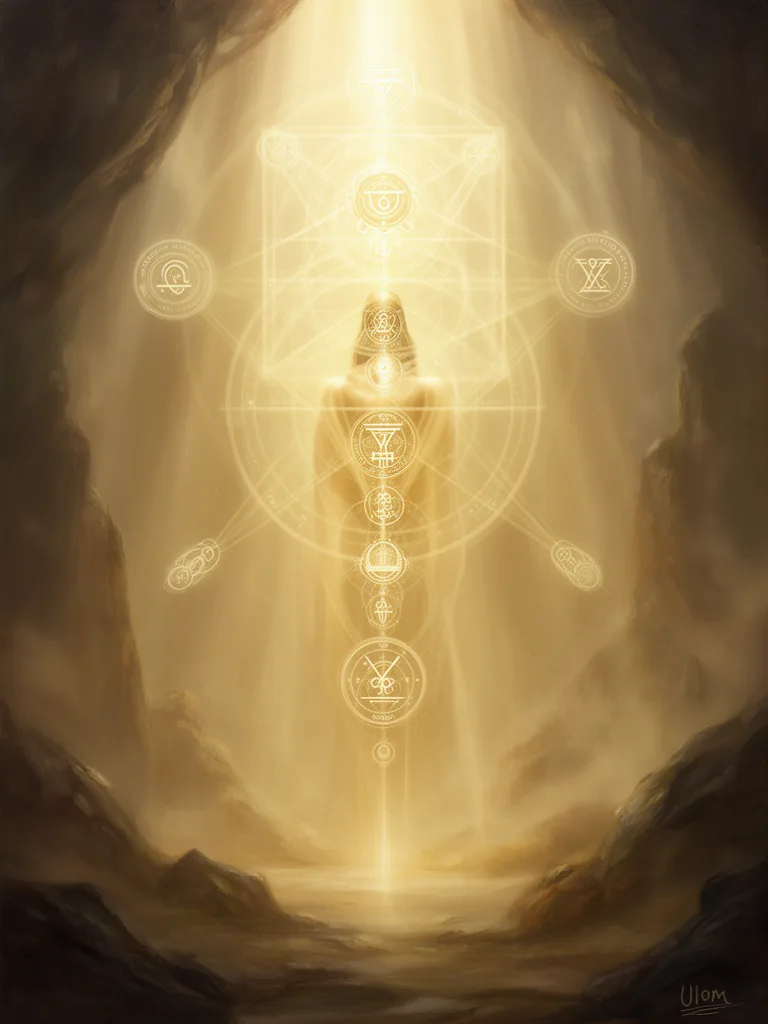
Ulom signifies the intelligible deity, representing the objective, material universe as conceived in the theogony of Mochus. It is understood as the reflection of an unknowable, ever-concealed divine principle, akin to the Pleroma in Gnostic thought.
Where the word comes from
The term "Ulom" lacks a clear, widely accepted etymological origin in ancient languages. It appears primarily within the esoteric writings of Helena Blavatsky, who attributed it to the Phoenician philosopher Mochus. Its precise linguistic roots remain obscure, possibly a neologism or a reinterpretation of an ancient, less common term.
In depth
The intelligible deity. The objective or material Universe, in the theogony of Mochus. The reflection of the everconcealed deity; the Pleroma of the Gnostics.
How different paths see it
What it means today
Helena Blavatsky, in her monumental efforts to synthesize and disseminate esoteric wisdom, introduced "Ulom" as a term to encapsulate a profound cosmological idea, drawing from fragments of ancient Phoenician theology as recorded by, or interpreted through, later sources. The notion of an "intelligible deity" suggests a divine principle that is not merely a remote, abstract force but one whose very nature is to be understood, to be cognized through its cosmic expression. This is not an anthropomorphic god, but rather a universal intelligence that structures and animates existence.
The comparison to the Gnostic Pleroma is particularly illuminating. The Pleroma, a term derived from Greek meaning "fullness," describes the totality of divine aeons and powers emanating from the ultimate, unknowable Godhead. The material universe, in many Gnostic systems, is a creation of lower, imperfect beings who have fallen from this divine fullness. Ulom, as presented by Blavatsky, seems to bridge this gap, suggesting that the objective universe, while material, is a direct and comprehensible reflection of this divine source, rather than a mere shadow or corruption. It implies a cosmic order that is inherently rational and knowable, a universe imbued with meaning and purpose.
This perspective challenges the modern scientific worldview, which often separates the observer from the observed, the mind from matter. Ulom invites a re-enchantment of the world, viewing every phenomenon, from the smallest particle to the grandest galaxy, as a word spoken by the divine, a facet of an overarching cosmic intelligence. It is a call to see the universe as a living scripture, a text waiting to be read by those attuned to its intelligible language. This requires a shift in consciousness, a cultivation of inner perception that can discern the divine pattern woven into the fabric of reality. The practice, then, becomes one of deep contemplation and mindful engagement with the world, seeking the divine reflection in every aspect of existence, transforming the mundane into a sacred text.
RELATED_TERMS: Logos, Sophia, Nous, Pleroma, Demiurge, Brahman, Tao, Akasha
Related esoteric terms
Books on this concept






No reflections yet. Be the first.
Share your interpretation, experience, or question.
