Spook
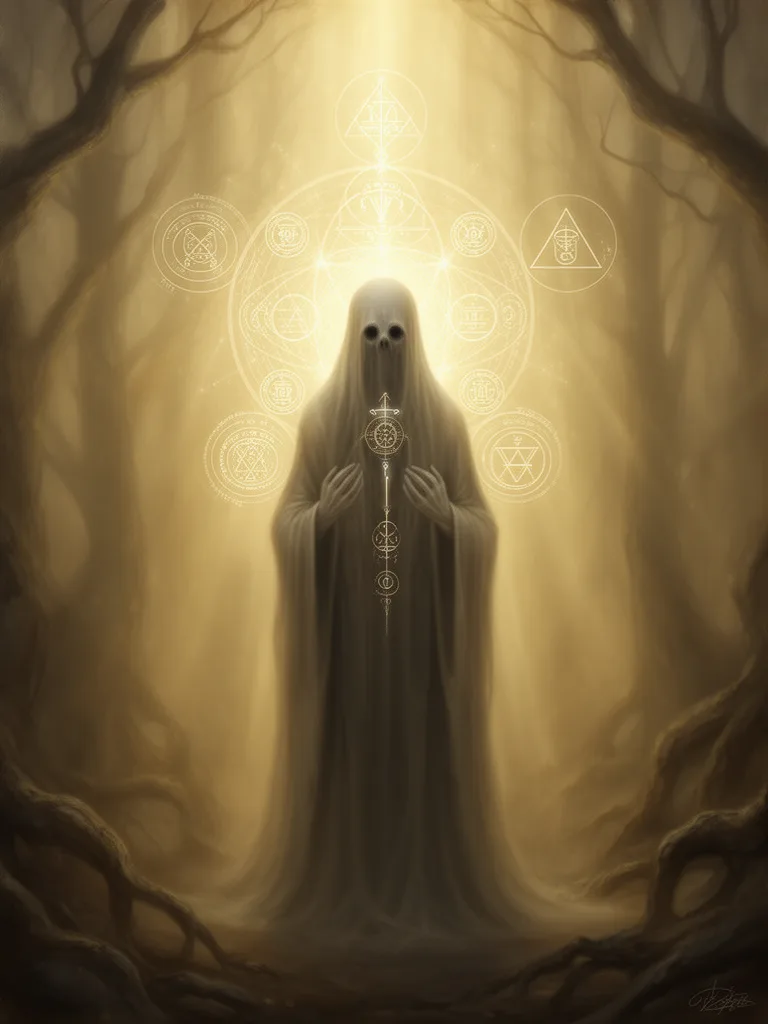
A spectral apparition, often associated with hauntings or spiritualist phenomena. The term also carries a secondary meaning related to faith or reverence, particularly in certain South Asian traditions.
Where the word comes from
The English word "spook" likely derives from the Middle Dutch "spook" or "spoke," meaning a ghost or specter, appearing in English by the 17th century. Its connection to "Sraddha" (Sanskrit: śraddhā), meaning faith or devotion, is a distinct, though perhaps coincidental, semantic thread.
In depth
A ghost, a hobgoblin. T'.sed of tlie various apparitions in the seance-rooms of the Spiritualists. Sraddha (8k.). Lit., faith, respect, reverence.
How different paths see it
What it means today
Helena Blavatsky’s inclusion of "Spook" in her glossary, juxtaposing its common English meaning of a ghost with the Sanskrit term śraddhā, invites a curious re-examination of spectral phenomena. The common understanding of a spook is a disembodied entity, a remnant of consciousness, often associated with places or events charged with lingering emotional energy. This aligns with the Jungian concept of the collective unconscious, where archetypal images and traumas can manifest in ways that feel external and uncanny.
However, Blavatsky’s linkage to śraddhā, a term denoting deep faith, devotion, and reverence, offers a profound counterpoint. Śraddhā is not a passive acceptance but an active engagement, a conscious orientation of the soul towards the sacred, the true, or the ancestral. It is the vital force that animates rituals, sustains spiritual practice, and allows for the perception of realities beyond the material. Mircea Eliade, in his studies of the sacred and the profane, often highlighted how the perception of the sacred world was mediated by such acts of faith and ritual, transforming ordinary space and time into something numinous.
When we consider the apparitions in spiritualist seance rooms, which Blavatsky specifically references, the concept of śraddhā becomes particularly resonant. The participants, in their hope and belief, project a form of faith, an expectation of contact with the beyond. This collective intention, this focused reverence for the possibility of communication, might be seen as a spiritual technology, a means by which the veil between worlds is thinned. The "spook," then, is not merely an inert echo but potentially a manifestation shaped by the very faith that seeks it. It suggests that our encounters with the unseen are rarely one-sided; they are often co-created by the observer's inner disposition, a potent reminder that what we perceive is deeply intertwined with what we believe. The spectral and the sacred, in this light, are not entirely disparate realms but are accessed through similar channels of profound, focused attention.
Related esoteric terms
Books on this concept








No reflections yet. Be the first.
Share your interpretation, experience, or question.
