Sheol
Sheol is the ancient Hebrew concept of the underworld, a shadowy realm of the dead where souls exist in a state of unconscious stillness. It is distinct from Gehenna, which represents a place of punishment. Sheol signifies the universal, neutral fate of all humanity after death, regardless of earthly deeds.
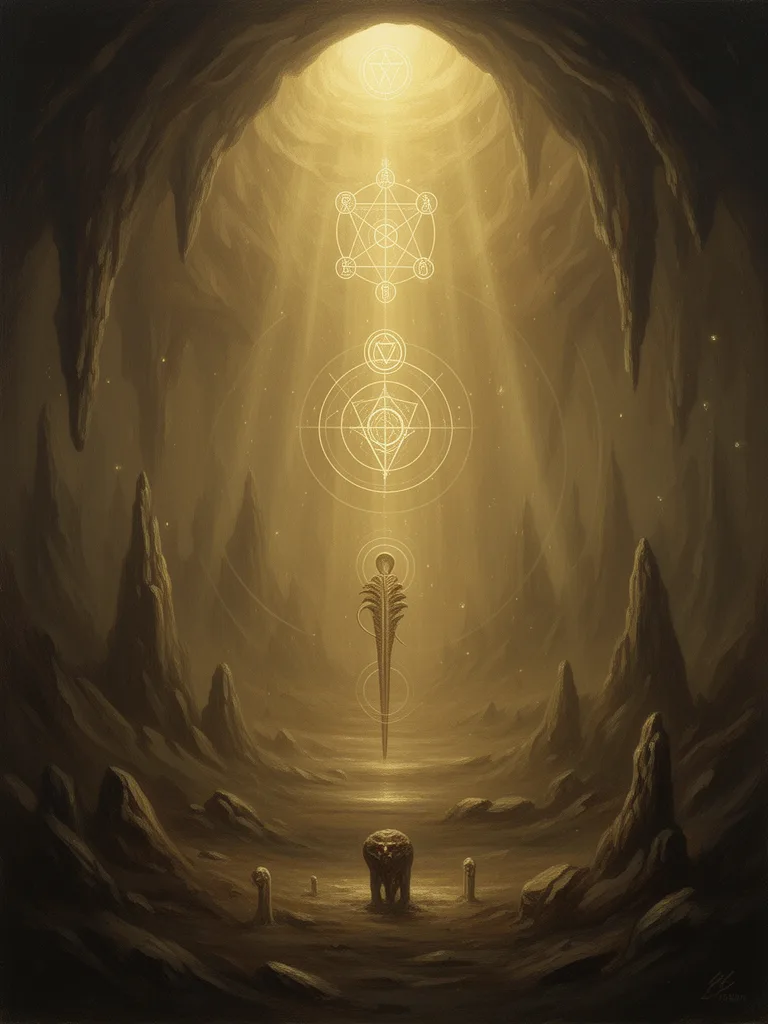
Where the word comes from
The term "Sheol" originates from the Hebrew word שְׁאוֹל (sheol), likely derived from a root meaning "to ask," "to hollow," or "to be deep." Its precise etymology remains debated among scholars, but it consistently refers to a subterranean, pit-like dwelling. The concept appears throughout the Hebrew Bible, reflecting an early understanding of the afterlife.
In depth
The hell of the Hebrew Pantheon; a region of stillness and iniictivity as distinguished from Gehenna, (q.v.).
How different paths see it
What it means today
The Hebrew concept of Sheol, as described in the Old Testament and later elaborated upon, presents a starkly different vision of the afterlife than the dualistic heavens and hells that came to dominate Western religious imagination. It is not a place of torment or ecstatic reward, but a realm of "stillness and inactivity," a shadowy pit where the dead simply are, or rather, are not in any meaningful sense of conscious existence. This is not a moral judgment; it is the universal destination, the great equalizer.
Mircea Eliade, in his seminal works on myth and religion, often highlighted the primal human impulse to understand the world beyond the veil of life and death. Sheol speaks to this ancient impulse, an attempt to map the unknown territory of the departed. Unlike the fiery infernos of later eschatologies, Sheol is a place of dust and silence, a return to the earth from which humanity was formed. It is the antithesis of the vibrant, often chaotic, world of the living.
The distinction Blavatsky draws between Sheol and Gehenna is crucial. Gehenna, a valley near Jerusalem associated with pagan child sacrifice and later a symbol of fiery punishment, represents a more active, punitive post-mortem state. Sheol, on the other hand, is passive, a state of being that is akin to non-being, a profound quietude. This echoes certain contemplative traditions that seek a dissolution of the ego, a return to an unmanifest state, though Sheol’s passivity is an imposed condition rather than a cultivated spiritual attainment.
For the modern seeker, Sheol can be a powerful reminder of our mortality and the potential for a natural, undramatic end. It challenges the pervasive Western narrative of individual accountability in the afterlife and offers a vision of cosmic unity in dissolution. It is a quiet space in the vast library of human spiritual thought, a whisper of what lies beyond the clamor of existence.
RELATED_TERMS: Underworld, Hades, Netherworld, Afterlife, Death, Oblivion, Gehenna
Related esoteric terms
Books on this concept








No reflections yet. Be the first.
Share your interpretation, experience, or question.
