Pan
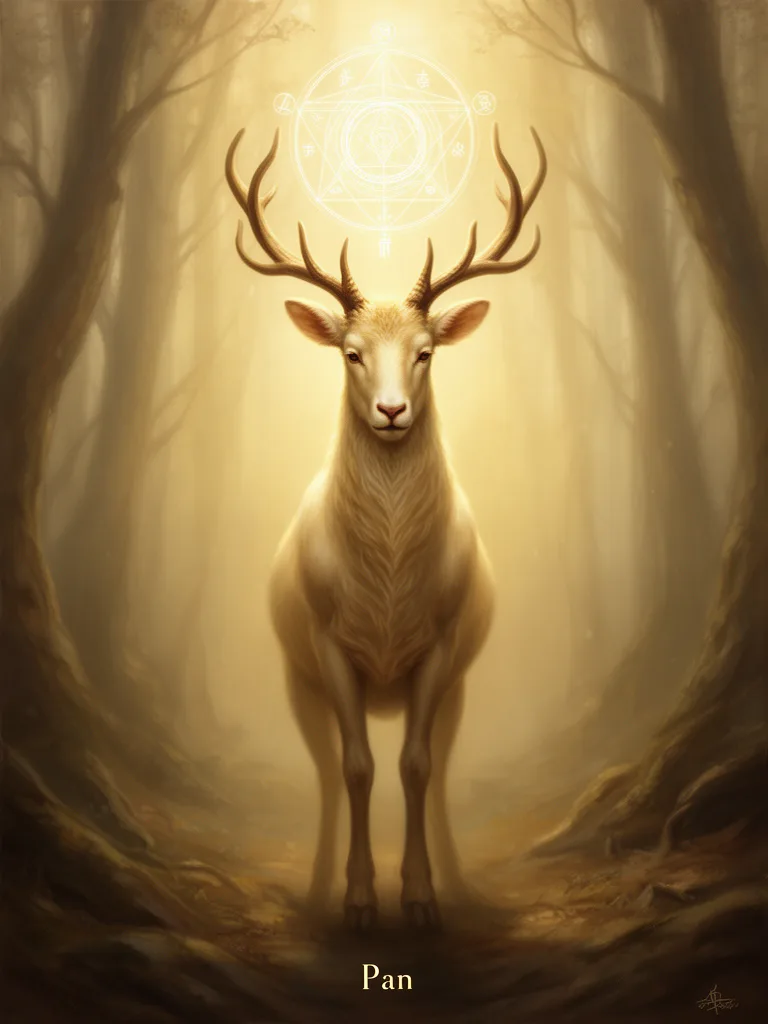
Pan, meaning "all" in Greek, is the ancient god of wild nature, shepherds, and hunters, often depicted with goat-like features. He embodies the vibrant, untamed forces of the natural world and the ecstatic music that arises from it. His name signifies the totality of existence, a concept explored in pantheistic philosophies.
Where the word comes from
The name "Pan" derives from the ancient Greek word "pas" (πᾶς), meaning "all" or "every." This root signifies his all-encompassing connection to nature. The god appears in classical Greek literature, notably in Homeric hymns, from at least the 8th century BCE.
In depth
The nature-god, whence Pantheism; the god of sliepherds, huntsmen, peasants, and dwellers on the land. Homer makes him the son of Hermes and Dryope. His name means All. He was the inventor of the Pandiean pipes; and no nymph who heard their sound could resist the fascination of the great Pan, his grotesque figure notwithstanding. Pan is related to the Mendesian goat, only so far as the latter represents, as a talisman of great occult potency, nature's creative force. The whole of the Hermetic philosophy is based on nature's hidden secrets, and as Baphomet was undeniably a Kabbalistic talisman, so was the name of Pan of great magic etficiency in what Eliphas Levi would call the "Conjuration of the Elementals". There is a well-known pious legend which has ])een current in the Christian world ever since the day of Tiberias, to the eiTect that the "great Pan is dead'\ But people are greatly mistaken in this; neither nature nor any of her Forces can ever die. A few of these may be left unused, and being forgotten lie dormant for long centuries. But no sooner are the proper I'oiiditions furnished than they awake, to act again with tenfold power. Panaenus {dr.). A Platonic ])hiloso]iher in the Alexandrian school of Philaletheans. Pancha Kosha f'Sk.). The live ••sheaths". According to Vedantin j)hilosoph>-. \'ijnanamaya Kosha, the fourth sheath, is composed of Buddhi. or i.^ Buddhi. The five sheaths are said to belong to tht^ two higher i^rineiplcs — Jivdinia and Sak.'ihi. which represent the Upahiia and An-iipahita, diviiitspirit ivspcctivi'ly. Tlittlivisiuii in the esoteric teaehiiif; differs from tliis. as it divides man's pli>sieal-metaphysical aspect into seveji principles.
How different paths see it
What it means today
The figure of Pan, the wild god whose name signifies "all," offers a potent counterpoint to the often domesticated and anthropomorphized deities of more structured religious systems. His essence is the untamed, the spontaneous, the vital force that animates the forests, the mountains, and the very air we breathe. As Mircea Eliade observed in his studies of shamanism and archaic religions, the sacred is often found in liminal spaces, in the wild places where the veil between worlds is thin. Pan inhabits these spaces, his music a siren call to the primal energies within us, a reminder of our deep, often forgotten, connection to the earth.
Blavatsky's reference to Pan as a talisman of "nature's creative force" and his association with the Mendesian goat points to a deeper, alchemical understanding. The goat, a symbol of fertility and untamed desire, becomes a conduit for the generative powers of the cosmos. This resonates with the Hermetic principle of "As Above, So Below," where the macrocosm is reflected in the microcosm, and the divine spark is present in all of nature's manifestations. Eliphas Levi's invocation of elemental conjuration, while perhaps couched in the language of 19th-century occultism, speaks to the ancient practice of engaging with the elemental spirits, the personifications of natural forces, which Pan so powerfully embodies.
The popular pronouncement that "the great Pan is dead," a sentiment often linked to the rise of Christianity, is, as Blavatsky rightly notes, a profound misunderstanding. Nature's forces, like the underlying consciousness they express, cannot truly perish. They may lie dormant, forgotten in the clamor of human affairs, but they awaken when the conditions are right, when the seeker tunes into their frequency. Pan's music is not merely a melody; it is the vibration of life itself, a call to recognize the divine in the wild, the ecstatic, and the all-encompassing presence that pervades the universe.
RELATED_TERMS: Nature, Animism, Pantheism, Dionysus, Elemental Spirits, Vital Force, Cosmos, Sacred Geography
Related esoteric terms
Books on this concept






No reflections yet. Be the first.
Share your interpretation, experience, or question.
