Sesha
Sesha, also known as Ananta, is a primordial serpent in Hindu cosmology, symbolizing infinite time and space. It serves as the couch for Vishnu, the preserver deity, and represents the eternal, underlying substratum of existence upon which the universe rests.
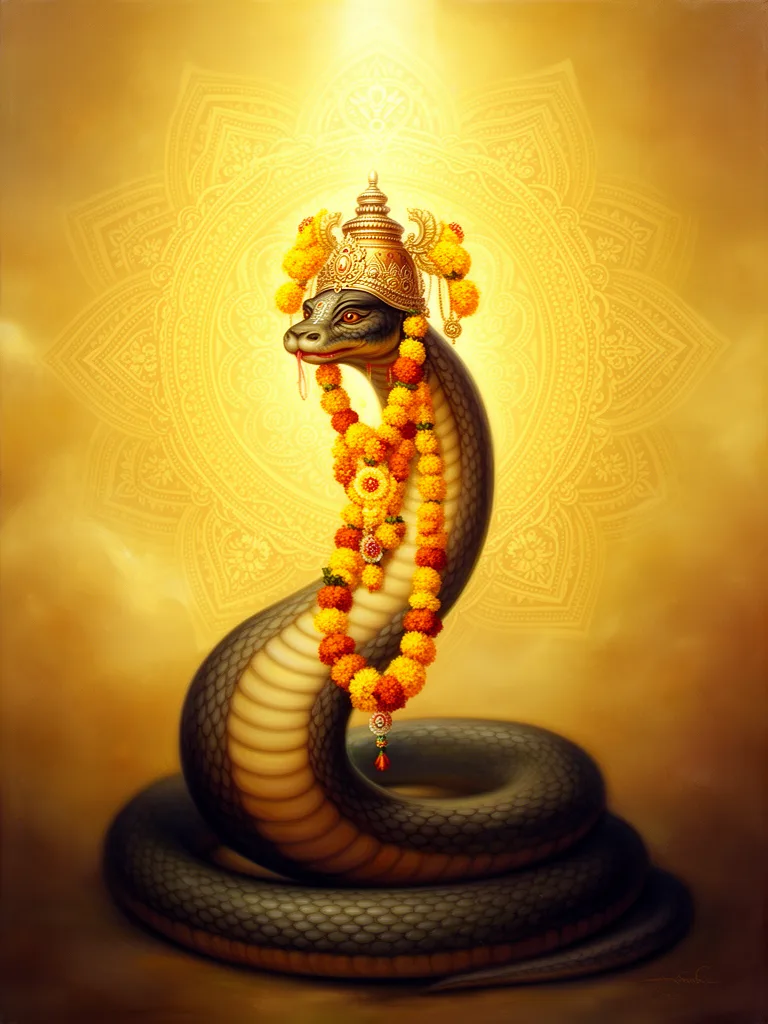
Where the word comes from
The Sanskrit term "Sesha" (शेष) derives from the root śiṣ meaning "remainder" or "that which is left over." It signifies the eternal aspect that persists beyond creation and dissolution. Ananta (अनन्त) means "endless" or "infinite." The concept appears in ancient Vedic texts and is central to Puranic literature.
In depth
Ananta, the great Serpent of Eternity, the couch of Vishnu; the symbol of infinite Time in Space. In the exoteric beliefs Sesha is represented as a tho-usand-headed and 5(rf»-headed cobra; the former the king of the nether world, called Patala. the latter the carrier or support of Vishnu on the Ocean of Space. Set or Seth (Eg.). The same as the Son of Noah and Typhon — who is the dark side of Osiri.s. The same as Thoth and Satan, the adversary, not the devil represented by Christians.
How different paths see it
What it means today
In the grand theater of Hindu thought, Sesha unfurls as more than a mere mythological creature; it is a potent symbol of the boundless, the eternal, the very fabric of existence. Blavatsky's reference to Ananta, the "Serpent of Eternity," captures this essence perfectly. This is not a serpent of fear or temptation, but of cosmic endurance, a divine couch upon which Vishnu, the preserver, rests between the grand cosmic cycles. Mircea Eliade, in his studies of myth and reality, would recognize in Sesha the archetypal symbol of the primordial waters, the undifferentiated state from which all creation emerges and to which it ultimately returns.
The thousand heads, a common depiction, are not to be taken literally but as an indication of infinite awareness, a consciousness that encompasses all. It is the backdrop against which the drama of the universe plays out, a silent, ever-present ground of being. In the language of Carl Jung, Sesha embodies the archetype of the Self, the totality of the psyche, both conscious and unconscious, the eternal principle that underlies all manifestation. The idea of Sesha as the "remainder" also resonates deeply, suggesting that even after the dissolution of a cosmos, there remains an infinite essence, an unbroken continuity. This is not a passive void, but an active, potent stillness, a cosmic potentiality awaiting the next act of divine unfolding.
The connection Blavatsky draws to Seth in Egyptian mythology, and even to Satan as an adversary rather than a devil, hints at a cross-cultural recognition of primordial, often dualistic, forces that underpin existence. While the exoteric representation might focus on the netherworld, the esoteric understanding points to the infinite expanse, the ocean of space where Vishnu dreams the universe into being. It is a reminder that the ultimate reality is one of infinite duration, a cosmic breath that expands and contracts, but whose essential nature remains unbroken, like the serpent forever coiling upon itself.
RELATED_TERMS: Brahman, Vishnu, Ananta, Pralaya, Kalpa, Maya, Samsara, Eternity
Related esoteric terms
No reflections yet. Be the first.
Share your interpretation, experience, or question.
